
By Kirk Evans
ADVANCE FOOD COLUMNIST
“Took my love, took it down, I climbed a mountain and turned around. And I saw my reflection in the poop-covered hills, ‘til the poopslide brought me down….”
I could hear my 12-year old daughter Eve singing this to herself as she performed what we called a “poop-patrol” in the backyard. We were preparing for a big BBQ, and I wanted the yard clean for our guests.
Days earlier we had gone to the halal butcher in Fredericksburg to pick out our main course, a whole lamb. When we got there, we were shown into a large walk-in refrigerator where a dozen skinned lambs and goats were gently swinging from hooks chained to the ceiling. Eve and I picked out one weighing about 30 pounds.
“Head on or off?” the butcher asked us.
“Off,” we said.
“Heart? Lungs? Kidneys? Liver?”
I had read up on this. The kidneys were prized, as was the heart.
“Heart and kidneys,” I said. “You can keep the rest.”
“Tomorrow.”
“Tomorrow.”
***
Asado.
The word literally means “roasted,” but in Argentina it also refers to the social event defined by an abundance of guests, roasted meat, cheeses, and wine. For Argentines, hosting an asado is a national tradition.
I was introduced to them while working for a small wine import company in Virginia during a weeklong trip to Argentina’s wine country surrounding the city of Mendoza where we spent our days reconnecting with established suppliers and scouting for new wines to bring back to the U.S. Each of our hosts wanted to impress us with their hospitality and largesse, so we ended up being invited to five asados in as many days.
Every one was a major event that must have taken days to prepare. We were served lamb, goat, an abundance of sausages, including morcilla, Argentinian blood sausage, and many different cuts of beef, including massive ribs that must have been 14 inches long. Serving tables were loaded with olives, cheese, chimichurri, salads and salsa criolla. Sometimes there was live music.
Once, during a very fancy nighttime asado at a large, established winery in the deserts surrounding Mendoza, it began to rain. Rain in the Mendoza desert is like snow in Hawaii. When it happens, it’s an event. The entire crowd, including musicians, kitchen staff, and servers, stopped what they were doing and went outside and turned their faces up to the sky, oohing and ahhing at the raindrops.
The heart of the asado is the asado cross, which is a device used to grill meat at a specific distance above a wood fire. It evolved from a technique used by gauchos, Argentina’s legendary skilled horsemen. When out in the desert for days at a time chasing cattle, gauchos would grill a jackrabbit over a campfire by tying it to crossed branches. They would plant one end of the branch into the ground at the edge of the fire and suspend the meat over the heat at an angle, adjusting and turning the crossed branches to keep the meat cooking evenly.
Today’s asado crosses are large and sturdy, made of steel, and are able to suspend large, primal cuts of meat, or entire animals, out over a fire. They can be adjusted to lean at any angle, and can be spun to cook meat evenly on both sides.
Some of our hosts were farmers of modest means, and we enjoyed small, intimate asados with them and their kids in their cozy family homes and back yards. Some were catered events hosted by successful businesses with exports all over the world. Our last asado, held on a palatial estate, was one of those.
As we turned off the main road in our hired bus and began the long trundle up a dusty dirt road into the hills that day, the fragrance of wood smoke soon penetrated the cabin. I looked out the window and saw that a trench had been dug alongside the driveway starting about a quarter mile from the house. The trench was filled with burning logs, making a bonfire about a quarter mile long and 6 feet wide.
Small asado crosses were spaced evenly along the trench. Lambs, goats, rabbits, and large cuts of beef were leaning out over the fire. I watched as grill masters known as asadors patrolled the trench armed with buckets of basting liquid, stopping here and there with long-handled mops to slap it onto the sizzling meat.
The thing that set this asado over all the other ones were those massive beef ribs, each one more than a foot long and probably weighing at least 2 pounds. Unseasoned but for flaked salt and wood smoke, they carried a layer of fat that was creamy and golden, making the ribs unbelievably unctuous and delicious. We sat on the grass in the front lawn and gnawed on those ribs, our eyes rolling with pleasure and our faces shiny with beef fat.
I resolved to recreate the asado at home.
***
I left the wine business several years ago, but I never forgot the amazing food and culture of the Argentines—and their asado. I searched the internet for awhile, looking crosses to buy, but you couldn’t really get them here back then. They were only available from specialty companies in Argentina, and were prohibitively expensive. It soon became clear that the only way to get an asado cross was to make one myself, or find somebody who could do it for me.
I had a general idea of what I wanted, and came up with a crude drawing of a functional asado cross. I was working at an HVAC company at the time, and had become friends with a very smart guy who ran the parts department and had a reputation for being able to fix—or make—just about anything.
One day I sidled up beside him at his desk and slid my drawing in front of him.
“It’s called an asado cross and you use it to grill meat.,” I said. “You think we can make one of these?”
Jim’s eyes lit up. He pushed his work to the side and smoothed out my drawing, and began working over my idea like a hyena with a tasty bone.
“It’s gonna need to be adjustable here and here,” he said. “It will need some kind of sliding hook here. We can make the pivot by doing it like this. Do you want to be able to turn it over to cook the back side?”
Jim gave me his own drawing the next day. Our asado cross would be 5 feet tall, set on long, sturdy feet that would support anything up to a leg of beef, and would pivot at the base from 0 to 90 degrees. The center pole could be swiveled around in its base to allow us to cook both sides of the meat over the fire. Two cross bars could be adjusted up and down to accommodate cuts of varying length. Each cross bar had two hooks used to hang the meat. The hooks could slide from left to right on the bars to allow them to adjust to any width. It was ingenious, and far better than anything I could have come up with. Jim even listed out the raw materials we’d need: how many feet of steel, how much hardware, and estimated the cost.
Total cost: Less than $200.
I had to go to a few different shops around town for square steel tubing, steel plate, and hardware. The only things I couldn’t source locally were the hooks, so I ended up ordering 4-inch butcher’s hooks online.
I arrived at Jim’s home on a Saturday morning, and he showed me into his workshop where he had just about every tool for every project imaginable. For ours we’d need a chop saw for cutting the feet, center pole, and cross bars, a drill press for drilling holes for the hooks and pivot points, and a MIG Welder to put it all together. Over the next several hours, Jim patiently taught me how to cut and drill steel, and how to weld—sort of.
When he welded to pieces of plate together, the result was a neat “stack of dimes” that is evidence of a professional job. My crude attempts looked more like a stack of soggy pancakes.
Still, it came together remarkably well, and at the end of the day we took the cross outside to spray it black with heat-resistant paint to keep it from rusting.
Jim’s son Chris heard about the project and gave me a custom-made galvanized steel fire pit that fit neatly between the feet of the asado cross.
The day before our asado, I drove out to Thornburg to pick up a trailer-load of seasoned oak logs. On the way back, I picked up our lamb—minus the head but plus the heart and kidneys. That night I prepared the fire pit and erected the cross base, and the next morning early, I got Eve up to help me prepare the lamb. We covered our picnic table with newspaper and laid the lamb carcass on it. It was about 4 feet long. I knew that to allow the lamb to hang on the cross properly, it would need to be split open and flattened out. I handed Eve a sharp cleaver and cleaned my sharpened hatchet with soap and water. We spent the next hour prepping the lamb by cutting away obvious fat and gristle, and inexpertly hacking at the joints with cleaver and hatchet so they would spread flat.
As splinters of bone flew up and flecks of meat stuck to our faces, Eve looked at me with a big grin and said, “I was born for this!”
We secured the lamb to the crossbars with the butcher’s hooks, and carried the whole thing out to the fire where we slotted the center tube into the base. As a finishing touch, we hung the heart and kidneys inside the ribcage with wire. As hosts of the feast, Eve and I decided to reserve these delicacies for ourselves.
I got the fire going and adjusted the angle of the cross so that it was leaning over but not too close. I took charge of feeding the fire, and gave Eve the job of asador—responsible for mopping the meat with a baste I had made from water, fresh herbs, garlic, white wine, and lemons.
We’d been roasting the lamb for about three hours when friends and family began to arrive, armed with multiple sides of vegetables, salads and salsas. Outdoor speakers pumped a steady beat. Everybody wanted to learn about the asado, and everybody especially wanted a piece of hot, crispy lamb meat to chew on while Eve and I gave them the tour.
Jim showed up with home-made T-shirts and beer coozies to commemorate the day.
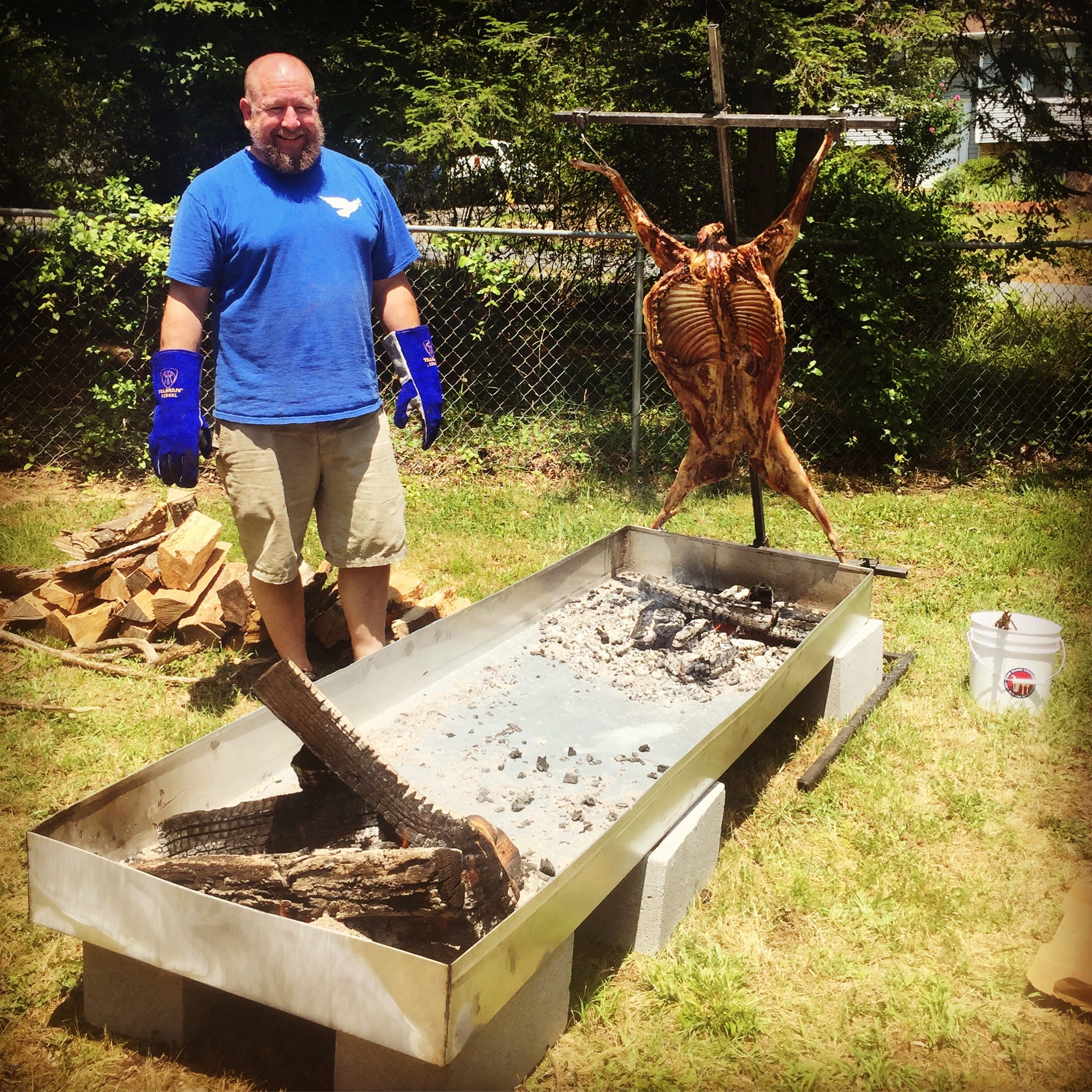
After four hours, the lamb was done. My brother Max and I lifted it off the base, released it from the hooks, and laid it on a table where we had prepared tools for serving. I removed the heart, hot and crispy on the outside, and the kidneys, also hot and crispy, though curiously shrunken. Then I beckoned to Eve.
We went into the kitchen where I sliced up the heart. Eve took her portion and I took mine. Heart meat is very different than the muscle meat we’re used to: very chewy and very iron-y. Not for me. Judging by Eve’s alarmed expression, not for her either. We both eyed the kidneys. “Nah” we said, and tossed them to the dogs.
Outside, Max, Eve, Jim, and I put on nitrile gloves and lined up with our carving tools behind the big table. Guests queued up with plates so heavy with sides there wasn’t much room for the lamb. We cut slices of meat and loaded up everyone’s plates as they filed past. Eventually we gave up using knives and just pulled hunks of meat off the bones and served it that way. We got real messy. Lamb is very fatty. It was a glorious day.
We still talk about that first asado when we all got together and celebrated being alive, happy with our good fortune and our health. The asado cross still sits in the garage, waiting for the next time we take it out for a spin. Eve and I are working on plans to cook those incredible beef ribs I had all those years ago in Argentina.
Looking forward to sharing good food with those we love.
And nobody stepping in dog poop.