
By Ranjit Singh
ADVANCE ENVIRONMENTAL COLUMNIST
People often write about how hard it is to cope with relentlessly bad environmental news, and how they need other pursuits simply to keep going and maintain sanity. I get it. But I have a different story.
More than 20 years ago I completed a doctorate on authoritarian politics in the Arab World. I created a model that linked variations in opposition groups to ruling elites’ certainty of the costs of unity or defection. I tested this model via field research conducted in various Arab countries, where by that time I’d lived for over seven years.
In my dissertation’s obligatory “Acknowledgements” section—the last section anyone types up—I thanked professors, family, and friends. I also added a heartfelt tribute to our family home on Potomac Creek:
The Unicorn Farm continues to bark against the creep of suburban homogenization, enduring as a green island of eccentricity for generations of offspring, immigrants, and innumerable life-spans of grateful animals.
My doctoral research appeared in various forms: a chapter in an edited volume, an article in a peer-reviewed journal, etc. I went on to pen enough analyses of Middle Eastern politics to earn tenure at my small university.
Yet, I find that my work in recent years has concerned people, nature, and the environment, especially in the area of our family farm in south Stafford. I could not have known it at the time, but that homage to the farm was portentous: Even as I put the finishing touch on the most laborious intellectual project I’d ever completed, a part of my mind was always elsewhere.
And that has proved essential.
***
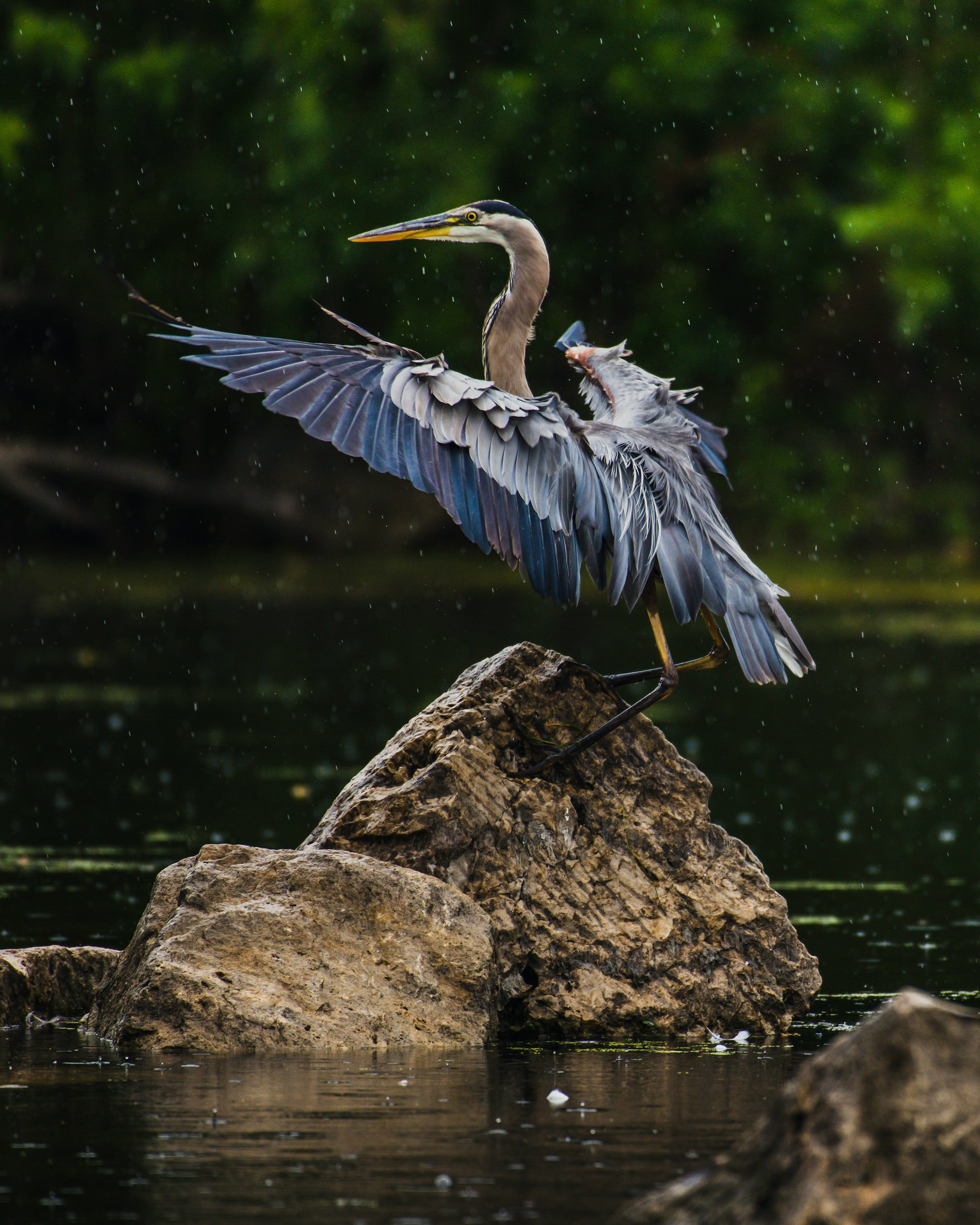
I sometimes join friends counting nests in Potomac Creek’s great blue heron rookery. It’s an annual event conducted in late January, before the birds return for the spring nesting season. The heron rookery lies on the other side of the creek, just a few hundred yards from our farm. I used to bring my kids when they were small and less distracted.
Counting twiggy nests perched high in the crowns of sycamores and pin oaks (the two tree types they seem to favor most) is muddy, laborious work even on a fortuitously nice midwinter day.
It’s hard going.
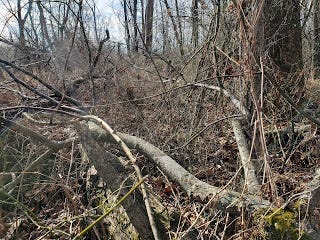
Our target tree is straight head.
Many trees that hosted heron nests in previous years are helpfully numbered with small metal discs pinned to their bark. But you need to find them and be able to get to them. That means passing through plenty of sharp bramble and boot-sucking wetlands.
Even muck boots offer no guarantee of dry feet. On our map of the rookery, a few trees have been playfully named after past volunteers who took icy baths in the attempt to reach them. Thus far, I’ve avoided such honors.
I make a point of walking on the narrow tops of campus curbs to stay ready for challenges like stepping on slippery logs to cross streams. This tests my balance. It also recalls the mannerisms of personal hero biologist Bernd Heinrich. Heinrich wrote that he habitually runs from his car to his campus office. I won’t go that far. But I like to think that we both provide students some amusement.
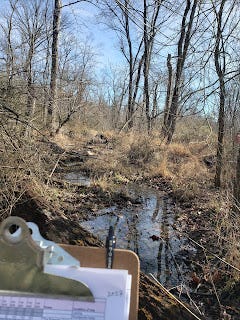
Recording nests.
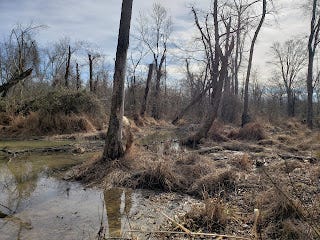
More hard going.
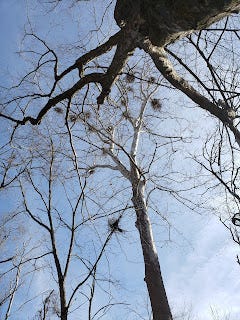
The payoff.
These Potomac Creek trees can play host to two, three, or four nests. A precious handful have up to 25—veritable bird condominiums seventy feet or more above the marshes. Elsewhere, in an essay about coyotes of all things, I described blue herons as introspective philosopher-birds, but one can only imagine the racket when dozens of heron babies are screaming for food in a single tree. Such unicorn trees raise questions of why herons are so attracted to one particular tree and not another. Let me know if you’ve got the answer.
Of course, some trees that held nests in previous years are now empty. The creek is a dynamic place. Windstorms knock down both nests and trees. The ongoing decimation of ash trees by the invasive ash borer is also limiting the herons’ choices. I’ve come across dead and dying herons before (and kept a small heron skull in my university office until it crumbled). There are many variables at play.
Our annual nest count therefore provides only estimations. But since our nest data goes back to 2007, it allows comparative insight into the general health of the large heron community that calls the Creek home.
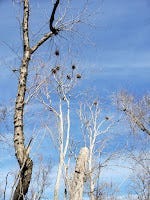
Despite good years and bad, the Creek’s heron population appears relatively stable. Steps have been taken to keep it so. In the mid 1990s, a local non-profit, the Northern Virginia Conservation Trust purchased the 70-acre rookery to protect it from human predation and abuse: housing developments, timbering, hunting (herons are big targets even though federally protected), trash dumping, unruly ATVs, etc. Today, the rookery is buffered by a Muslim cemetery and largely embedded within Stafford County’s 3,000 acre Crow’s Nest Natural Area Preserve, established in 2008.
The rookery has become a sanctuary. The herons that returned to the Creek this spring to start the next generation seem safe for now.
***
And that’s what I’m getting at.
In a turn of events no one could have predicted twenty years ago, for three years I served as chair of the board of directors of the Conservation Trust, the non-profit that first protected the rookery. And today I serve on the county’s appointed wetlands board.
This modest work has been absolutely necessary for me. As I was discovering environmentalism, horror unfolded across my area of professional expertise. The former Syrian regime brutally murdered its population. In the course of a long civil war, it dropped as many as 80 thousand barrel bombs, often targeting hospitals, deploying the double-tap technique that maximizes deaths among emergency responders.
One city the regime singled out for special punishment was Aleppo. When I was 19, I spent a year and a half there.

Aleppo before the war. Wikipedia.
Aleppo was a beautiful, ancient city that wrapped me in its maternal arms. We fell mostly out of touch, but I know that some of my old friends, their spouses, and children, are dead now. The luckier ones were displaced or became refugees. Yet to prepare for classes, I needed to read accounts of torture and watch gory videos of innocents suffering. I needed to know what was happening, and what was or wasn’t suitable for the classroom.
In the last three years, the predicament repeated itself. I used to live in the Gaza Strip, too.
It can be a mercy to worry about nature, even as it faces unprecedented challenges. I’m not in any way dismissing them. I consider myself a clear-eyed environmentalist.
But my green colleagues and I talk about herons, creeks, and trees. That is, we talk about beautiful things we can reasonably hope to protect.
From our own dysfunctional species.
Mercy on us all.
***
Ranjit Singh teaches in the Department of Political Science and International Affairs at the University of Mary Washington. He’s also an active environmentalist. His “No Lines in Nature” Substack blends history, science, and philosophy to explore our relationship with the natural world world. You can find it HERE.
This is beautiful, Ranjit. Honored to read it. Grateful to you for writing it. Such amazing perspective.
Thank you for this powerful reflection and for your hands-on work protecting Potomac Creek, Crow’s Nest, and the broader landscape we share.
Your example shows how caring for sensitive habitats sustains entire ecosystems, including the people who, like you, find refuge and renewal in what our ancestors once knew as the everyday natural world. These places remind us that wonder is still possible.
I hope more readers will follow your lead by supporting and joining land trusts. Virginia’s United Land Trusts (VaULT) lists many conservation groups working across the Commonwealth, and The Nature Conservancy in Virginia offers another strong avenue for those who want to help protect land and water.
Thank you again for helping protect the wonders of life on this earth—and for inviting the rest of us to do our part.