By Monimala Basu, SPECIAL to the ADVANCE
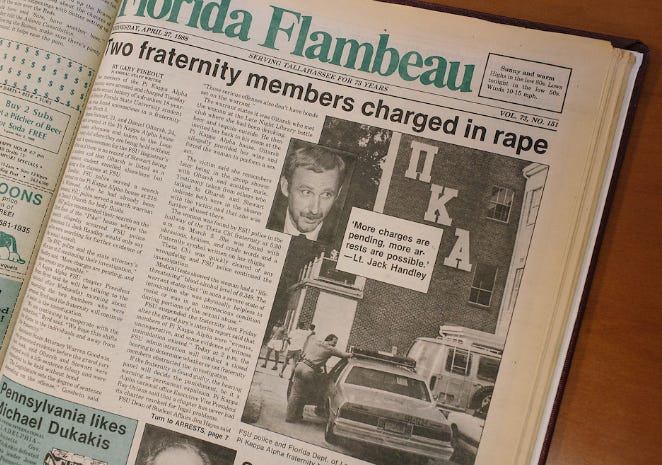
[Editor’s Note: When I earned my Ph.D. and taught as a grad student at Florida State University during the late 1980s, one of my part-time jobs was advising the Florida Flambeau, the independent university newspaper where I had been editor several years before. My friend Moni Basu, who wrote the following essay, was then editor. I worked with Moni and other Flambeau reporters for months as they reported the Pi Kappa Alpha gang-rape story—coverage that helped form the basis for a widely-cited, foundational sociology journal article, “Fraternities and Rape on Campus,” published in 1989 by the journal Gender & Society, and still all-too relevant today. —Steve Watkins.]
***
The Cornell Rape Case Takes Me Back to Another Gang Rape that Occurred at my University Nearly Four Decades Ago
By Moni Basu
I’ve been reading about how former Cornell University student Jane Doe’s gang rape allegations have triggered terrible memories for countless survivors of sexual assault. Many have taken to social media to post: “I am Jane Doe.”
I know another Jane Doe. She, too, was once a high school graduate who left her family and home to start university with the verve for life that is expected of someone embarking on a monumental chapter of her life. She, too, had walked into a local nightclub and was highly intoxicated; tests placed her blood-alcohol level at .349 percent, enough to cause death. She, too, ended up in a fraternity house where she was gang-raped. She, too, was the victim of what Cornell’s Jane Doe has described as a vicious and vulgar act. She, too, dropped out of college, never to be identified publicly.
But she is not Jane Doe to me. I know her name. I know her story.
In March 1988, I was the editor of the Florida Flambeau, a small independent newspaper in Tallahassee that, much like The Cornell Daily Sun, broke the story of a rape at the Pi Kappa Alpha fraternity house on the campus of Florida State University. Unlike the Cornell case, however, the Pike brothers faced legal proceedings soon after the rape.
The Jane Doe I know could not remember much of what happened to her, but the FSU police named PKA member Daniel Oltarsh as the ring leader who forced her to have sex with him and at least two other frat brothers in a gang rape that involved a toothpaste tube. Police found her in the hallway of the Theta Chi house next door. She had been dumped unceremoniously, unconscious with her skirt pulled up, her underwear down, and the initials of yet another frat, Sigma Alpha Epsilon, scrawled on her thighs with a ballpoint pen. She was rushed to hospital, where she was tested for rape.
The police questioned several PKA members who were at the house that night. They denied any knowledge of the rape.
The woman was traumatized and scared. She did not want to press charges. The state pursued indictments without her. It was believed to be the first time members of a prominent fraternity house were prosecuted for a campus gang rape.
One of the Pike brothers agreed to talk to the police in exchange for total immunity. His testimony was used to build the case against the others. In the end, three Pikes—Oltarsh, Byron Stewart and Jason McPharlin—were indicted. They were charged with felony sexual battery, but Stewart and McPharlin plea-bargained long before a trial date was set for lesser charges. McPharlin pleaded no contest to a negligence charge and got six months’ probation. Stewart pleaded no contest to sexual battery and got five years’ probation.
Oltarsh maintained the woman had consented to have sex. He pleaded no contest to sexual battery before his trial and was sentenced in July 1990 to one year in jail, two years of house arrest after his jail term and 20 years of probation. He violated the terms of his sentence and spent three more years in jail. His parole ended in 2014. He is listed on the Florida sex offender registry.
As the legal proceedings began in May 1988, deep divisions surfaced on the FSU campus. The Flambeau covered every twist and turn in this story. Letters to the editor attacked the victim as a liar, or someone who deserved what she got. Some called her unpatriotic for smearing the reputations of FSU’s upstanding young men. She was ostracized and threatened. A lot of that is happening now to the former Cornell student. In fact, the Cornell case feels eerily like a repeat of what happened at my college all those years ago.
The Pikes had been the most prestigious fraternity at FSU, and the campus police spokesman called the case a milestone. Before it, he said, opinion would have been that the woman was responsible for what happened to her. FSU suspended the Pikes, the frat house was closed, and the chapter disbanded. But the fraternity was reinstated more than a decade later in 2000.
I thought about FSU’s Jane Doe for many years after the PKA case faded into rear view, and in 2015, when I was a reporter at CNN, I decided to call her. I had always understood her need for privacy but was bothered that the public never heard her version of events. And, two years earlier, in 2013, I had reported a story about a rape survivor in India that helped me process my own sexual assault at FSU. About 26 percent of undergraduate women experience sexual assault, according to a national campus climate survey. That’s a staggering number of women whose lives are broken at college.
My editor and I decided we would call the FSU victim “Maria” in the CNN story. She still lived in Florida, not far from some of her perpetrators, and we felt it best to continue her anonymity. She had made a brief appearance on a CBS News show in 1990 after Oltarsh’s sentencing, but this was the first time that her version of the story was told to the world, the first time that she talked about her many years of struggle to get her life back together after it was shattered.
I spoke with Maria’s therapist, and when she gave me the green light, I persuaded Maria to return to FSU with me; neither one of us had walked across campus since 1988. She hadn’t been able to bear the pain and humiliation after her rape and had returned home. My term as editor of the Flambeau had long since come to an end, and I left Tallahassee a year-and-a-half after that.
At home, Maria had her ups and downs. She turned to alcohol and bulimia and even contemplated suicide. It was after three failed marriages and the deaths of her mother and sister—both alcohol related—that Maria began to heal. She returned to college in Texas, and in 2002 completed a master’s degree in psychology.
“I went back to school because I felt robbed,” she told me back then. “Robbed of my education, robbed of my typical student life, robbed of my aspirations, robbed of success. Those guys took all that away from me. I showed them wrong.”
When I met her, she had been clean for six years. She was still in therapy for post-traumatic stress. She suffered from flashbacks in which gruesome images of that night swept across her mind. She had accepted what happened, and no longer felt the shame she once did.
“I will never get an apology,” she told me. “I don’t need one.”
We walked together where the old PKA house once stood; the frat has since moved to a 55,000-square-foot mansion in a Greek community off campus. Standing there, at the place where she had been raped, Maria said she felt nervous for all the young women on campus. She wanted to hug her 18-year-old self who made the decision to walk into the fraternity house that night in 1988.
“I need to let her know now that she is safe and OK,” she said as we stood under the glare of a street lamp on Jefferson Street.
Maria told me the trip to FSU and the subsequent publication of the story felt cathartic to her. It was another step in a lifelong process of healing.
I have been thinking a lot about my trip to FSU with Maria 11 years ago, when the The Hunting Ground had just been released. The film documented the epidemic of sexual assault on college campuses and efforts to cover up the crimes. Not much had changed since Maria’s rape in 1988, and I’m not sure how much has changed since that film first screened.
Every time there is a horrific sexual assault case on a college campus, we talk as a nation about what needs to be done to prevent such heinous acts. And yet, how many women are carrying on with their lives with the deep scars of rape?
We’ve been talking a lot, too, in the past few days about Greek culture and whether colleges need to take a harder look at how that plays into incidents like the one at FSU and now at Cornell. I’ve always thought fraternities and sororities promoted a dangerous sort of groupthink—the kind that prevents a young man from saying, “No. This is wrong. I am going to report you,” and instead send messages like the Chi Phi brothers at Cornell did on Snapchat that said, “Free pussy upstairs,” and asked, “Shop still open?”
New York’s sexual assault laws are complicated in cases of voluntary intoxication, and I don’t know how this case will be resolved. I don’t know whether Jane Doe will get justice.
In my head, I keep hearing over and over again something that Maria told me as we parted ways in Tallahassee. It was something that took her a long time to say.
“It was not my fault. I didn’t deserve it.”
Jane Doe, I hope you are saying the same.
***
Monimala Basu is director of the MFA program in Narrative Nonfiction and the Charlayne Hunter-Gault Distinguished Writer in Residence at the Grady College of Journalism and Mass Communication at the University of Georgia. An earlier version of this essay appeared on her Substack Word on a Wing.