
By Phil Huber, ADVANCE COLUMNIST

The kitchen table is where economic policy becomes real.
It is where the mortgage statement lands beside the electric bill; where the grocery receipt competes with the prescription refill; where the credit-card balance waits beside an estimate for a broken water heater. Politicians can celebrate stock indexes, tax cuts, and applause lines. Families live somewhere else: in the narrow space between payday and due date.
The best test of an economy is not a speech, a campaign hat, or a headline unemployment number. It is a simple question: After the bills are paid, what is left?
For too many families, the answer is less every month. The administration promised to put working Americans first and make it easier to build a secure life. That is a fair promise to test. But the test is not a rally, a cable-news argument, or a corporate report. The test is the kitchen table.
The administration’s policies must be judged together, not one at a time. A tariff may be sold as toughness. A cut in food or health aid as discipline. A tax cut as relief. A work requirement as responsibility. But families experience the combined result: higher prices, more expensive repairs, less help when illness strikes, and more debt when there is no other choice.
The kitchen table does not care about ideology. It records only the arithmetic.
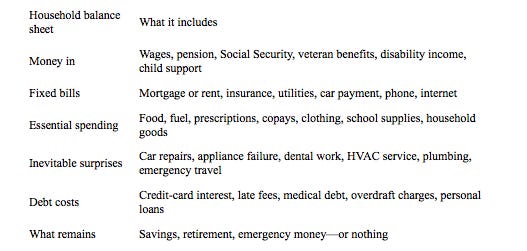
When the “what remains” line gets thin enough, poverty does not arrive in one dramatic event. It arrives one bill at a time.
Start with food. A family that loses food assistance does not stop needing food. The cost shifts—to a credit card, local pantry, church voucher, or the child who eats less. Food banks are essential, but they cannot replace federal nutrition assistance at the scale families need. Feeding America has warned that current SNAP changes put nearly 6 billion meals at risk.
Transportation is another unavoidable cost. In much of Virginia, including the Fredericksburg region, a dependable car is the price of getting to work, school, child care, medical appointments and the grocery store. That means gasoline, insurance, tires, inspections, repairs and often monthly payments.
A tariff that raises the price of imported parts, tires, appliances or consumer goods does not remain an abstract trade-policy debate. It appears in the mechanic’s estimate, at the register and on the credit card statement. Analyses have found that the combined effect of tariffs and federal fiscal policy could leave lower-income households with the largest proportional losses, while the top 1 percent gains overall.
Health care is where many careful budgets collapse. Beyond the premium come deductibles, copays, prescriptions, dental bills, lab work and emergency-room fees. A family may handle an ordinary month. Then a child breaks an arm, an aging parent needs help or a spouse needs a procedure.
Cuts to Medicaid and other health supports do not make illness disappear. They move costs from a government ledger to a household ledger, where the margin for error may already be small.
Then comes debt—the quiet accelerator of poverty. A credit card pays for groceries one month, a car repair the next and a medical bill after that. Soon the family is paying interest on food, transportation and health care.
Poverty Is Not Always a Lack of Work
Often, it is the interest charge on a life that costs more than a working family can cover.
Critics call this “welfare,” as though every recipient chose not to work. That is not the full story. SNAP and Medicaid serve children, older adults, people with disabilities, caregivers, students and people working in jobs without adequate wages, stable hours or health coverage. Children represented about 39 percent of SNAP participants in fiscal year 2023.
Many recipients work. The Government Accountability Office found that about 70 percent of adult wage earners in households receiving Medicaid or SNAP worked full time in a typical week. Among Medicaid adults under 65 who are not receiving disability benefits or Medicare, 64 percent worked full- or part-time; most of those not working were caring for someone, in school, ill or disabled.
A safety net is not a hammock. It is what keeps a temporary setback from becoming a permanent collapse.
Taxpayers deserve accountable programs directed to people who qualify. But accountability is not cruelty. Paperwork that pushes eligible people off assistance shifts costs elsewhere—to families, hospitals, churches, local governments, food banks and ultimately other taxpayers.
There is little evidence that punitive work requirements produce their promised result. The Congressional Budget Office found that SNAP work requirements increased employment less, while Medicaid work requirements appeared to have little effect on employment. Good policy should help people find stable work and preserve their health, not remove food or health coverage over a bureaucratic deadline.
And When the Household Budget Finally Breaks, Where Does a Family Go?
First, it turns inward. Relatives are called. Payments are deferred. Prescriptions are delayed. Then come harder choices: groceries on a credit card, a missed doctor’s appointment, the minimum payment instead of the full amount, or postponing the power bill to keep the rent current.
After that, the family enters America’s emergency maze. It calls 211 and seeks utility help, food aid, rental support, Medicaid, charity care or a church voucher. In Virginia, 211 connects people with food, housing, healthcare and utility resources; Fredericksburg directs residents there for referrals to local assistance.
But the referral line is not a magic checkbook. It cannot create affordable apartments, restore benefits, erase medical debt or repair a transmission. Families fall onto a patchwork of nonprofits, local agencies, churches, food banks, emergency rooms and high-interest lenders. That safety net was never meant to replace sound national policy.
Nor does the problem stop with lower-income families. They feel the first blow because they have the smallest cushion. Middle-class families feel the same pressure through the disappearance of theirs.
The retirement contribution gets cut. The college fund stops growing. Emergency savings are drained. A medical bill goes on the card. One layoff, illness, divorce or major home repair can turn a solidly middle-class household into one living paycheck to paycheck.
Middle-class status should mean the ability to survive an ordinary emergency. It should not mean merely being able to postpone one.
A modest tax cut is not a raise if tariffs, insurance increases, health costs, food costs and debt payments take it back before the month ends. A household experiences an economic plan as automatic withdrawals, app alerts and due dates.
This is not about telling Republican voters they were wrong or that Democrats are always right. It is about asking whether the administration’s promises to working people are being kept.
The utility company does not lower the bill because a customer voted Republican. The pharmacy does not discount prescriptions based on party registration. The mechanic does not reduce the cost of tires because the driver supported tariffs. A working-class Republican family, a middle-class independent family and a Democratic family living paycheck to paycheck all face the same arithmetic.
Many Republican voters believe in work, thrift, family obligation, local community and taking care of one’s own. Those are honorable values. But none can overcome an economy that raises costs while reducing help when a job, car, home or family member is in trouble.
Responsibility matters. So does a government that does not punish responsible people for ordinary human emergencies.
The administration should face one plain question: How many families must exhaust savings, delay medical care, rely on a food pantry or turn to high-interest debt before it admits that its policies are not producing the security it promised?
A Responsible Government Changes Course Before a Crisis Becomes Normal
Every voter—Republican, Democrat, independent and unaffiliated—has the right to ask every elected official: “Are your policies making it easier or harder for my family to build a stable life?” That is not partisan. That is citizenship.
The kitchen table is the great nonpartisan fact-checker. It records what came in, what had to go out and what remained at the end of the month.
For too many Americans, what remains is worry, debt and the fear that one emergency will push them from precariousness into poverty.
If the administration cannot recognize that reality—or chooses policies that deepen it—the problem is not the family budget.
The problem is the policy.
***
Phil Huber is a retired Army Reserve colonel, federal civil servant and consultant who writes on civic education. He lives in Fredericksburg.

You left out one important detail here WHO PUT THE MESS ON THE KITCHEN TABLE ? DEMOCRATS DID FOR 150 YEARS. SLOWLY SEEPING INTO THE FAMILY STRUCTURE TO MAKE EVERYONE. DEPENDENT ON GOVERNMENT !