
By David S. Kerr, SPECIAL TO THE ADVANCE
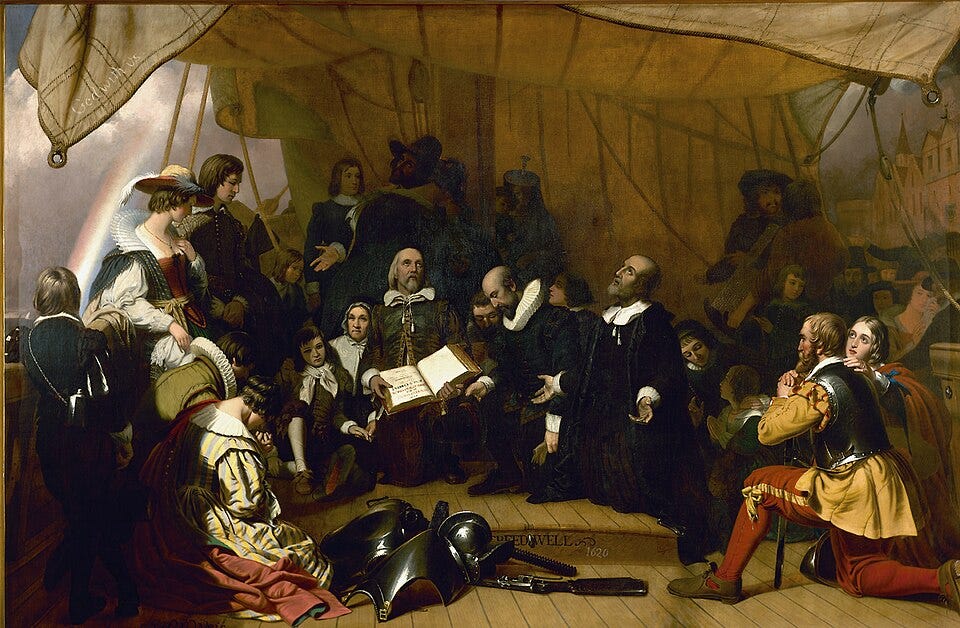
Founding father and second President of the United States John Adams credited the Mayflower Compact as being one of the foundation stones of the Declaration of Independence and the U.S. Constitution. Other framers, including Thomas Jefferson, offered similar comments.
But the Mayflower Compact wasn’t like the other statements and declarations that helped guide our founding fathers. It wasn’t as expansive as the Magna Carta and it didn’t borrow from the legacy of the ancient Greeks and Romans or, for that matter, from the philosophers of the Enlightenment. Rather, it was a simple document borne out of practicality and necessity.
On Thanksgiving Day, we celebrate the Pilgrims and their remarkable feat of survival in the New World. Their ship, the Mayflower, didn’t have a lucky voyage. It nearly sunk riding out a late season hurricane and was blown off course. Their goal had been the Virginia Colony, but when they made landfall, they were off the coast of modern-day Massachusetts.
They were also a far more diverse group than history often describes. Roughly half of the settlers were Pilgrims (Puritans) and the other were men and women skilled in farming, carpentry, and other trades, as well as a few old-fashioned adventurers.
However, all was not well within this unusual band. Tension was in the air. Arguments about how to proceed and who was in charge had already started. They had heard the rumors about dissent and infighting in the Virginia Colony and knew they didn’t want to break into that kind of factionalism.
The debate on how they would govern themselves isn’t recorded. They probably discussed several options. However, the framework they devised was elegant in its simplicity, with implications that were much more far reaching than any of these intrepid souls could have imagined at the time.
The principal paragraph of the Mayflower Compact is short and to the point: “Having undertaken, for the Glory of God, and advancements of the Christian faith and honor of our King and Country, a voyage to plant the first colony in the Northern parts of Virginia, do by these presents, solemnly and mutually, in the presence of God, and one another, covenant and combine ourselves together into a civil body politic; for our better ordering, and preservation and furtherance of the ends aforesaid; and by virtue hereof to enact, constitute, and frame, such just and equal laws, ordinances, acts, constitutions, and offices, from time to time, as shall be thought most meet and convenient for the general good of the colony; unto which we promise all due submission and obedience.”
It seems innocuous enough, but it wasn’t. Everything about this statement was new and radical, though the Puritans and their fellow travelers probably didn’t see it that way. To them, it was a practical matter.
They were a long way from home and had to find some way to govern themselves. What the Mayflower Compact did was give every man, regardless of station, a vote. The barrel maker’s vote carried as much weight as a Pilgrim farmer. But beyond that, it declared that the colony would abide by the decisions of the majority of the “civil body politic.” It was a democratic system.
However, before going much further, it should be noted that waiting for them in the “wilderness” was a thriving Native American community. The Wampanoag tribe, the people who would first meet the Pilgrims, and prove instrumental in their initial survival, was governed through a system of Sachems (tribal leaders) who relied heavily on family ties and consensus for their authority.
In many respects its democratic structure mirrored the type of collaborative politics the Pilgrims were seeking to establish.
The Wampanoag Sachems governed from the village to the regional level. They saw to the needs of the elderly and infirm and handled relations with other Sachems. The Great Sachem, their overall leader, dealt with larger matters such as dealing with the Pilgrims. It was a sophisticated political system that no doubt had evolved over generations.
The Compact, by contrast, was made quickly in the cramped confines of the Mayflower. While short it was highly unique in its time. Particularly to a European mindset. It dutifully and repeatedly acknowledges the supremacy of the English king, but there is no reference to royal approval. They were doing this on their own.
What the document established was a self-governing colony. Little did they realize that their compact, written in their eyes only as a matter of necessity, would survive and years later help inspire a new nation. Consider that when you sit down for your turkey and dressing and an afternoon of watching football. It’s even more reason to celebrate.
***
David Kerr is a Stafford County resident. He taught for nine years as an adjunct professor of political science at Virginia Commonwealth University. He has worked for various federal agencies as well as on Capitol Hill. David also served on the Stafford County School Board. He lives with his wife, two horses and three cats. He is also a Navy veteran.

Yes.