
By Phil Huber
ADVANCE COLUMNIST
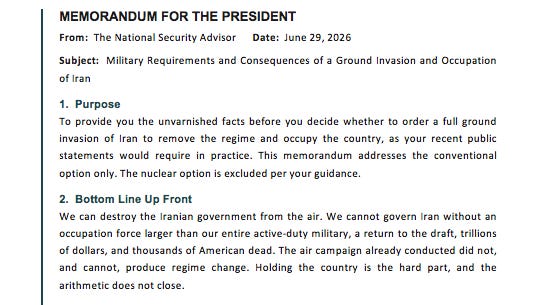
Imagine the document that should be sitting on the Resolute Desk right now.
For months, President Trump has talked about Iran in the language of annihilation. In April he posted that “a whole civilization will die tonight, never to be brought back again,” alongside threats to bomb the country “back to the Stone Age” and to “decimate” every bridge and power plant. As the ceasefire frays again this summer, he vows to “finish the job.” But “finishing the job”—actually toppling the regime and holding the country—is not an airstrike. It is a ground war and an occupation. And before any president orders that, his National Security Advisor owes him the unvarnished arithmetic, in writing, with a line at the bottom to sign.
So here is the memo the President should have to read—and initial—before he turns a slogan into a war. The facts in it are not partisan. They come from RAND, from the Center for Strategic and International Studies, from the Pentagon’s own counterinsurgency doctrine, and from the cost of the war we are already fighting. Read it as he would have to. Then ask yourself which box he checks.
MEMORANDUM FOR THE PRESIDENT
From: The National Security Advisor Date: June 29, 2026
Subject: Military Requirements and Consequences of a Ground Invasion and Occupation of Iran
1. Purpose
To provide you the unvarnished facts before you decide whether to order a full ground invasion of Iran to remove the regime and occupy the country, as your recent public statements would require in practice. This memorandum addresses the conventional option only. The nuclear option is excluded per your guidance.
2. Bottom Line Up Front
We can destroy the Iranian government from the air. We cannot govern Iran without an occupation force larger than our entire active-duty military, a return to the draft, trillions of dollars, and thousands of American dead. The air campaign already conducted did not, and cannot, produce regime change. Holding the country is the hard part, and the arithmetic does not close.
3. The Facts
a. Force required. Initial invasion force assessed at a minimum of 500,000 troops — the size of the 1991 Gulf coalition, against an enemy four times larger than Iraq.[1] Holding the country under standard counterinsurgency doctrine (20 per 1,000 civilians × ~90 million Iranians) requires roughly 1.8 million troops—more than our entire active-duty force of 1.3 million.[2] No allies have committed to share this load.
b. Mobilization. There is no path to those numbers from the all-volunteer force. It requires full call-up of the Guard and Reserve and, almost certainly, reinstatement of the draft — the largest mobilization since World War II.
c. Time. The invasion phase: weeks. The occupation: a decade at minimum, a generation realistically. Iraq and Afghanistan each ran twenty years and ended in withdrawal. The IRGC and Basij are purpose-built for protracted resistance.[3]
d. American casualties. Conservative estimates for the invasion phase alone (first six months): 5,000–10,000 U.S. dead. Pessimistic scenarios exceed 50,000. This excludes the insurgency that follows and the wounded.
e. Cost. The air war alone has already exceeded $100 billion in roughly 100 days.[4] A full invasion and occupation is projected at $3–$5 trillion over the first five years, atop existing debt.[5]
f. Second- and third-order consequences.
• Disbanding the Iranian state repeats the 2003 de-Baathification error that fueled the Iraqi insurgency.
• No legitimate successor government exists; any installed leader is branded a puppet on day one.
• Persian nationalism unifies even regime opponents against a foreign occupier.
• The Strait of Hormuz (one-fifth of world oil) closes—global energy shock and domestic recession.
• Iranian proxies open new fronts; Russia and China gain a strategic windfall while we are pinned down, away from the Pacific.
• A cornered regime gains maximum incentive to sprint for the very nuclear weapon we seek to deny.
4. Recommendation
Do not order a ground invasion and occupation. It is not resourceable without conscription, not affordable, not winnable on any timeline acceptable to the American people, and the strategic costs accrue to our adversaries. Continue coercive pressure and the negotiated track. The honest judgment of your military planners is that the United States has the power to break Iran but not to hold it.
5. Decision
☐ ATTACK—Order the ground invasion and occupation of Iran. I accept the requirement for conscription, an occupation force exceeding the active-duty military, $3–$5 trillion in cost, and 5,000–50,000+ American dead.
☐ DO NOT ATTACK—Decline the ground invasion. Continue pressure and negotiation.
______________________________________________
Donald J. Trump, President of the United States
Date: _____________________
What Would Trump Do?
So which line does he check and then sign?
Read the memo cold and the answer looks obvious: no rational commander-in-chief initials ATTACK. The numbers forbid it—1.8 million troops we do not have, a draft we have not used since Vietnam, $3 to $5 trillion we cannot borrow, and thousands of flag-draped coffins, all to break a country we then cannot govern. DO NOT ATTACK is the only signature the facts allow.
But this President does not govern by memo. He governs by impulse, by the news cycle, and by the need to never look weak. And here the record actually cuts toward restraint: every time the decision moved from a Truth Social post to a live order, he flinched. He called off the April 7 strike less than two hours before the deadline. He reversed the June 11 strike with missiles three hours from launch. On seizing Kharg Island he simply admitted, “I’m not sure the country has the appetite for it.” The apocalyptic rhetoric has always been the leverage, not the plan. He wants the deal, the victory lap, the reopened strait — not the war.
If the pattern holds, he checks DO NOT ATTACK, and then tells the country that the credible threat of attack is what won the peace.
The danger is that a bluff only works until it is called. Rhetoric this extreme builds its own momentum, and a collapsed ceasefire or a cornered adversary can drag even a reluctant president across the line he keeps approaching. A leader who keeps threatening a war he does not intend to fight may one day find the war has decided for him.
That is why the memo matters. Not because we expect the President to read it — but because the American people should. They are the ones who would fill the ranks, pay the trillions, and bury the dead. The signature block at the bottom of that page belongs, in the end, to them.
So I’ll put the question where it belongs. You’ve seen the facts the President would see. Which box do you think he signs—and which would you?
***
Phil Huber is a retired Army Reserve colonel, a federal civil servant, and a retired consultant who writes on civic education. He lives in Fredericksburg.
[1]RAND Corporation analysis cited in Iran War Updates, iranwarupdates.com
[2]Counterinsurgency ratio of 20 per 1,000; House of Saud, houseofsaud.com
[3]Casualty and timeline ranges per published ground-war scenario analysis, Ground War Scenario
[4]Air-campaign cost: Boston Globe / Moody’s Analytics, bostonglobe.com
[5]CSIS projection of $3–$5 trillion over five years, houseofsaud.com