
By Phil Huber, ADVANCE COLUMNIST

Turn on the evening news long enough and the script starts to sound familiar. A Republican spokesman often will not begin with roads, wages, childcare, housing costs, or grocery prices. Instead, the message comes wrapped in warnings about schools, gender, immigration, religion, crime, “wokeness,” socialism, communism, or even “TDS.” The goal is to make you look here and not there.
That is political framing. It pulls attention away from the problems people live with every day and points it at an emotional target. A kitchen-table issue becomes a cultural panic. A policy debate becomes a moral fight. An argument about government becomes an argument about fear, identity, and belonging.
The word “stars” comes from a simple image: a magician tossing bright stars into the air to make the audience look one way while the real trick happens somewhere else. The star is a shiny object. It grabs the eye, stirs emotion, and pulls attention away from the policy question or governing failure that should have been the focus all along.
Republicans use this approach because it works. Culture-war issues are easier to repeat than tax, health, labor, or budget policy. They fit into a short television clip, a campaign ad, a fundraising email, or a social media post. It is much easier to say “protect the children” or “stop the radicals” than to explain what a party would actually do about wages, insurance costs, housing shortages, or childcare.
It is also easier to attack than to answer. It is much easier to say “Democrats are socialists” than to debate taxes, wages, health care, or public investment. It is easier to say “You suffer from TDS” than to answer criticism on the merits. These are not really arguments. They are shortcuts meant to stop thought, stir emotion, and push the audience back into familiar camps.
Democrats have message stars too, but they usually point in a different direction. Their language often centers on protecting democracy, lowering costs, reproductive freedom, gun safety, civil rights, and climate action. Whether readers agree or not, those messages are usually framed as calls to protect rights, solve public problems, or lower burdens on everyday people. That difference in intent matters.
Independent voters matter here too. Many are less tied to party language and more open to persuasion. They often hear the same stars without the party loyalty that makes people automatic believers. They are often the audience both parties are trying hardest to reach, and they are more likely to notice whether a message is solving a problem or merely changing the subject.
So, the political game becomes a game of substitution: see this, not that.
See school boards as battlefields, not as places to talk about teacher shortages, class size, literacy, or school safety. See immigration as invasion, not as a labor, legal, and humanitarian challenge. See gender as a cultural emergency, not as a question of privacy, dignity, and equal treatment. See race as division, not as a conversation about fairness, history, and opportunity. See religion as persecution, not as the continuing American duty to protect freedom of conscience for everyone. See socialism and communism as scare words, not as a way to avoid talking about wages, health care, and public investment.
That is the trick: The framing tells the audience what to notice and what to ignore.
There is another reason to pay attention to these stars. They can hide how much common ground exists. Studies from the University of Maryland’s Program for Public Consultation have found that Republicans, Democrats, and independents often agree on far more public issues than our politics suggests when they are given real choices, balanced information, and time to think.
That matters because democracy depends on compromise, and compromise depends on recognizing common ground. Compromise is not weakness. It is how free people with different views live under the same Constitution. No party gets everything it wants for very long, and no movement can govern a large and diverse country by treating every disagreement as betrayal.
The stars push in the other direction. They are built to divide us, deepen distrust, stir chaos, and make fellow citizens look like enemies instead of partners in self-government. They reward outrage over understanding. They make compromise look weak, and they make democratic habits harder to practice. Over time, that does real damage.
This list can be turned into a simple game. There are 22 Republican stars on the full list, but only 7 are shown here to start. Copy the table, keep adding lines, and see who gets to 22 first. Later columns will mention the other 15 stars in my list.
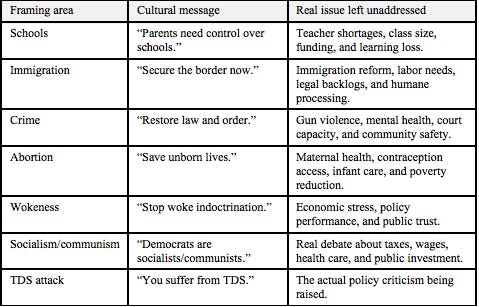
There is a reason this pattern lasts. It can pull together people who may disagree on taxes, trade, or deficits but can unite around identity and grievance. A cultural message gives activists a cause, donors a story, and candidates a ready-made script. It also lets leaders avoid questions where their answers may be weak or unpopular.
This is why cultural politics often feels repetitive. The same arguments return because repetition is the point. If a party can keep the public focused on emotional flashpoints, it can reduce pressure to deal with harder questions of daily life. Meanwhile, voters still face the same bills, the same housing squeeze, and the same frustration with institutions that seem more interested in performance than results.
That is where the stars game comes in. Each day, count the stars seen in speeches, interviews, headlines, ads, social posts, and cable segments. A star is a moment when a politician or commentator tosses out a bright distraction—a culture-war cue, a fear label, or a symbolic outrage—to pull attention away from what else is going on.
You can count Democratic stars too. That helps readers compare not just how often each side uses message stars, but what each side is trying to make people notice. Independent voters may find that comparison useful because it helps sort persuasion from distraction.
The game is simple. Which Republican stars show up the most on a given day? Which ones fade? Which new ones are added? Which Democratic stars show up in response? Which messages deal with real governing problems, and which ones mainly keep the conflict alive?
It also makes the news cycle easier to read. Some days, the stars will be everywhere. Other days, they will be fewer. The point is to learn how framing works and how often common ground is buried under noise.
The larger lesson is simple. Democracy works better when voters can tell the difference between a real problem and a manufactured distraction. If the public keeps rewarding the people who shout the loudest about symbolic enemies, the real issues—cost of living, health care, education, infrastructure, public trust, and effective government—keep getting pushed aside.
So, the next time the news comes on, count the stars. Count the culture-war flashes. Count the fear labels. Count the moments when someone is trying to make the audience look left while the real issue sits on the right. Then ask one more question: what problem did that message actually solve?
That question helps reveal whether the speaker is trying to govern or trying to distract.
***
Phil Huber is a retired Army Reserve colonel, federal civil servant and consultant who writes on civic education. He lives in Fredericksburg.

Bravo
Mention the Epstein Files and a constellation appears.
Thank you for this measured and informative article.