
By Jeff Eastland and Ranjit Singh, ADVANCE CONTRIBUTORS
Another day, another local data center controversy—this time a a 99-acre data center campus proposed in the Falmouth district of Stafford county, where it would threaten Potomac Creek.
The matter came before the County Board of Supervisors on July 7. The applicant is Metts LC of McClean, Virginia. Metts LC is requesting that the relevant property be rezoned from A-1 (Agricultural) to M-2 (Heavy Industrial). They want to construct three data center buildings and an electrical substation there.
Despite there being no dense housing nearby, I argue this application is deeply flawed for several reasons.
First, the applicant is requesting a Comprehensive Plan amendment to add the site to the Urban Services Area and the Central Stafford Targeted Development Area.
Significant changes to the Comprehensive Plan should not to be taken lightly. They will directly affect our futures. That’s because the Plan, as described by the County itself, is “arguably the single most important document in a locality besides the County Code.”
“A Comprehensive Plan establishes goals, objectives, and policies that shape the future direction of a community as it relates to the physical development of its land. Policies typically identify what the community’s vision is for anticipated growth. More specifically, policies may identify where growth is desirable and establish the type and intensity of development. A plan also should address the other interrelated aspects of growth, including: transportation, housing, public facilities, infrastructure, and natural and cultural resources. The Plan serves as a guide upon which development proposals are evaluated to ensure conformance with the desires of the community.”
Want to know what Stafford County will look like 20 years from now? The Comprehensive Plan is your best guide.
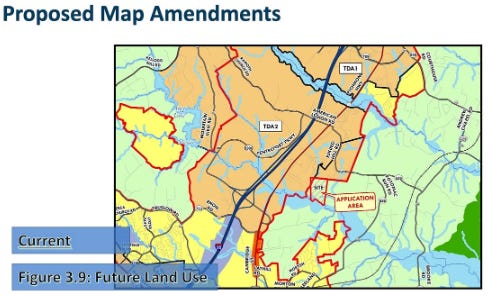
In the graphic posted at the top of this column, the current Urban Services Area and Targeted Development Areas are in brown. As you can see, the county has been trying to push much new development around the Centreport Area. The proposed data center site is outlined as the “Application Area.” It lies directly on Potomac Creek, and almost entirely apart from the areas slated for development. Just downstream is the Crow’s Nest Natural Area Preserve, a 3,000-acre nature park fed by the creek and one of the state’s ecological crown jewels.
This is not what the Comprehensive Plan intends for our county. Approving the developer’s request would be, in effect, moving the goalposts to favor a private interest. This discordance was pointed out by a member of the Board itself at the July 7 meeting.
Second, constructing an invasive industrial data center would severely degrade an ecologically sensitive area and the creek itself, causing downstream impacts that would affect the water quality of the county and the Chesapeake Bay.
The developer’s application complies with the minimum standards regarding setbacks from the creek. But these standards are only that: the bare minimum. The heavy activity needed to complete and run an industrial data center entails soil disruption, tree and vegetation removal, herbicide application, new roads, heavy equipment, and much more. Perhaps you’ve seen the immense swaths of bare earth that are now a common sight in that part of the county.
And it’s important to note that the proposed work—if approved—would be done adjacent to an officially-designated Resource Protection Area, which is “regulated environmentally sensitive land that lies alongside or near the shorelines of streams, rivers and other waterways which eventually drain to the Chesapeake Bay.” We need these Resource Protection Areas to be respected because, as the county website itself says, in their natural condition they “reduce runoff and filter pollutants, providing an essential function to restoring the health of the Bay.”
We also know that, in terms of water quality, Potomac Creek is already an impaired creek. It has received the EPA’s worst designation for water quality. Undoubtedly, building this large data center campus would further and severely degrade the RPA and the creek itself, harming water quality in the county and far downstream. It’s hard to imagine any reasonable person arguing otherwise.
Third, and of equal importance, the Seddon family cemetery sits in the middle of the parcel.
In the name of development, Stafford County has a habit of destroying the very things that make it a unique place to live. This data center plan would add to that ignoble record.
In remarks I made during the general public comments period at the July 7 meeting, I focused on the recent past, and the unfortunate removal of Buzzard’s Roost, an iconic Civil War site.
Buzzard’s Roost was a 40-foot rocky outcropping that served as a lookout during the Civil War and contained inscriptions from Union soldiers in 1862 and 1863. The Roost represented a very significant historical resource in a county that prides itself on heritage. However, in 2022, this unusual feature was cut out and removed from its original context to permit the construction of an enormous warehouse, an act then decried by history buffs. My intent was to compare that historical and cultural atrocity with elements of this current application, as you will see.
The Seddon family cemetery is 200 years old. Another rare cultural resource, it contains the remains of the Seddon family, a noted white Stafford County family that held local, state, and federal positions throughout the eighteenth and nineteenth centuries. But it also holds at least 12 unmarked graves believed to be those of enslaved people—people enslaved by, and buried with, the Seddons. Such cemeteries are very unusual in the South.
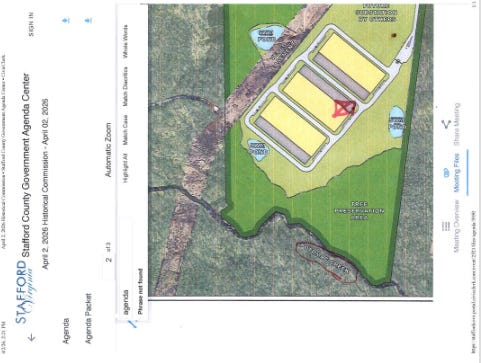
Here’s another official Stafford County graphic that shows the original Generalized Development Plan with the Seddon cemetery marked in red. It lies right in the middle of one of the proposed data center buildings.
Since Virginia law prohibits construction on top of cemeteries, one alternative would be to relocate the remains per state and county ordinances, which may involve a court decision. But relocation is not a desirable outcome, either. As stated by a board member at the July 7 meeting, who would want their descendants dug up and removed? And what justifies removal of enslaved remains by rich white men?
The applicants have gotten into much more than they bargained for. They appear not to have properly researched the parcel they own, and may now be stuck between a rock and a hard place. This is what happens when outside corporations come in with no interest in—or regard for—our county’s historical and cultural resources or environmental considerations (despite their claims to the contrary).
Just because certain minimum standards are met does not necessarily mean that we must allow a certain kind of development there. Not when human stories and history are to be told, and environmental protection taken into account.
Despite an initial motion for denial at the July 7 meeting, there was just enough opposition to hold off the developer for now. Some very good remarks were made, including by Anita Dodd, chair of the Historical Commission, members of the Cemetery Committee, and Kim Taylor-Wilson, who spoke eloquently about the dignity for the enslaved buried there. Alyson Azzara from the George Washington District spoke definitively about various problems with the application, including lack of a proper and sound study. The Board eventually voted 4-3 to defer the matter until the applicant could do a full investigation of the cemetery and surrounding grounds.
What happened to Buzzard’s Roost a few years ago was wrong, and so now is this data center proposal. For the integrity of Potomac Creek and our county’s wetlands, and for the preservation of our historical resources, I feel it imperative that this application be denied. Many seem to agree. On July 15, a special meeting of the Stafford Historical Commission was called to discuss the Potomac Creek data center application and the results of the July 7 Board of Supervisors meeting.
It was the best attended Historical Commission meeting I have ever been to. Many attendees were angry, not only at the potential destruction of county historic and cultural resources, but also at the county’s lack of transparency in its decision to inform the county’s Cultural Resource Specialist not to attend the Board meeting of July 7. The Historical Commission plans to address the upcoming archaeological evaluation that is to be performed and then brought back to the Commission, the Planning Commission, and the Board of Supervisors.
This is an active proposal, with much at stake for our county both in principal and on the ground. The Planning Commission and Board of Supervisors are on hiatus until late August. The developer’s application has an extension until October 31.
The new battle for Potomac Creek continues.
***
Jeff Eastland is a retired antique dealer, lifetime activist and writer, and one-time Environmental Studies major. He lives on a seven-acre farm in farm that is a certified Wildlife Habitat in Stafford, Virginia. A version of this essay originally appeared on Jeff Eastland’s personal Substack and on Advance environmental columnist Ranjit Singh’s Substack No Lines in Nature. Ranjit Singh teaches in the Department of Political Science and International Affairs at the University of Mary Washington. He’s also an active environmentalist. His “No Lines in Nature” Substack blends history, science, and philosophy to explore our relationship with the natural world world.

Thanks for an informative article involving important issues that affect (or will affect) most of us in the Fredericksburg region. In case others aren’t following local AI/data center issues, there are pending and/or approved applications in every jurisdiction in our area.
I don’t live in Stafford County and I’m not familiar with the details of its land use regulations. I am very familiar with land use good practices and related ordinances and processes from my tenure as a county attorney in a nearby Virginia county.
I recommend a two-point approach to anyone opposing any proposed land use application, a strategy that I think is especially worthy of consideration in applications that local governing bodies are predisposed to approve due to resulting tax revenue windfalls, like data center applications.
The first approach is to explore all the detriments that flow from the proposed use and expound in detail on them. This approach seeks denial of the application, and you fight like heck.
It’s also important to take all that information about detriments and demand of your elected officials (in this case the Stafford County Board of Supervisors) that they ensure that every single detriment is adequately addressed by existing or amended ordinances, and/or by applicant proffers or governing body-imposed approval conditions. Essentially, with this approach, you take the proposed development plan and make it the best possible plan.
Important issues to be addressed include the source of the water supply for extreme-high users like data centers, electricity rate-impacts on residential users caused by insatiable electricity users like data centers , noise and air pollution (diesel powered backup generators are super noisy and super polluters), all the other issues already discussed in your article, and any other issue that arises throughout the land use application process.
Personally, I worry that local governing bodies still aren’t asking all the right questions; that they are blinded by potential tax revenue windfalls, the calculation and fairness of which are naively based on overly optimistic applicant forecasts. These forecasts are so rosy, they also make me ponder whether, even if they prove true, there isn’t a lot more tax revenue to be gained via negotiation.