

By Dennis Wemm
THEATRE CRITIC
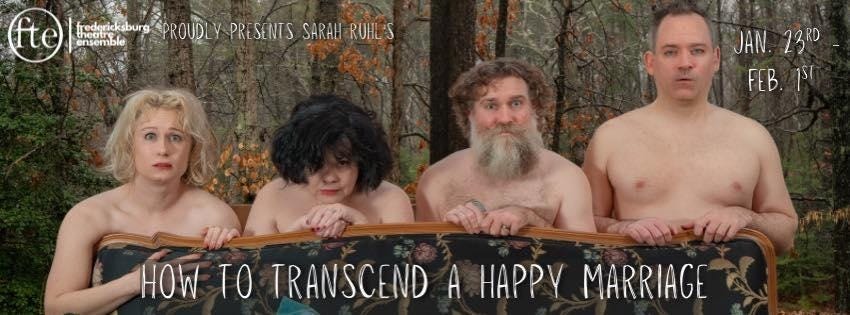
How to Transcend a Happy Marriage
by Sarah Ruhl
Presented by the Fredericksburg Theatre Ensemble
Directed by Collette “CoRi” Riddle and Ava Spencer
Tickets - This show has closed, but check the ticket link for forthcoming shows.
Sarah Ruhl writes plays about people who bend the rules to their own needs. She writes plays about people yearning for connection with other humans and searching to find an identity in a world that seems restrictive. Like many a rumination on human relationships, the questions are maybe never intended to be resolved.
This is a fairly serious comedy, where Anton Chekhov meets Aaron Sorkin and Wendy Wasserstein in New Jersey. Overall vibe modern Noel Coward. Suburban cool. Smart people enjoying each other’s company in comfort. Crudités, not veggies. Their lives are carefully trimmed to avoid unpleasant surprises: no sloppiness, just the right wine for the occasion served in the right glass for people they already know while the kids are invisible. Do they want anything else?
The point of view for the play is supplied by George (Adreienne Daly), who is married to Paul (Andy Braden). George’s name (short for Georgia) connects her to a vaguely Australian culture. She is intense and deeply connected to her husband, and she connects directly with the audience in a series of soliloquies. Ruhl uses her voice to express the dreamy unreality of the novel situations she finds herself in.
Paul, her husband, is glad and big; he accepts new ideas and paths easily and calmly. He’s a calm anchor with a good sense of humor who finds a way of understanding everyone and everything by translating the experience into his own world. That is, until he is gob-smacked by the implications of what he’s seeing and hearing and realizes his own need. Paul’s silence is his moment of revelation, George talks about hers.
Jane is a bit more centered than George, a little more connected. Her poise is a mask that she wears so comfortably that it might seem to be herself, until it starts to slip, and we see her confusion in the face of uncertainty. She genuinely loves the people she associates with, and they genuinely love her. She’s a natural hostess and a good mom who tries to maintain a breezy calm exterior.
Michael (Doy Demsick) is a cerebral tinkerer. He plays with ideas, knows the perfect quote for the occasion, and cites the quote by pulling out the book it came from. He genuinely has the right thing to say or do at any given time and is gifted at changing the subject to avoid uncomfortable situations. He lightens the mood by strumming a ukulele and leading a sing-along to an original song that celebrates the foursome’s long past together. But every new experience is filtered by the context of his own puckishness.
None of them know that they need anything more until they meet their polar opposites.
Along comes Pip, David (pronounced Dah-veed) and Freddie. They are younger than the two couples, they are way less married than the two couples. Their lives seem to be performed rather than lived. Pip, who has many identities, is puckish. She’s a temp in Jane’s office who is determinedly free-spirited. She loves to explain how she doesn’t fit into categories. She’s in love with nature and harmony and eating veggies and meat (that she kills with her own hands) and hash brownies and shrooms and no alcohol. Her relationship with Dah-veed and Freddie is easy-going and handsy and very self-aware, while being perfectly honest. She has an answer for each personal question, unlike the other two women. Does that reflect the real Diana (her assumed name, possibly borrowed from a deceased person)? Feel free to apply any of your images or ideas to Pip, she’ll process them and change her apparent character to fit them in seamlessly. It’s not until Act II that we begin to realize that she’s not as worldly as she’s let on.
Dah-veed and Freddie? They’re seldom seen without each other. While Pip seems to be the fulcrum of their see-saw, in her absence they mostly huddle together. Dah-veed attempts to recreate himself, rename himself, and sports an assumed accent that could be from just about anywhere in Europe. Freddie seems to be a bit less flamboyant and more direct, but he speaks less than the other two triangle members. All in all, the throuple feels to me like an improv troupe: their outside persona reacts to prompts given by their audience which they then embody fully.
You need a voice of normalcy to provide the face of society, and who is more aware of social norms and quick to defend them than a very mature teenage daughter? Jenna (Becky Brassfield) is Jan and Michael’s kid who comes in to find a kinky sex scene going on in the living room, prompting her to run away from home. She spends the time afterward discovering what she feels about what she’s seen before she returns, having no place else to go.
The first moment is intended to set up the challenge that the characters will face: a goat is center-shot with an arrow by an off-stage Pip. It falls and she appears, carrying it off stage. This blends into a realistic dialogue/exposition scene so smoothly that it sets the tone for the entire evening.
Sociological buzz-words fly as the couples try to identify and categorize these other three. They can’t seem to place them, and that makes them fascinating enough to invite them into the long-standing friendship. New Year’s Eve seems the perfect time to bring them in for an examination. Polyamorous? Bisexual? Who sleeps with whom and when?
The directors (Collette “CoRi” Riddle and Ava Spencer) and actors manage throughout the play to express the characters and relationships in an understated, perfectly natural tone. Everyone seems to be naturally speaking with old friends rather than saying dialogue. The banter is fun and erudite and, well, normal. None of the characters are allowed to fall into easy stereotypes. It feels like we’re in the room with old friends who have no need to fake interest, their affection for each other is smooth, natural, and warm until the throuple’s wild pitch changes the game for everyone. Adventure and excitement seem unnatural for these people, but adventure finds them.
Intimacy direction by Benjamin Bryant and movement coaching make the unreal scenes, including the New Year’s Eve party easy to watch and non-threatening.
There are some magically realistic elements to the staging that add a mythic touch to the story, and these elements are handled well and seamlessly by directors and crew. They blur the line of the real and the strange just enough. They leave the question open for whether those moments are actual in the world of the play or if they’re chemically induced, and that’s the way that Ruhl is playing the game.
Scenically (Kylie Clark) the set is both simple and complex: nature is the backdrop, with trees and AstroTurf carpeting and an informal dining room stage right and a sectional living room stage left. This provides an adequate and attractive playground for the actors. Appropriate but understated music and sound cues (Devon Clark) support the wacky point of view of the play. Lighting effects (Silas Alvarez) are subtle, well-cued, and support the whole performance well.
How to Transcend a Happy Marriage deals with adult themes from adult points of view. Portrayed are: suggested and stylized fully clothed sensuality between all of the cast members (except for Jenna), adult language, casual but illegal (when the play was written) drug use, alcohol consumption. The effects of the drugs are played for comic effect.
FTE, over the years, has certainly proven to be a reliable community theatre doing work that is worthwhile and challenging. They always leave me wanting to see what’s next. Weather challenges may have affected how many people were able to share this show with me. I hope you got to see it!
Dennis Wemm is a retired professor of theatre and communication, having taught and led both departments at Glenville State College for 34 years. In his off time he was president and sometimes Executive Director of the West Virginia Theatre Conference, secretary and president of the Southeastern Theatre Conference, and generally enjoyed a life in theatre.





Local Obituaries
To view local obituaries or to send a note to family and loved ones, please visit the link that follows.

Support Award-winning, Locally Focused Journalism
The FXBG Advance cuts through the talking points to deliver both incisive and informative news about the issues, people, and organizations that daily affect your life. And we do it in a multi-partisan format that has no equal in this region. Over the past year, our reporting was:
First to break the story of Stafford Board of Supervisors dismissing a citizen library board member for “misconduct,” without informing the citizen or explaining what the person allegedly did wrong.
First to explain falling water levels in the Rappahannock Canal.
First to detail controversial traffic numbers submitted by Stafford staff on the Buc-ee’s project
Our media group also offers the most-extensive election coverage in the region and regular columnists like:
And our newsroom is led by the most-experienced and most-awarded journalists in the region — Adele Uphaus (Managing Editor and multiple VPA award-winner) and Martin Davis (Editor-in-Chief, 2022 Opinion Writer of the Year in Virginia and more than 25 years reporting from around the country and the world).
For just $8 a month, you can help support top-flight journalism that puts people over policies.
Your contributions 100% support our journalists.
Help us as we continue to grow!


This article is published under Creative Commons license CC BY-NC-ND. It can be distributed for noncommercial purposes and must include the following: “Published with permission by FXBG Advance.”