
By Rebecca Rubin, ADVANCE CONTRIBUTOR
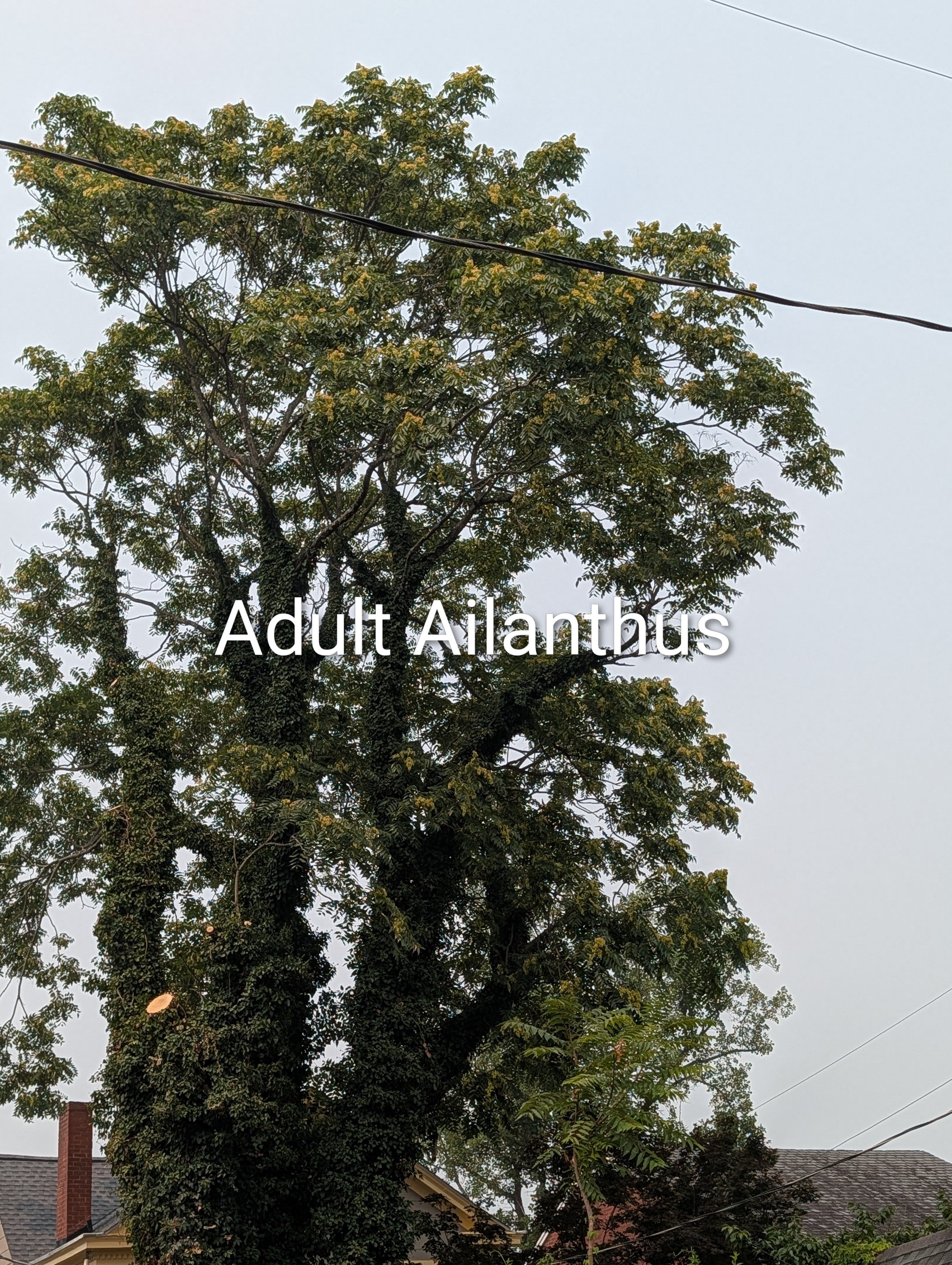
Early one July morning, I watched with fascination and concern as an intrepid arborist scaled the first 40 or so feet of an old, ivy-covered ailanthus (technically, Ailanthus altissima; and implausibly—for reasons which shall become apparent—called the tree-of-heaven.) From a series of precarious perches along brittle limbs—and with saw dangling from his belt—he and a co-worker on the ground de-limbed the tree in several places, while I waited to see if the branches he was standing on would hold. They did. Mission accomplished. Except not.
Perhaps unbeknown to the arborist and unfortunately for the client, cutting this tree is just the beginning. Wounding it causes it to propagate aggressively.
Several neighbors have experienced this firsthand, by taking down an ailanthus tree or de-limbing it as though it were like any other tree. Only it’s not.
Weeks later, they may find roots growing into their basement or dozens of shooters popping up in their lawns along a massive root system; these roots and shoots can’t be killed off without applying a potent herbicide. Their frustrations grow as the colonies rapidly multiply. Mowing worsens the problem. The good news is that recognition and understanding of this problem is progressing rapidly within our community as more people come face to face with the magnitude of these issues.
We are not alone. Ailanthus is a devilishly invasive, non-native tree that has infiltrated most of the United States. Any cut or wound will cause the tree to re-propagate with alacrity. Male and female trees alike spread through new shoots that form clonal thickets. Female trees are also prolific reproducers, capable of dispersing up to 10 million viable seeds across their 40-100 year lifetime. The tree is a fast grower, as are its roots which can spread 50-150 feet from the parent tree. It out competes nearby native trees and is a favored host to the spotted lantern fly, which forms masses on the tree and also drains sap from another 70 or so species of plants, including grapevines.
Ask anyone who has agricultural or viticultural crops—the spotted lantern fly is an economic threat to both. It’s a swarm-feeder that eats voraciously into vineyards, orchards and crops. Those who have experienced an infestation around their home also know the lantern fly’s habit of leaving a sugary, black residue that stunts the plant by blocking out sunlight and therefore photosynthesis. The spread of spotted lantern flies can be arrested or mitigated on any tree—ailanthus or otherwise—when they’re in the nymph stage (the insects tend to crawl upwards on the tree), and to a lesser degree in the early winged stage by way of circle trunk traps, which capture the lantern fly without causing undue harm to birds and insects—unlike sticky trap tape, an equal opportunity killer.
Loudon County publicly recognized its spotted lantern fly problem in 2024 by launching its inaugural spotted lantern fly eradication campaign. Now conducted annually, “Scrape the Grape” is a partnership formed among Visit Loudon, Loudon Invasive Removal Alliance, the Virginia Cooperative Extension Program, and the Loudon Wineries and Winegrowers Association intended to expand knowledge, outreach, and engagement in ways that help protect Loudon’s agriculture. Volunteers are trained to identify and destroy egg masses, thus preventing a more severe future infestation. What’s impressive here is Loudon’s decision to confront the problem head on, rather than ignore it and hope it would go away.
How to Kill an Ailanthus
Can Ailanthus trees be removed? Yes. The simplest technique is to dig them out when they are less than a foot or two high, assuming they are freestanding and not attached to a larger root system. The trick here is recognizing what they look like at this stage and avoiding confusion with beneficial look-alike species such as sumac and black walnut.
At the next stage of growth, an ailanthus tree more than a couple feet tall and with less than an 6-inch caliper, which is probably 90 percent of them in our region, can be treated by using a paintbrush to apply a potent herbicide around the basal stem—the bottom 12-16 inches of the plant, above the soil line. Done properly, this technique is dripless. After 1-3 months, only a dead stalk will be left. The tree can be cut down and removed at that point, although there’s usually no need to do so unless the tree poses a threat to safety.
For those trees whose caliper is more than 6 inches, the tree is circle-cut with an axe, and an herbicide is applied immediately to each cut. Again, the tree should be left to stand for several months before it dies off and can be removed. Variations on this theme involve a “cut stump” method, in which the sapling or mature tree is taken down to the stump and herbicide is applied immediately to the cut portions, although these methods tend to be less effective at killing off the root system —especially as many people don’t realize the need for the herbicide application is immediate, within a minute or two of making the cut.
The basal stem technique takes about 30 seconds per tree with an appropriate herbicide. Pathfinder 2 is a popular choice because it has the appropriate concentration of triclopyr, is oil-based (oil helps penetrate the bark), and comes pre-mixed. The application is done between July and November when the plant is taking nutrients into its roots. For larger trees of caliper more than 6 inches, circling the trees takes longer—perhaps 10-15 minutes using the so-called hack and squirt method, where each cut is followed by a water-based herbicide application, such as Garlan 4 (water based because the bark has already been penetrated by the cuts).
An outstanding resource can be found here: https://share.google/0zM3NkoOfvLz8D5u5
Important safety note: while substances such as Pathfinder2 are readily available for residential use, appropriate caution should be taken to safeguard against contact with skin and eyes; for larger infestations, a certified pesticide management specialist is called for.
Why Herbicides for Ailanthus
As a large landscape conservationist for most of my adult life—someone who specializes in transactions designed to permanently conserve lands of several thousand acres and upwards—my entire orientation is towards saving nature. I find nothing more sad than applying a chemical to a living ecological system. Application of herbicide was not something I had ever contemplated—until my husband and I purchased several acres of land outside of Charlottesville as part of a self-inflicted habitat restoration. Over the past five years, we have witnessed firsthand the effects of galloping, non-native invasives which overtake native populations at a breathtaking pace. We have resisted the temptation, every step of the way, to apply pesticides. We’ve stood in groves of poison ivy for long periods of time to hand clip invasives such as Oriental Bittersweet vines and Japanese Honeysuckle off native trees. And we’ve hand-pulled invasive Japanese stilt grass and Chinese Bush Clover rather than apply a systemic herbicide to any of these. Those approaches are possible because all these invasive plants have at least one removal solution that does not involve poisoning, albeit going that route can take years longer. But, this is not the case with ailanthus trees, which are in a special category. To the best of my knowledge, if ailanthus tree removal is the desired outcome and the tree cannot be dug out, it must be poisoned.
For those who may question why invasives can’t simply be left alone to form a new ecosystem, the answer is straightforward: Native flora and fauna evolved and adapted together over thousands of years to create the appropriate habitat for native species. We humans also benefit: This is the basis of our food supply and overall quality of life, including myriad benefits delivered by ecosystem services such as water and air filtration, soil stabilization, and temperature control. Non-native vegetation may provide none or some of these habitat benefits, and not to the degree needed; the more invasive forms also create monocultures that disrupt and outcompete native habitat, weakening it significantly, and reducing the numbers of native species including pollinators.
Urgent Need for Action
Tempting though it may be to see the ailanthus tree only as a profound economic threat to agriculture, viticulture and real estate, it is—at least to me—equally emblematic of an urgent need for planning and partnership-building for the city of Fredericksburg and its environs and, more broadly, for cities across the U.S. to which ailanthus has spread.
And while Fredericksburg is not unique in experiencing an ailanthus invasion, it may have more intrinsic natural resources to safeguard (such as its forest systems) than most cities, as well as a keener interest in protecting its real estate base. Many of these trees are located on city property, including along the trail system and river easement, and they are not new. They have likely spread unchecked for decades. What likely began as a few dozen trees here and there along the edges of trails and parking lots has been allowed to progress to become groves, infesting our local forests, trail systems, and neighborhoods.
Critical Steps for Fredericksburg
If the city of Fredericksburg were to start right now, it would be possible to treat by hand the preponderance of ailanthus trees on City lands between July and November, over the next one to three years. It would, for instance, make sense for the city to invest fewer resources into fall leaf pickup (those leaves being home to generations of insects which are essential to our pollinators and to the local food supply), and more into training and certifying the same crews to deal with invasive species, ailanthus in particular, on both city and private lands.
This would make a manifest difference, but it would not solve the problem entirely—because of course the trees would still propagate on National Park lands and private property.
Critical steps, then, would be for the city to:
+ Train and certify city workers or work with certified professional pesticide management contractors to properly identify, treat and remove ailanthus trees, starting with city property. This would help limit the spread into nearby private yards and federal lands.
+ Consider hiring a dedicated firm or firms with certified pesticide workers under a city-wide contract. Work block-by-block on eradication and appropriate signage.
+ Establish a list of professional pesticide management contractors and/or arborists certified in pesticide management and make this list available to the general public.
+ Create a sign-on list of private landowners who want to have their ailanthus trees treated and removed, something the city should consider doing free of charge given the potential effects on housing and real estate. Savvy prospective homeowners will know to look for this tree and recognize the associated issues and costs; absence of the tree on site and nearby makes that property more attractive to potential buyers.
+ Establish a partnership between the City and the National Park Service involving pursuit of grants for the benefit of both parties, to help fund these operations in the future and prevent ailanthus on National Park Service lands from spreading to city properties—and vice versa.
+ Offer free training and certification courses in pesticide application for city workers, private landowners, and professional arborists. Certification would be required, in any case, for removal of trees on city lands. Companies that specialize in tree cutting won’t usually have an individual certified in pesticide controls, and it would be a benefit to them and their customers for this training to be offered.
+ Widely publicize constituent resources available for invasive plant species removal—one of the best sites in the country can be found at Blue Ridge Partnership for Regional Invasive Species Management https://blueridgeprism.org/
+ Launch an informational an awareness campaign similar to that undertaken by Loudon County’s “Scrape the Grape” initiative.
Leadership and Preparedness
The question of ailanthus, it turns out, is not just about ailanthus—it’s about preparedness. It’s about how to bring more knowledge of the natural world to the fore in city planning, such that all constituents benefit when questions come up about such concerns as invasive plants hosting swarms of Spotted Lantern Flies.
As heat rises and air quality diminishes, we need more intact habitat—not less—and we need these areas filled not with invasive trees harboring insects that infest our agriculture, forests, and neighborhoods, but instead filled with the native trees with which our native birds, insects, and other living and non-living organisms co-evolved. We need all the benefits of these cooling, native systems supporting an abundance of life to help compensate for sweltering stretches of buildings and asphalt—the bounties of larger swaths of continuous areas of flourishing habitat and wildlife to offset hardscaped developments and fractured lands.
We need to rely on our planners, elected reps, and other leadership to take natural systems and their invaders seriously, and to have the kind of forward-looking vision and thinking that embraces a far more balanced ecological city footprint.
***
Rebecca R. Rubin is a landscape-scale conservationist and a board member of several non-profit conservation organizations.

An excellent piece. And very much needed. I see Ailanthus growing in all kinds of places. Most residents think “ oh, it’s a wonderful Tree. I will let it happen all by itself.” Little do they know that they have set themselves up for a lot of heartache. As I drive down the street from our house I see a 20 ft Ailanthus growing behind Libertytown and soon it will be too big to kill. Tree Fredericksburg will be taking on more and more invasive control starting this fall. If you want to help, watch for our emails.
Well, we can add this to the long list of stuff I just didn't know til I read it in The Advance! Thanks for your expertise, Rebecca. Officials in the surrounding counties should take note as well. Sounds like the Ailanthus doesn't much care about zip codes.