
By Phil Huber, ADVANCE COLUMNIST
A president’s approval rating is a snapshot. A historical ranking is a report card.
Approval measures how people feel today. It goes up and down with prices, jobs, wars and the daily news. It matters. But it does not tell us everything we need to know: Is the president making the country safer? Is he using power wisely? Is he leaving the country better than he found it?
That is what presidential rankings try to measure.
Siena College Research Institute last published its Survey of U.S. Presidents in 2022. It was the seventh Siena survey since 1982 and is still the latest one. A new survey would be useful now, in 2026, although Siena has not said when one is coming.
In 2022, Siena asked 141 scholars to grade 45 presidents in 20 parts of the job. They looked at honesty, leadership, appointments, working with Congress, handling the economy, foreign policy and avoiding major mistakes. Franklin Roosevelt came in first. Donald Trump came in 43rd, ahead of James Buchanan and Andrew Johnson.
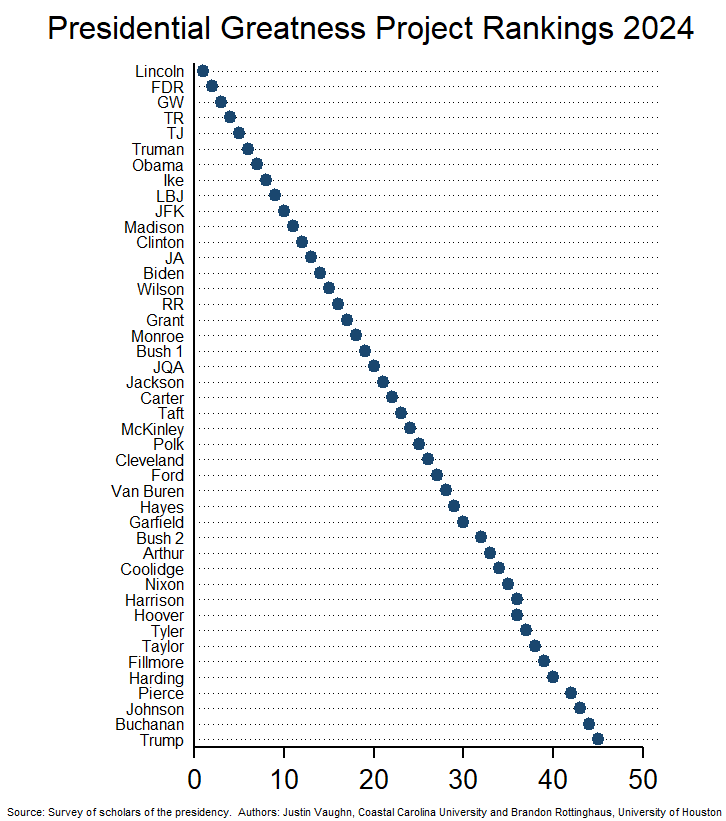
The Presidential Greatness Project expert survey came out in 2024 and put Trump last. But Siena’s survey is more useful for voters because it tells us why. It breaks the presidency into pieces and asks whether a president did the job well.
As a retired Army colonel who served six and a half years on active duty and later in the Army Reserve, and as a retired federal civil servant, I take seriously the oath to support and defend the Constitution. Trump has told voters to treat this November’s congressional election as if he is on the ballot. “I’m asking you to pretend that I’m on the ballot,” he said. I intend to take him at his word.
Congressional candidates have their own records. But Trump has made this election a choice between a Congress that will simply cheer him on and a Congress that will sometimes say no.
Siena gave Trump credit for his willingness to take risks and his ability to lead his party. He knows how to fight, grab attention and keep loyal supporters.
But fighting is not the same as governing.
Siena put Trump last in integrity and near the bottom in running the executive branch, working with Congress and avoiding major mistakes. People can argue about the exact rankings. But the message is clear: the scholars did not believe his political skills made up for weaknesses in the rest of the job.
The test is simple. Does a president follow the law? Does he respect the courts and Congress? Does he use power carefully? Does he tell the truth when it is not easy?
Those questions should matter whether the president is a Republican or a Democrat. Power that we excuse when our side is in charge becomes power the other side can use later.
Look at executive orders. Every president uses them. They can be lawful and necessary. But Trump has issued 288 executive orders in less than two years: 225 in 2025 and 63 more through late September of this year.
The issue is not only the number. It is what happens when a president tries to do too much alone. A legal tracker currently lists 970 cases challenging Trump administration executive actions. Not every challenge will succeed, and the administration has won cases, too. But nearly a thousand cases should make Americans stop and ask: Why are so many actions ending up in court?
Congress makes laws. Courts decide whether a president has gone too far. Those checks are not bureaucratic red tape. They are the rules that keep any president from having too much power.
Iran shows why Congress matters. The president is commander in chief and can act quickly when Americans are in danger. But the Constitution gives Congress the power to declare war. A long or growing conflict needs an honest debate, a clear goal and a vote by the people’s representatives.
The United States has carried out repeated strikes on Iran since Feb. 28 of this year. The House voted in September to tell Trump to end the conflict or ask Congress for permission to continue it. Seven Republicans joined Democrats. The Senate rejected a similar measure by only one vote.
As this is being read, the administration is sending about 9,000 more troops, sailors and Marines toward the Middle East. Trump says the Iran war will end “right after the election,” if not sooner. But he also says heavier bombing after the midterms is possible.
Americans may disagree about Iran. They should not accept war by drift—without Congress clearly approving it, without a stated goal and without a believable plan for ending it.
Tariffs raise the same question: Who makes big decisions, and under what authority? Tariffs can be useful against countries that cheat or use unfair practices. But they can also raise costs and leave farmers, businesses and families guessing about prices and jobs.
In February, the Supreme Court ruled that Trump could not use an emergency-powers law for his broad tariffs. The administration then turned to other trade laws, including a temporary 10 percent import surcharge and Section 301 investigations that may support more tariffs.
The point is not that presidents can never use tariffs. It is that when the Supreme Court says no, a president should work with Congress instead of searching for another way around it.
Siena ranked Trump last in foreign-policy accomplishments and executive appointments, and near the bottom in economic management and leadership. Those may sound like survey categories. To voters, they mean: Are we safer? Can businesses plan? Are prices predictable? Do our allies trust us? Is government working for the country, not just for the president?
Trump says he is on the ballot this November. Fine. Let us take him at his word.
Vote for the member of Congress who understands that governing means more than cheering for a president. Vote for someone who will protect constitutional limits, demand a lawful use of military power, insist on stable economic policy and hold any president accountable.
That is not a partisan test. It is the basic test of responsible self-government.
***
Phil Huber is a retired Army Reserve colonel, a federal civil servant, and a retired consultant who writes on civic education. He lives in Fredericksburg.

Very informative. Thank you again, Phil, for another interesting and well written article.