
By Steve Watkins, ADVANCE EDITOR
I got an email late last week from Quinn Slaven, a 28-year-old MAGA operative appointed Press Secretary for the Department of Veterans Affairs this past April. Before that, he’d been communications director for an obscure Republican congressman from North Carolina, and before that he’d bounced around different PR jobs after graduating from a small college in Iowa. I wasn’t surprised to learn from his Linkedin profile that he’s also earned certificates from Google in “Writing Prompts like a Pro” and “Generative AI.”
Quinn’s informal salutation—“Hi Steve—suggested something friendly would follow, but instead he launched into eight paragraphs of hammerhead criticism of a FXBG Advance commentary by one of our columnists, Phil Huber.
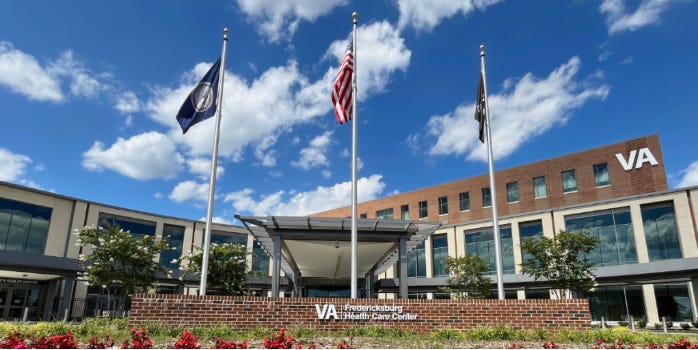
In addition to being our Heather Cox Richardson, Phil is a retired colonel in the U.S. Army-Reserves, Vietnam War veteran, former Military Intelligence officer, U.S. State Department Kuwaiti Oil Fires Team Leader, and Deputy Civil Affairs NATO Commander. In an Advance column titled “Fight or Fold: The Pattern Fredericksburg Needs to Test on the VA,” Phil had taken the VA to task for the chronic under-staffing of the still-new veterans medical center south of town—the subject of a couple of local town hall meetings held recently by Virginia Congressman Eugene Vindman and U.S. Senator Tim Kaine.
Phil’s column had only just run the day before I got Quinn’s email, so it was flattering to learn that the PR head of the largest civilian cabinet-level department in the U.S. federal government was so carefully reading our little publication—and had made it a priority to respond.
Here’s what he had to say:
Hi Steve,
I saw this article that recently ran on your site and wanted to flag it has several factual errors. So many that it frankly warrants being taken down, but at the very least I’m hoping you will correct these:
The author starts off the piece with, “At the Fredericksburg VA Medical Center, staffing has fallen to roughly 41 percent of authorized levels, a direct casualty of the administration’s federal hiring freeze and workforce cuts.”
Nothing in that sentence it true. Fredericksburg VA has been open for less than two years and our staffing is proportional to the number of Veterans we serve. I don’t even know where that 41% number comes from because we are well over that for the full facility capacity, and the capacity is intentionally high to account for growth in the coming years.
He then wrote: “Veterans in our community are waiting longer, driving farther, and getting less.”
Also, not true and he never reached out to ask for wait times. Not sure what he means by driving farther since this VA has opened 40 new clinic including the one in Fredericksburg, which would mean they have more options of where to go.
After a long diatribe he writes: “And yet wait times have gotten worse, not better—mental health appointments now take roughly 70 days, primary care over 100.”
Not true. According to the publicly available data (which tracks scheduled wait times, actual completed are almost always lower still) mental health appointments are at 11 days for individuals, 2 days if paired with primary care, and primary care alone is at 8 days.
Your guidelines for journalists say they should verify information before releasing it as well as gather, update and correct information throughout the life of a news story. I’m hoping you will stick to that and correct this one. Or, like I said, take it down entirely.
Thank you,
Quinn Slaven
Press Secretary
U.S. Department of Veterans Affairs
I of course got in touch the Phil right away to find out what was going on—knowing Phil to be a careful writer whose work is always measured, thoughtful, and appropriately sourced. In typical Phil fashion, he spent the next couple of hours rechecking his sources and writing a response for me to do with as I saw fit.
What I saw fit to do was forward it to Quinn at the VA, who I imagined must be sitting at his computer staring at his in-box, waiting for our reply. Here’s what I wrote:
Hey there, Quinn. How thoughtful of you to take the time to go over Phil’s commentary about the VA and other matters of government malfeasance. I ran that by him--Phil’s a long-time veteran, by the way, starting with the Vietnam War, where he was a helicopter pilot. Here’s what he wrote me back, which I thought I’d pass along to you since you’ve taken such a deep interest. I’m considering running your email and Phil’s response in The Advance so our readers can get in on the conversation as well. Your thoughts?
From Phil:
I’ve gone through each of Slaven’s three points against my primary sources, and I think a narrow, factual response is warranted rather than the takedown he’s requesting. Here’s where I landed on each:
1. Staffing at “roughly 41 percent”
Slaven says this is entirely untrue. It isn’t invented—it’s Senator Kaine’s on-the-record figure for the facility’s staffing at the end of 2025. But it is dated. I failed to catch that when I was doing research. Kaine has since cited a more current ~60 percent figure, and our own reporting on the Vindman transparency push cited a 37 percent vacancy rate from Vindman’s office as of late August. I’d propose we update this line to reflect the current number and note the trend (41 percent → ~60 percent), rather than remove the point. It strengthens the piece, since progress from a genuinely low base is part of the story too.
2. “Waiting longer, driving farther, and getting less”
Slaven says I never asked about wait times and disputes “driving farther.” This is a framing objection, not a factual one. Veterans said exactly this on the record at the Vindman/Kaine roundtable—canceled community-care referrals, coordination breakdowns between the VA and outside providers, and Kaine calling the situation “particularly galling.” I don’t think a correction is warranted here, but I’m open to tightening the sentence if you think it reads as an unsupported blanket claim.
3. Wait times of ~70 days (mental health) and ~100 days (primary care)
These numbers are not mine—they’re Rep. Vindman’s office, from his July 16 press release, stated in those exact terms. That’s a named, on-record source, not a fabrication. Slaven counters with the VA’s own Access to Care dashboard, but he’s citing the established-patient column (8–11 days). The same dashboard’s new-patient column—the relevant number for veterans trying to get in the door for the first time—shows 47.3 days for mental health and 55.3 days for primary care as of August 27. That’s still lower than Vindman’s figures, which may reflect a different measurement window, but it does not support Slaven’s claim that “nothing is true” here—if anything it corroborates the direction of the piece. I’d suggest we add explicit in-line attribution (”according to Rep. Vindman’s office”) if it isn’t already clear enough, so the sourcing is unmistakable.
None of this changes the basic premise of the piece: Veterans in this community are still not getting the care they deserve, on any reasonable reading of the numbers—VA’s own, Vindman’s, or Kaine’s. The staffing gap is real, the wait times are real, and the piece’s argument about testing pressure rather than assuming it’s futile still holds. I want to correct what’s genuinely stale (the 41 percent line) and sharpen attribution where it helps, but I don’t think this rises to needing a takedown or a broad retraction.
Here is the sourcing.
Staffing figure (41 percent):
Original source: Sen. Tim Kaine’s statement that the facility “was staffed at only at 41% at the end of 2025”—Fredericksburg Free Press
Updated figure: Kaine now cites roughly 60 percent staffed—NBC4 Washington
Alternate figure: FXBG Advance’s own reporting cited a 37 percent vacancy rate per Vindman’s office as of late August 2026, with the VA confirming ~600 onboard employees plus 80 in onboarding—FXBG Advance
Wait times (70 days mental health / 100+ days primary care):
Verbatim source: Rep. Eugene Vindman’s July 16, 2026 press release—Vindman press release
Related figure: Vindman’s April 2026 letter cited 88 days for mental health—Vindman letter
VA’s own dashboard (new-patient column, checked directly, station 652BY, Aug. 27, 2026 data): 47.3 days mental health individual, 55.3 days primary care—VA Access to Care
Veteran testimony on wait times/driving/coordination:
Vindman/Kaine roundtable coverage, Aug. 26, 2026, Howell Branch Library—FXBG Advance
Now, the revised staffing paragraph for the correction note—this swaps the stale 41 percent line for the current figures while keeping the trend line intact:
Revised opening paragraph:
“At the Fredericksburg VA Medical Center, staffing has climbed from roughly 41 percent of authorized levels in late 2025 to an estimated 60 percent today, according to Sen. Tim Kaine—still leaving the facility well short of full strength after the administration’s federal hiring freeze and workforce cuts. Veterans in our community are waiting longer, driving farther, and getting less.”
I told Quinn I’d already made the change to Phil’s opening paragraph, and invited him to review it for himself, with my regards.
Seven minutes later, I received another email from Quinn, this one somewhat conciliatory, though there was no “Hi Steve”:
I appreciate you and Phil for taking the time to review it.
Regarding the wait times. It’s worth noting that new patients only make up about 10% of the appointments VA conducts. Critics often latch onto those figures because as is the case across any health care facility (VA or private) your first appointment typically takes longer so scheduling can also take longer. 81% of Veterans seen at Fredericksburg VA say they were always or usually able to get an appointment as soon as needed.
Here is an on-the-record statement from me you are welcome to publish [highlight Quinn’s]:
Fredericksburg Health Care Center has nearly 600 onboard employees as of August 2026, with 80 candidates in various stages of onboarding. This is on schedule and aligned with the number of veterans seen at this clinic. Staffing will increase as the population of veterans being served increases.
Fredericksburg has served over 22,000 Veterans, and has completed more than 214,000 appointments, all of which surpass its first-year targets for this clinic, which is still in Phase 3 of its opening.
Thanks,
Quinn Slaven
Press Secretary
U.S. Department of Veterans Affairs
***
To which I responded:
Duly noted. I do have to consider everything in this exchange on the record though, Quinn, because as official government communication, it of course is.
The exchange might have ended there, but Phil noticed that the highlighted passage Quinn had sent us—that “on-the-record” statement—was word for word the same one Quinn had given the Advance’s military correspondent, Hugh Lessig, for Hugh’s story several days earlier about Vindman’s first meeting with the local veterans. The same statement had also appeared—again word for word—in a Fredericksburg Free Press story about the VA a few days after that.
You’d almost think it was AI.
Not one to let these things go unaddressed, Phil—who used to deal with accountability stuff like this all the time when he was in the military—sent me a long, technical list of follow-up questions concerning sources and methodology which I promptly forwarded to Quinn, and which you can read below if you’re of a mind to, though I think you already get the picture.
It’s been way more than seven minutes as I write this, but no response from the VA so far.
From Phil to me to Quinn:
Because terms such as “onboard,” “staffed,” “on schedule,” and “aligned with the number of veterans seen” can mean different things, I would appreciate clarification of the VA’s staffing-planning and reporting process for the Fredericksburg facility. In particular, I would like to understand how VA determines the number and mix of employees needed to provide timely, high-quality care to the veterans served here.
Please provide the following information, preferably by service line and occupation where available:
1. The current workload-based staffing requirement for the Fredericksburg Health Care Center—that is, the number of full-time-equivalent employees VA determines are needed to meet current demand and deliver services at VA access and quality standards.
2. The current number of authorized positions for the facility.
3. The current number of funded positions.
4. The current number of onboard employees and onboard FTE, distinguishing between headcount and full-time-equivalent staffing if those figures differ.
5. The number of vacant authorized positions and the number of vacant funded positions.
6. The number of people currently in the hiring pipeline, broken down where possible by stage—for example, selected candidates, tentative offers, background/security processing, credentialing and privileging, final offers, and employees with established entrance-on-duty dates.
7. The facility’s planned or approved staffing level at full operational capability, including the expected date or conditions under which that level is to be reached.
8. The staffing requirement, authorized staffing, funded staffing, onboard staffing, and vacancies for the most critical direct-care areas, including:
o Primary care.
o Mental health.
o Specialty care.
o Nursing.
o Medical support assistants and scheduling staff.
o Pharmacy.
o Laboratory, imaging, and other diagnostic services.
o Social work and care coordination.
o Any other occupation VA identifies as mission-critical or difficult to fill.
I would also appreciate an explanation of the requirements-calculation process used for this facility:
· What staffing methodology or model does VA use to calculate the Fredericksburg facility’s local staffing requirements?
· Which workload, patient-demand, clinical-complexity, access, and facility factors are included in the calculation?
· Does the calculation account for enrolled veterans, veterans actively using the facility, appointments completed, appointment requests, wait times, referrals to community care, specialty-care demand, telehealth workload, and anticipated growth in the local veteran population?
· How often are staffing requirements recalculated or formally reviewed?
· What event triggers a recalculation—for example, growth in enrollment, growth in appointments, addition of a clinical service, persistent wait-time problems, opening of another phase of the facility, or changes in community-care use?
· Who performs the calculation at the local level? Please identify the responsible office or officials at the Fredericksburg Health Care Center, the Richmond VA Health Care System, VISN 6, and VHA headquarters, as applicable.
· Who reviews, approves, validates, or adjusts the resulting staffing requirement?
· Is there a written staffing plan, model, workload analysis, staffing gap analysis, or other document supporting the conclusion that current staffing is “on schedule and aligned with the number of veterans seen”?
Finally, please explain the specific basis for the statement that staffing “will increase as the population of veterans being served increases.” Is there a defined workload threshold, staffing ratio, budget trigger, or approved phased staffing plan that governs when additional positions are authorized and funded?
I recognize that individual personnel information cannot be released. I am requesting aggregate staffing and workload information sufficient for veterans, elected officials, and the public to understand whether the facility has the clinical and support workforce needed to meet current and projected demand.
Thank you for your attention to this matter. I would appreciate a written response and any available supporting staffing plans, workload analyses, or public briefing materials.
Phil

All very fascinating.k
If Trump cared about veterans, he wouldn't have cut 40,000 employees at the VA, including 1,000 doctors and 3,000 nurses (figures from PBS).
Veteran, United States Army, Okinawa