
By Phil Huber, ADVANCE COLUMNIST
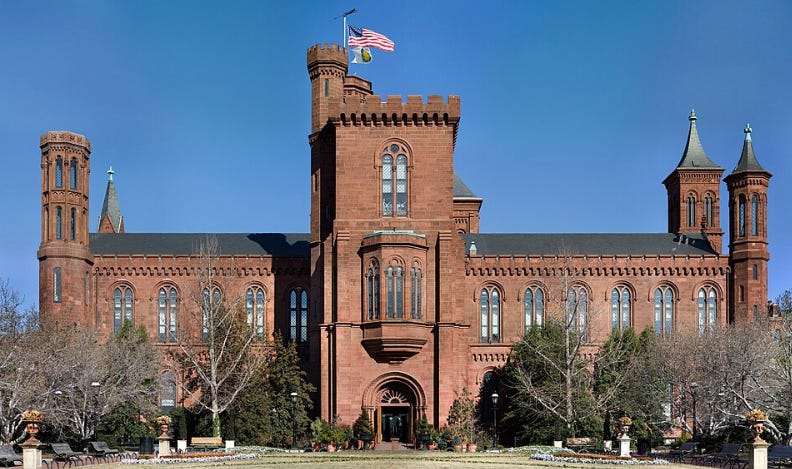
From Fredericksburg, the road to Washington is short enough that the capital’s habits never stay in the capital for long. What starts as a stunt in one federal agency soon becomes a signal of something larger. That is why the White House order to place warning signs outside the Smithsonian’s National Museum of American History deserves more than a shrug. It is not just a spat over one museum. It is a glimpse of a government more interested in controlling the story than doing the job.
President Trump has ordered signs posted outside the museum to warn visitors that its exhibits present “inaccurate” history and to direct them toward what his administration calls better sources of information. The move follows a 162-page White House report accusing Smithsonian leadership of ideological bias and urging corrective action. That is an extraordinary step. A government confident in its own case does not need to put official warning labels on a museum.
The Smithsonian should not be treated like an enemy camp. Its job is to tell the American story honestly—the proud parts, the painful parts, and the parts still being written. Fredericksburg knows something about that. Here, the National Park Service preserves battlefield ground that reminds us history is not a slogan. It is a lesson, and it deserves better than political theater.
That is why the idea of Virginia and Maryland answering with roadside billboards works as satire. Not as policy, and not as a serious use of state power, but as a mirror. If Washington wants to post warnings about history, then the states around it might post their own reminders about the present: the danger is not at the museum door, but in the White House. The point of the joke is not the billboard itself. The point is to expose the mindset behind the original sign.
And that mindset has shown up before. The National Park Service has also been pulled into fights over signs, language, and interpretation, even as the agency has faced staffing losses, budget pressure, and mounting operational strain. Reports on Trump-era budget proposals have described deep cuts to park operations and a possible large drop in workforce levels, while other accounts describe parks under stress as visitation remains high. That is what makes the Smithsonian fight so revealing. The administration keeps finding time for symbolic battles, even when the institutions involved need steady management more than ideological policing.
There is a further irony. Even while the Park Service faces pressure on staffing and core operations, money has been steered toward highly visible beautification projects in Washington ahead of the nation’s 250th anniversary. Reports this year said at least tens of millions of dollars in park-related funds were going to capital projects in the city, even as the broader park system carried a maintenance backlog of more than $24 billion. There always seems to be money for appearances. The harder case is made for the daily work of stewardship.
That is the real warning sign. Government is not supposed to curate its own image and call that leadership. It is supposed to fund institutions, protect public lands, preserve history, and let experts do their jobs. A democracy does not survive by posting signs to settle arguments. It survives by telling the truth and doing the work.
Phil Huber is a retired Army Reserve colonel, federal civil servant and consultant who writes on civic education. He lives in Fredericksburg.

The comparison verges on tired and trite at this point, but again I think of Orwell's book 1984: "This process of continuous alteration was applied not only to newspapers, but to books, periodicals, pamphlets, posters, leaflets, films, soundtracks, cartoons, photographs – to every kind of literature or documentation which might conceivably hold any political or ideological significance."