
By George Solley, SPECIAL TO THE ADVANCE
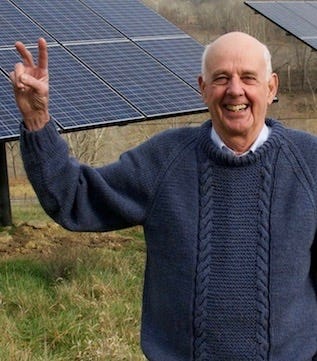
I was saddened to learn of the death this week of Wendell Berry—poet, writer, teacher, agrarian, and vocal proponent of keeping a strong and intimate relation to the land.
I met him many years ago, when I was a graduate student in English at the University of Kentucky and he taught creative writing there. His office was just down the hall from a couple of my classrooms, and I frequently met him walking to class or the library—a tall, quiet, kind, and invariably polite man, older than I but still young. We would exchange pleasantries but never had a real conversation.
But something about him struck a chord. I knew of his writings up to that time and had read some of his poetry and fiction. It stuck with me, and as I roamed the world for the next 30 plus years I would periodically learn of a new work or an article by him, and I would try to find and read it. I’m not sure why his work drew me to it during those years when I was focused on completely different matters.
Perhaps he appealed to my latent sense of the land, somehow inherited from generations of both sides of my family living and working, up until my parents’ generation, as farmers and landowners in Virginia, Alabama, and Kentucky. Perhaps it was the Kentucky connection (the surname of the title characters of two of his last novels is Catlett—my mother’s maiden, and my middle, name.)
My interest in the same matters that concerned him has only grown since settling down in Fredericksburg, 30-odd years ago. Environmental matters have been of increasing importance to me, and have been the focus of my interests and activities now for many years—the land we live on, growing things, climate matters, and our relationship with the Earth.
In one of those cases where a seemingly small thing creates a seed that grows into something much more substantial, I believe that those brief encounters with Wendell Berry in my early twenties have had an enormous impact on the person I have become over half a century later.
“We have lived by the assumption that what was good for us would be good for the world,” he wrote in his book The Long-Legged House. “We have been wrong. We must change our lives, so that it will be possible to live by the contrary assumption that what is good for the world will be good for us…. We must recover the sense of the majesty of the creation and the ability to be worshipful in its presence. For it is only on the condition of humility and reverence before the world that our species will be able to remain in it.”
***
George Solley studied literature at the University of Kentucky and Duke University. He served as a U.S. Marine officer for 23 years in the US, Asia, Oceana, Europe, and the Middle East. After retiring to Fredericksburg, he has led efforts to create a pathways system and downtown riverfront park in the city, served on many city and community commissions, boards, and committees, spent two terms as a City Councilor, and most recently served as chairman of the city’s Clean and Green Commission.

Good homage for good man.