By Steve Watkins, ADVANCE EDITOR

When Amazon Web Services invited me to the groundbreaking ceremony for a $460 million wastewater treatment upgrade they’re building for Spotsylvania County—it’s a data center thing—I was expecting hard hats, work boots, and shiny new spades. Not Jeff Bezos gold-plated shovel heads, necessarily, but not Amazon Basics either.
That didn’t happen. The 100 invitation-only guests were steered instead to 87 manicured acres just off Courthouse Road and ushered inside the swanky Stevenson Ridge Lodge—a safe and sanitary 12 miles from the Massaponax Wastewater Treatment Plant.
A flock of Amazon factotums greeted us there—perfectly-coiffed young women and men plying us with nametags and drinks and Sharpies for autographing ceremonial sections of purple sewage pipe. They gave us half an hour to mill around and socialize before directing us to a self-serve lunch line for roast beef, green beans almondine, and key lime mousse.
Stevenson Ridge mostly rents itself out as a wedding venue, which in a way I suppose this was, with Spotsy as tradwife, and Amazon the smooth-talking city slicker promising her the world—in exchange for enough reclaimed water to cool their eight data centers and then some: a perpetually humming 6.78 million square feet and counting.
Dress was business casual, the Spotsylvanians in noticeable contrast to the crisply-pressed Amazonians and their corporate guests from the Netherlands, the U.K., and, well, Florida. The wedding favors were symbolic packets of seeds—to be planted, not thrown at the bride and groom. Also gold-embossed medallions with the Amazon logo on one side, Spotsylvania County seal on the other.
I happened to have just read—and mentioned to a couple of Amazon executives in conversation before the lunch—a new poll that found only 20 percent of Americans think data centers are a good thing, while 51 percent say they’re bad, and 63 percent don’t want them built anywhere nearby.
The execs—one of whom was Mandy Ulrich, a UVA sociology grad, longtime Census Bureau worker, and now senior East Region Amazon manager for water and energy strategy—said yes, they’d seen that poll, too, and had come to the realization that one of their problems was they’d been too secretive in the past. They needed to do a better job of sharing information with the public, she said, because too many people had wrong ideas about data centers, and didn’t know about all the jobs and money and infrastructure upgrades companies like Amazon—especially Amazon—did for the community.
She explained to me, and later at lunch to everybody, that the wastewater facility upgrade will ensure that by 2030, the Amazon data centers in Spotsy won’t be using any potable water whatsoever, but will rely instead on the non-potable purple water from the much-higher-capacity treatment plant—a nearly half-billion-dollar gift from Bezos & Company.
And to top it off, Ulrich said, 96 percent of the time the Spotsy data centers won’t even need water! They’ll be air-cooled instead.
There were, of course, a number of things Ulrich and Project Manager Jeff McCormick didn’t address during their lunch speeches—though to be fair, McCormick, a retired nuclear sub commander, did preach a longer version of the data center gospel in a Free Lance-Star op ed that he reposted on his LinkedIn page and that you can read HERE to get around the firewall.
They didn’t say how much electricity it will take to run all those air-cooling units once the data centers are online, and they didn’t say what the environmental impacts and costs to consumers of the increased energy demands will be. They didn’t say how they’re handling complaints in other data-center counties about the noise and pollution and extended use-time of back-up diesel generators that can end up running for days at a time.
They didn’t mention the Virginia Department of Environmental Quality fining Microsoft $2.5 million after one of their NOVA data centers ran 62 backup diesel generators for seven days straight, pushing nitrogen oxide, carbon monoxide, and particulate emissions past permitted limits.
They didn’t offer guarantees or say what will happen if data centers switch to water cooling more than the promised 4 percent of the time, which is only 15 days a year. They didn’t say what the impact will be as the number of data centers in the county grows beyond the eight currently under construction, drawing more and more water from the Rappahannock, whether purple or potable, and demanding more and more electricity from Dominion, and driving energy costs up for the rest of us. And they didn’t say—nobody did—what will happen if Amazon doesn’t live up to its promises, or if the AI bubble bursts, or if the technology becomes obsolete and we don’t need data centers any more.
What Ulrich and McCormick did tell folks at lunch, besides the purple-water particulars of the new wastewater treatment project, was that Amazon has invested a whopping $1 billion in Spotsylvania so far, with even more to come. So lower taxes, more jobs, improved infrastructure, happier lives—echoes of sunny Donald Trump holding forth a week earlier at the White House:
“If you want to get rich as a state or as a town, if you want to pay lower taxes, if you want to create tremendous wealth, if you want your house to be more valuable and everything else, you’re going to want a data center.”
They left it to the last speaker, Spotsylvania Supervisor Drew Mullins, to address the data center “disinformation” being spread around the county, and the country, fueling those disastrous poll numbers. The grim-faced Mullins, a violin store owner and former Navy Seal, brought it up twice—he calls it “disinfo” on his social media—and exhorted the crowd to carry Data Center Truth back to their neighbors, families, and friends.
Mullins was one of two Spotsy board members to vote against a statewide call for a data center moratorium, which may have had something to do with why he was invited to speak. I was expecting him to say more—an exegesis on what disinfo he was talking about, and who might be disseminating it—but he only spoke for a few clipped minutes before stepping away from the mike.
Next up was a photo session with the Amazon reps, then the corporate guests, then the reps AND the corporate guests, then the Spotsylvanians, then maybe the Spotsylvanians AND the Amazon reps AND the corporate guests. I wasn’t paying attention by then, and missed my opportunity to corner Mullins for a follow-up interview because I got sidetracked in conversation with a Friends of the Rappahannock fundraiser, there for the groundbreaking and a scheduled meeting afterward with the Amazonians.
I was surprised to see her there, but probably shouldn’t have been. FOR is doing the Lord’s work, after all, and I expect you have to make all sorts of compromises running a $3.5 million non-profit devoted to saving the sixth most endangered river in America—even if it means taking money from companies that might be draining it dry.
I reached out to Mullins later on to ask about the disinformation thing, but by the time I got around to it I also had to ask him about something else: A homophobic slur he’d made the day before on X. I sent him this email:
Hey Drew,
I’m Steve Watkins with the FXBG Advance. I was at the Amazon water treatment project ceremony yesterday and have a couple of follow-up questions. First is about your repeated references to “disinformation.” What specifically were you referring to, and from whom are you hearing this?
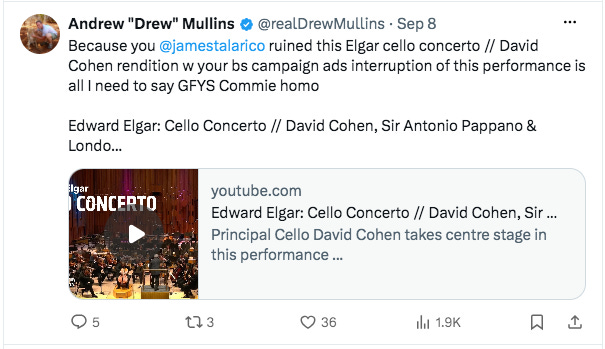
I also have to ask you about something you posted on X just the day before, apparently—Sept. 8—that I found when I was looking up background information on you. In the post, you took issue with some ads run by James Talarico during a classical music concert on YouTube, and you concluded with “GFYS Commie homo.” I’m curious about how you explain using that language and homophobic slur—as a “Believer. Husband. Father. SEAL veteran. Violin shop owner. Vice Chair Board of Supervisors.”
Here’s a screen shot.
I look forward to hearing from you about these questions. Happy to talk on the phone if you prefer.
Talarico, a Presbyterian seminary student and lawmaker, is the Democratic candidate for U.S. Senate in Texas.
I assumed—I hoped—that what Mullins had posted wasn’t the kind of bigotry that Amazon, and Bezos, and Ulrich, and McCormick would sanction, especially not from one of their principal supporters in Spotsylvania, and the elected official they’d chosen to speak publicly in support of their data centers. I assumed, and hoped, they wouldn’t sanction any sort of bigotry from anybody, and just hadn’t done their due diligence on the guy.
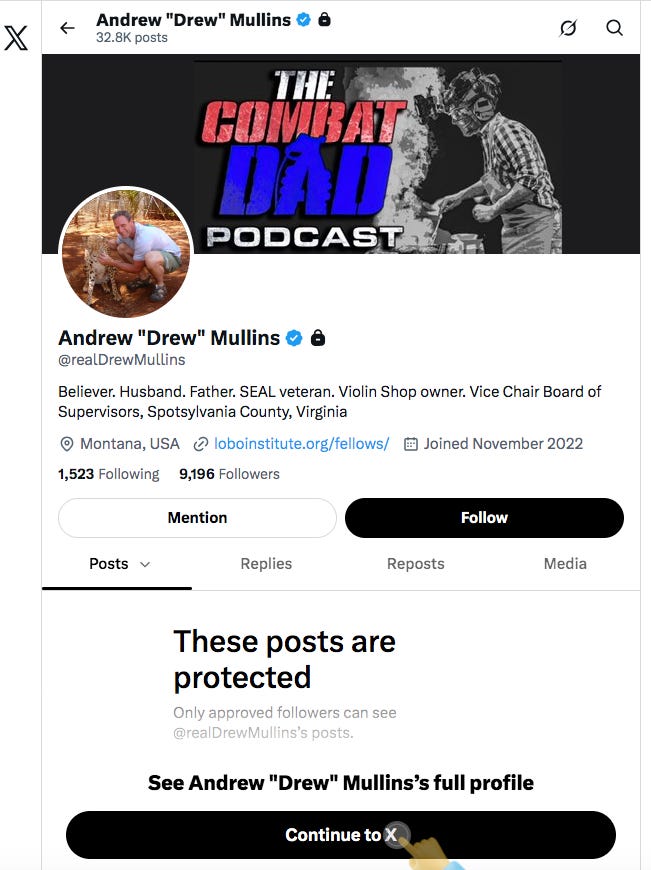
Mullins didn’t respond to my email inquiry, except to immediately block public access to his posts on X, including the one I’d screenshotted. His X account now:
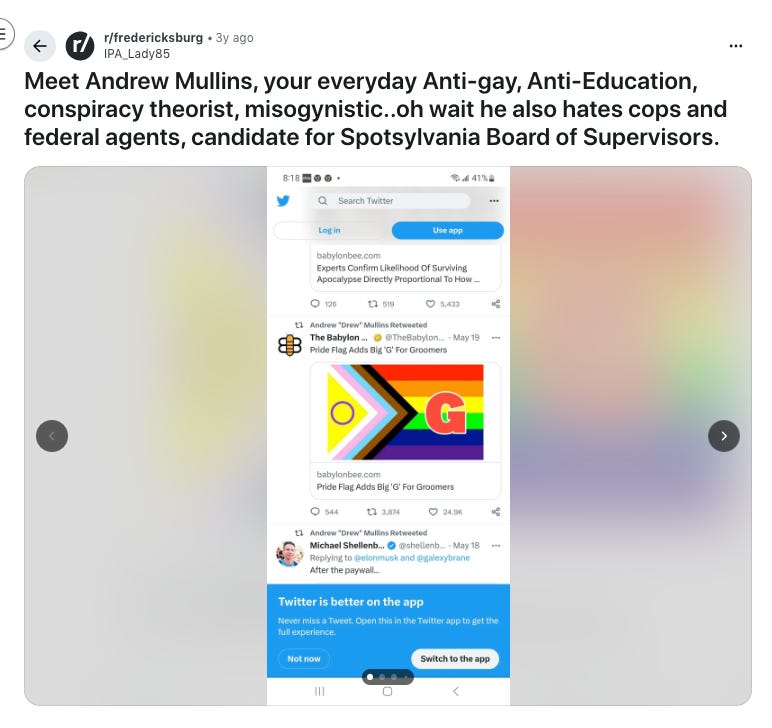
It didn’t take much digging to find out that bigoted slurs on social media are nothing new to Mullins—or whoever Mullins might claim hacked his accounts. You can see more of them HERE on Reddit, where they were posted a few years ago under the headline “Meet Andrew Mullins, your everyday Anti-gay, Anti-Education, conspiracy theorist, misogynistic… oh wait he also hates cops and federal agents, candidate for Spotsylvania Board of Supervisors.”
***
A few days after the historic wastewater treatment plant groundbreaking, I gave my commemorative medallion to a friend of mine who is no friend of data centers. He asked if I knew Latin, and could translate the Spotsy motto imbedded in the county seal: Patior Ut Potiar.
I pled ignorance, so he did it for me:
“I suffer that I may obtain.”
***
Steve Watkins is editor of The Advance.