
By Phil Huber, ADVANCE COLUMNIST
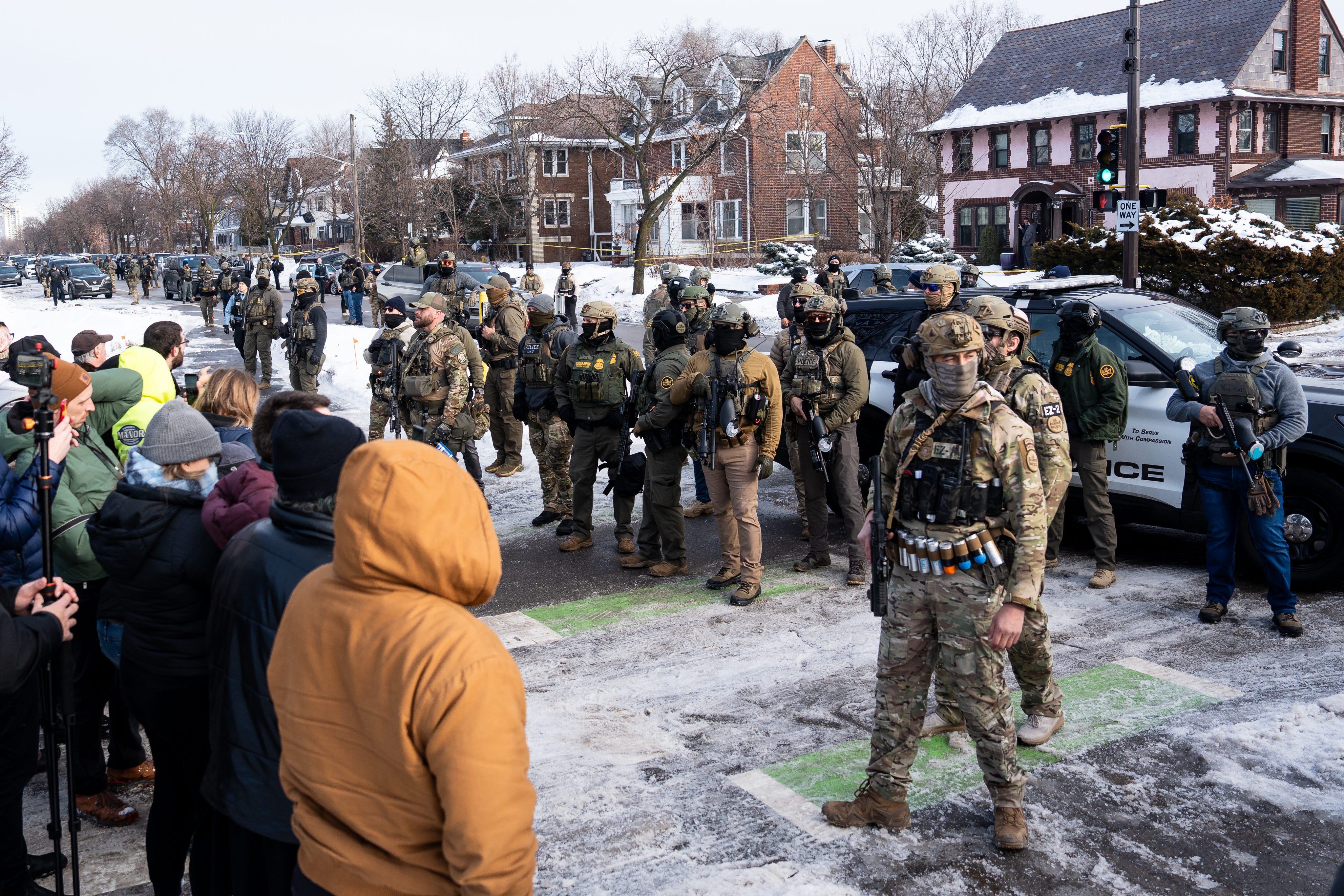
Imagine it is October 2028. The presidential election is weeks away. Political tensions are high. No Kings demonstrations and other protests are drawing large crowds in major cities. The president says crime is threatening public safety, demonstrations could become dangerous, immigration laws must be enforced, or federal buildings need protection.
National Guard troops are mobilized. Military vehicles appear downtown. Armed troops are stationed near government buildings, transportation centers and demonstrations. Federal immigration agents are operating in the same communities. Then comes Election Day.
Could this happen? I don’t know. More importantly, I have seen no evidence that President Trump or his administration has a plan to deploy military forces to major cities during the 2028 presidential election. We should not turn speculation into accusation. But neither should we ignore what has already happened.
During Trump’s second term, his administration has deployed or attempted to deploy National Guard personnel in several American cities. In Los Angeles, it went further, deploying about 4,000 National Guard troops and approximately 700 active-duty Marines in response to protests surrounding immigration enforcement. The deployment was opposed by California officials and became the subject of prolonged litigation.
Washington, D.C., provides the most important model. What began in August 2025 as a response to a declared crime emergency has now been extended through January 20, 2029. Unless the policy changes, troops will remain in the nation’s capital through the 2026 midterms and the 2028 presidential election.
But something else has happened that may matter just as much: the federal government has learned how to do this.
During the first year of the Washington mission, nearly 9,700 Guard personnel from more than 20 states and territories reportedly rotated through the capital. Many participating states were Republican-led. That does not mean those governors or Guard members would participate in anything improper. There is no evidence they would. Guard members take an oath to the Constitution and overwhelmingly perform their duties professionally.
But thousands of troops and their commanders have now gained experience in sustained domestic security operations. Governors and state headquarters have experience mobilizing them. The Pentagon and federal agencies have experience coordinating them. The transportation, housing, logistics and command mechanisms have been exercised.
The first time government does something extraordinary, it must build the machinery. The next time, the machinery is already there.
Crime and Protest
That matters because two justifications for deploying federal forces—crime and civil disorder—could easily arise during an election year. Trump has repeatedly emphasized crime in American cities. He has also sharply criticized No Kings demonstrations opposing his administration. The movement has demonstrated an extraordinary ability to mobilize people, with thousands of events held around the country.
Now imagine similar demonstrations during the 2028 campaign. They could be overwhelmingly peaceful. But scattered violence, property damage, confrontations involving immigration enforcement, or threats against federal property could provide an administration with an argument for federal intervention.
We have already seen a version of this. In Los Angeles, protests surrounding immigration enforcement were followed by the federalization of National Guard forces and eventually the deployment of active-duty Marines despite objections from California officials.
So, the question is no longer whether an American president could use military forces in response to demonstrations in an American city. It has happened. The question is whether doing it repeatedly makes the extraordinary increasingly ordinary.
Then There Is ICE
ICE adds another dimension. The administration has dramatically expanded federal immigration enforcement and encouraged greater state and local participation in it. At the same time, questions have arisen about whether federal agents could be present at or near polling locations.
A DHS election official said earlier this year that ICE agents would not be stationed at polling places during the 2026 election. That was reassuring. But administration officials subsequently declined to categorically rule out federal agents at polling locations when questioned about the issue. Election officials and voting-rights organizations have consequently been preparing for that possibility.
Federal immigration personnel have also become involved in investigations related to alleged noncitizen voting. Again, none of this proves that ICE agents will be used at polling places in 2028. It certainly does not prove that National Guard troops and ICE agents are part of some coordinated election plan.
But that is not the point. The point is that responsibilities and powers traditionally exercised primarily by states and local communities are increasingly intersecting with federal law-enforcement, immigration and military authority. That deserves attention before an election, not afterward.
They Don’t Have to Enter the Polls
The concern is not limited to what happens inside a polling place. Imagine armed Guard troops at train stations, government buildings and downtown intersections, ICE or other federal agents operating nearby, and large demonstrations and counterdemonstrations occurring at the same time.
Some citizens might feel safer. Others might feel intimidated. Either reaction matters.
Military personnel would not have to touch a ballot, enter a polling place or tell anyone how to vote to change the civic atmosphere surrounding an election. Elections depend on more than counting ballots accurately. Citizens must be confident they can assemble, speak, demonstrate, campaign, travel and vote without improper government pressure.
Soldiers also communicate something different from police officers. The military is trained to secure areas, protect facilities, control access, deter threats and demonstrate authority. Those are necessary functions in war and sometimes during genuine domestic emergencies.
But visible military authority in an American city during a bitter presidential election could acquire political meaning regardless of what individual soldiers intended. That would be unfair to the troops as well as dangerous for the country.
If Crime Is the Problem, Hire Police
There is a simpler solution if urban crime really is the problem: hire more police.
That makes the administration’s funding choices especially important. In its FY2026 budget, the administration proposed reducing Justice Department state and local grant programs from about $3.45 billion to $2.63 billion—a reduction of approximately $823 million, or nearly 24 percent. It also terminated hundreds of previously awarded public-safety grants, although many supported victim services, violence prevention, research and other programs rather than police salaries.
The administration also redirected homeland-security funding in ways that produced large reductions for several Democratic-led jurisdictions. At the same time, Washington has dramatically increased resources for immigration enforcement and offered new law-enforcement funding tied more closely to federal priorities.
To be fair, the administration has not simply stopped supporting local police. In 2026, DOJ announced nearly $700 million in COPS grant opportunities, including up to $158 million specifically for hiring and retaining sworn law-enforcement officers. It also created a nearly $300 million Model Cities Initiative for selected communities willing to participate in a federally defined crime-reduction strategy.
That makes the real issue clearer. This is not simply about whether Washington spends money on public safety. It raises three more important questions: Who controls the money? Who controls the officers? What mission are they being given?
If crime is the problem, civilian police are better suited to solve it. Police investigate crimes, make arrests, interview witnesses, collect evidence, build cases and work with prosecutors, courts, victims and neighborhoods. A Guardsman standing on a street corner cannot replace a homicide detective, an officer responding to domestic violence or a neighborhood officer who knows the community.
Police also provide something neither the Guard nor ICE can provide: local accountability. A local police chief answers through civilian government to the community. Citizens can attend meetings, challenge policies, demand changes and vote local leaders out of office. ICE agents answer to Washington. Federally controlled National Guard forces answer through a military chain of command.
Those differences matter. If Washington genuinely believes American cities need more police, Congress can provide grants for officers, detectives, forensic specialists, dispatchers, mental-health crisis personnel and other civilian public-safety professionals. That would address crime while strengthening rather than bypassing local government.
Picture It in Fredericksburg
Now bring all this home. Imagine National Guard troops at the Fredericksburg train station, along Princess Anne and Caroline streets, outside City Hall, near Central Park and around the University of Mary Washington. If crime were the problem, would we prefer those soldiers—or additional Fredericksburg police officers accountable to our community?
Now change one fact. It is October 2028. The presidential election is approaching. Large demonstrations are occurring around the country. Immigration enforcement has produced protests. Political tensions are high. The president says additional federal forces are necessary to maintain order.
Would we view their presence differently?
That is why the time to ask these questions is now. I am not predicting that Trump will deploy troops to major American cities during the 2028 election. I have seen no evidence of such a plan. But we know what has already occurred.
Military forces have been deployed in American cities. Active-duty Marines have been used domestically. Thousands of Guardsmen from more than 20 states and territories have gained experience in sustained domestic security operations. Washington’s deployment is scheduled to continue through the next presidential election. Immigration enforcement has expanded dramatically. And federal public-safety money is increasingly being used to advance federal priorities.
None of those facts tells us what will happen in 2028. Together, however, they tell us what could happen.
That is why this is ultimately not just a Trump question. It is a question about the kind of government we want to leave behind after Trump.
If crime is the problem, hire police. If demonstrations are peaceful, protect the constitutional right to protest. If a genuine emergency occurs, use the National Guard for the extraordinary mission for which it exists. And keep elections primarily where the Constitution and our traditions have placed them: in the hands of states, local governments and civilian election officials.
Because once we build the capability, establish the precedent and become accustomed to federal forces on American streets, the question changes.
It is no longer, Could it happen here?
It becomes:
Under what circumstances will we allow it to happen again—and what if the next time is an election?
***
Phil Huber is a retired Army Reserve colonel, federal civil servant and consultant who writes on civic education. He lives in Fredericksburg.

Well, during the Biden administration, we normalized the entry into our country of many millions of illegal aliens. So here we are. Actions and reactions.
Phil, get some professional help for that TDS. Your imagination is overloaded.