
By Ranjit Singh
ADVANCE COLUMNIST
Every mob hitman knows at least one environmental fact: If you throw something into the woods or river, it exits the human world.
My key ring holds a tiny key I pulled from the ignition of a 1949 Ford pickup I found abandoned with a couple other rusty vehicles in the woods near my house. Enveloped by cedars, and with bramble and vines growing up through its floorboard, the Ford is lost to the world for most of the year. The surrounding forest is littered with antique stoves, broken washing machines, and other objects no one wanted to pay to get rid of.
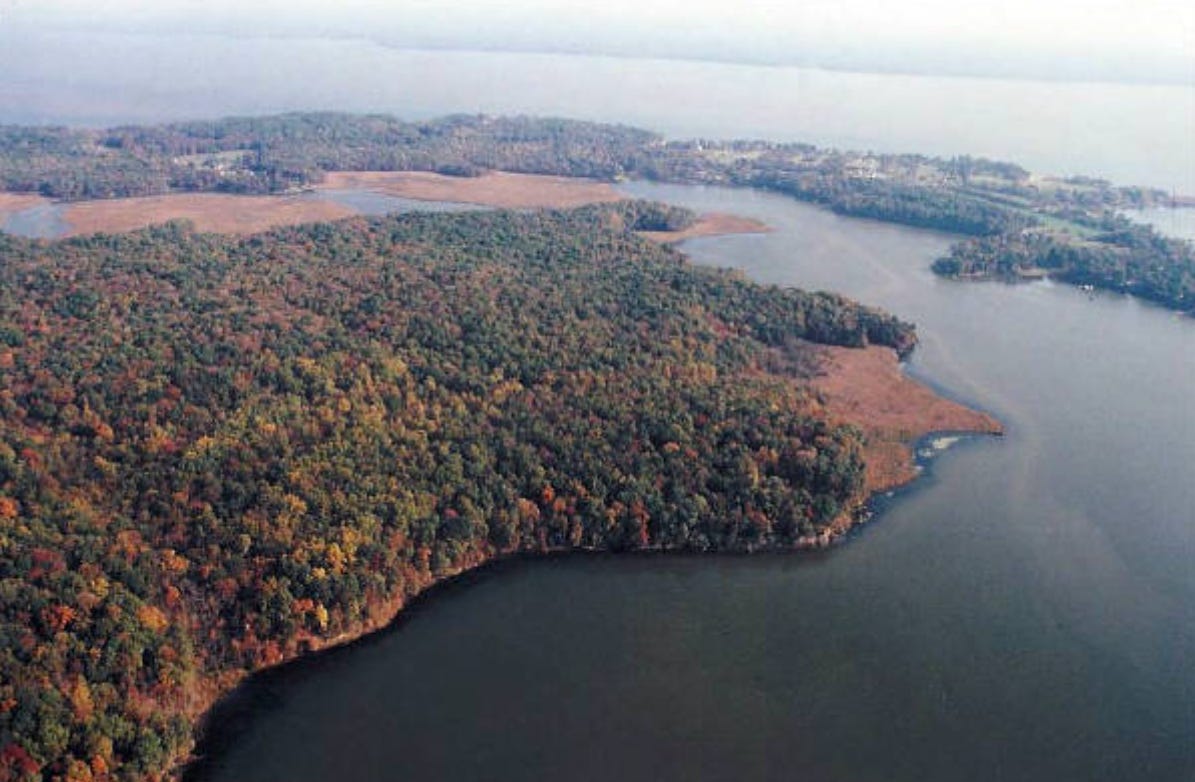
Similarly, Potomac Creek is full of tires, clothes, plastic bags, abandoned crab pots and fishing nets, soda bottles, COVID masks, and anything else that people can leave behind, throw out, or let blow into a substantial body of water. A good low tide is an adventure. You might see plastic oil bottles, a shoe or hat, maybe even an outboard motor like the one that fell off our sailboat when I was a kid. Moving upstream through Crow’s Nest Natural Area Preserve towards Brooke Road, the creek’s flow is much disturbed by bridges, roadwork, a dam, and the wide, clear-cut easements of the Dominion Energy company’s powerlines.
The Fredericksburg and Stafford County regional landfill is perched atop the creek’s wetlands. In dry spells, clouds of contaminating dust kick up and are deposited downwind. Conversely, downpours of rain flood the creek with pesticides and fertilizers from local lawns. The creek recently caught a break when locals stymied a politician’s plan to build a commercial tire incinerator at the landfill (the same guy had posted “WANTED” ads for local beavers, accusing them of harming the habitat). The creek lost out, though, decades ago, when a heating oil truck crashed into an unnamed stream that feeds into Potomac Creek and crosses our place, the Unicorn Farm. The truck released its entire toxic load into the marshes. Farther up, the creek—now just a brook—flows under the greasy gauntlets of the Route 1 and I-95 bridges, catching the colorful detritus of passing trucks and vacationers.
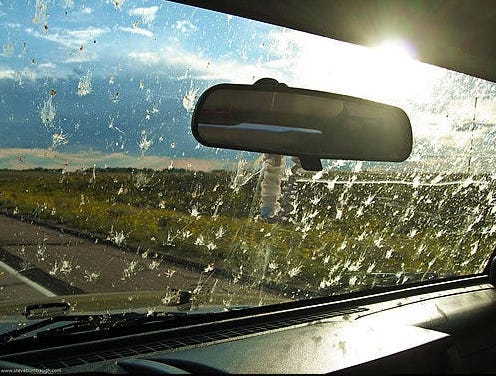
This trashing started during the colonial era. Yet up until just a few decades ago, a summer night’s drive along Brooke Road, which crosses the creek by our farm, still produced a windshield covered with splatted bugs of impressive diversity. The humid marshland offered up species like a febrile Jackson Pollock. By morning colorful moths of many kinds, damselflies, and green dragonflies were encrusted indiscriminately together, impossible to remove by wiper and fluid alone.
Some nights my car’s low beams revealed an incalculable number of green frogs crossing the road, all pointed in the same direction. It was awful to drive through their zombie-like procession. In the morning, frog slime covered the asphalt. But the amphibians would be back again the next night.
That unavoidable slaughter, a visceral indicator of biological plenty, is now gone. My windshield is clean. (Today, some call this the “windshield phenomenon.”) The World Wildlife Fund reports that 73 percent of the world’s mammals, birds, fish, and reptiles average populations have disappeared since 1970. We need look no further than Potomac Creek to believe it.
How can anyone comprehend or place value on so much lost life?
Nearly all the flowing waters in our region are sicker than they look. They’ve been that way for years. The causes are no mystery, and concerned scientists and activists have offered no shortage of specific courses of action.
In 2026 alone, the Rappahannock River at Fredericksburg suffered a massive spill of human waste, and the neighboring Potomac River witnessed an exponentially greater one. Author pic.
Decades ago, the stern environmentalist poet Robinson Jeffers chided, “It seems time our race began to think as an adult does, rather than like an egocentric baby or insane person.”
Jeffers’ frustration is understandable, but I think he’s wrong. I’m beginning to suspect that the hardest environmental choice we face is a metaphysical one, and that the real trick to reviving Potomac Creek is not to think like an adult at all.
Let’s recall, for example, a time when much of that missing life I described earlier was still around.
For those of us who grew up during the Cold War, proximity to Washington, D.C. meant we lived within the blast radius of more than one Soviet nuclear weapon.
The official advice in case of nuclear war was to stay inside and listen to the radio. Public libraries had radioactivity fallout shelters marked by unmistakable black and yellow signs—three downwards triangles within a circle—and, presumably, stocked with crackers.
Military experts discussed missile payloads and throw-weights. Adults calculated over dinner how many communist Russians and Chinese each American soldier would have to kill to reach parity on an apocalyptic battlefield. On TV, more than 100 million people watched The Day After, a 1983 film largely about family farms like ours, caught in a barren, post-nuclear strike America.
Responsible people seemed more willing to prepare for wholesale slaughter than to stop it from happening.
My immature self looked for a way to cope. How does one manage the thought of everyone they know dying all at once, probably without warning? How did you do it, if you’re old enough to remember those days?
Literary scholar David Copland Morris argues that when humanity sees itself as the sole source of values, it “removes the ground for value.” Similarly, I found solace in reimagining Earth as a place where human affairs were not all-important. It was warming to think we weren’t really alone here, and that in our absence life would bring continuity even to a grievously wounded planet. Bad things happen and the band plays on. I roundly embraced this child’s realism. Popular astronomer Carl Sagan lent a cosmic assist here; his true gift wasn’t just providing wonder at the immensity of the universe, but hope, rooted in a mind-bending yet unassailably real perspective. Later, in college and afterward, I learned others, too, were finding comfort in valuing life beyond our own species.
Angsty kids often discover that the spotlight (metaphysical or otherwise) isn’t all that liberating. I see it with my oldest son now. In school plays he always chose to work off-stage. A teenager beset by a pandemic, mass shootings, racial strife, and climate change, he adores astronomy and geology, and even penned a letter to popular physicist Neil deGrasse Tyson. He hikes, fishes, observes nature closely, and largely shuns human-centered news.
Of course, in other ways he is a focal point of the universe—our universe, anyway—like any much-loved kid. But there’s sadness there, too. I see him struggling to balance a terrifying reality with the need to do something about it. Perhaps he mourns a world of life he’s never known, and never will.
A global survey found that more than half of young people are experiencing “climate anxiety.” Today, even billionaires want to run to Mars.
Wish them Godspeed.
Maybe the first step to sanity is learning to act effectively from the wings, not center stage. Check your self-importance and not all bad things need to happen.
***
Ranjit Singh teaches in the Department of Political Science and International Affairs at the University of Mary Washington. He’s also an active environmentalist. His “No Lines in Nature” Substack blends history, science, and philosophy to explore our relationship with the natural world world. You can find it HERE. This essay is excerpted from a longer work in progress.
Vonnegut: Dear future generations, forgive us. We were roaring drunk on petroleum.
Add the state of Maryland to the Offender's List.