
By Phil Huber, ADVANCE COLUMNIST
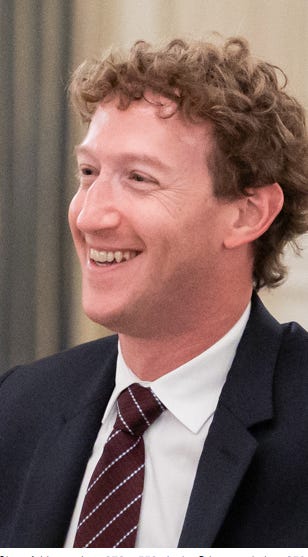
Mark Zuckerberg’s new essay, published in many national newspapers, promises that artificial intelligence will be “for everyone.” He says Meta will release more open-weight AI models, involve its board more deeply in safety decisions, and establish a $1 billion fund for communities hosting Meta data centers. Those are, on their face, generous offers.
But generosity is not governance. It is not accountability. And it is not democracy.
Run each offer through a simple test: who benefits if you stop reading right there, what dollar figure or decision gets named once and never explained. What the offer is aimed at, while your attention sits on the applause line, is the dagger behind the shiny star.
“Putting power in people’s hands” casts criticism of Meta as an attack on individual freedom rather than scrutiny of a trillion-dollar strategy. But open weights don’t hand people the compute, data pipelines, or distribution networks that determine who actually benefits. Meta keeps all three. The company gets credit for openness while keeping the infrastructure that makes openness meaningful—or meaningless.
“Meta’s board will have more say over safety” sounds like accountability. But Zuckerberg holds majority voting control over that board. A founder who can overrule his own oversight isn’t describing a check on his authority. He’s describing optics.
And the $1 billion community fund—the offer most likely to reassure Fredericksburg-area readers—is real money, announced the same week New York moved to ban new data-center construction. But the essay never says what the fund covers, who decides distribution, or what obligations attach. A dollar figure with no governance attached isn’t a policy. It’s a headline timed to a bad news cycle.
None of this means Zuckerberg is lying. It means a corporation deciding unilaterally what to offer, while readers stop at the offer instead of asking what stands behind it, is a pattern worth naming.
THE REAL DANGER, AND THE REAL DIAGNOSIS
Zuckerberg is right about one central fact: the greatest danger from artificial intelligence is the concentration of extraordinary power in too few hands. AI can shape what people see and believe, generate convincing falsehoods at scale, target voters, enable surveillance, carry out cyberattacks, and make opaque decisions affecting employment, housing, health care, policing, and national security.
The problem is that Zuckerberg is not outside that danger warning us about it. He is one of the people at its center.
No CEO—not Zuckerberg, not Sam Altman, not Elon Musk, and not the next technology billionaire—should sit in the Greek gods’ chair, deciding which powers society receives, which risks it must accept, and which rules apply. Nor should government occupy that chair unchecked. No person, corporation, agency, or nation should exercise such unaccountable control.
That is why in an earlier column for The Advance—”Before We Build AI Gods, We Need AI Rules”—I proposed an “AI FAA.”
The Federal Aviation Administration did not ban flying because aircraft can fail. It built a public safety system around aviation: standards proportionate to risk, independent certification, reporting of incidents, investigation, enforceable rules, and the authority to ground unsafe aircraft. The same basic structure is needed for artificial intelligence.
Low-risk AI—tools that summarize documents, schedule appointments, or translate languages—should remain broadly available under existing consumer-protection, civil-rights, and antitrust laws.
But high-risk systems are different. AI used in elections, critical infrastructure, health care, employment, housing, law enforcement, surveillance, cybersecurity, military operations, or autonomous weapons should face stronger safeguards before widespread deployment: independent testing, public documentation, mandatory reporting of serious incidents, meaningful human responsibility, and government authority to intervene before predictable harm becomes a catastrophe.
Meta’s announcements provide none of that. A board appointed within Meta is not an independent public regulator. A voluntary company standard is not enforceable law. A community fund, however welcome, is not a binding agreement protecting residents from power demands, water use, traffic, noise, land-use conflicts, or rising utility costs. Open-weight models may distribute access, but they don’t eliminate the risks of misuse, cybercrime, election interference, or unaccountable decision-making—the daggers the shiny stars were never built to show you.
THIS IS NOT AN ABSTRACT DEBATE
Fredericksburg-area residents understand the distinction. Data centers are no longer an abstract Silicon Valley issue. They are rising around us in Stafford, Spotsylvania, and the City of Fredericksburg, requiring large amounts of land, power, water, roads, and public services. The City has announced a potential $10 billion data-center agreement, while Vantage has announced a $2 billion investment and 782 megawatts of planned capacity in the region.
These facilities may bring jobs and tax revenue. They also impose costs that do not stay inside the corporate fence line. Residents should not have to choose between reflexively opposing every project and accepting whatever a global corporation offers. They deserve enforceable rights, reliable information, and a genuine voice before—not after—decisions are made.
That is why an AI FAA must be a layered public system, not another federal office in Washington.
Congress must set the national floor: strong rules for high-risk AI, protection for elections and critical infrastructure, independent safety testing, incident disclosure, and clear authority to act when systems threaten public safety or national security. No state should defend itself alone against a nationwide or global cyber threat.
But federal authority must not become corporate preemption in another form. Virginia must retain authority to enforce civil-rights, consumer-protection, privacy, workforce, and environmental laws. Localities must retain authority over zoning, water, electricity, roads, emergency services, disclosure, taxation, and community-benefit agreements.
Put simply, federal government should regulate what threatens the nation; state and local government should regulate what affects the people and places they serve. The company building the technology should not decide where one responsibility ends and the other begins.
Zuckerberg’s $1 billion fund may help some communities, but its premise is backward. A corporation should not decide unilaterally which communities deserve compensation, how much they receive, or what obligations accompany the money. Public costs require public decisions—transmission lines, generation capacity, water infrastructure, road upgrades, emergency-services support—negotiated openly through accountable government, not granted at a company’s discretion.
The same principle applies to AI itself. Americans don’t need a government that bans every new technology out of fear. We need government capable of distinguishing low-risk innovation from systems that can cause widespread harm. That is what aviation regulators learned long ago: we permit flight, but not without rules; we encourage innovation, but not without accountability. Artificial intelligence deserves no less.
The question is not whether Zuckerberg is sincere. The question is whether good intentions, corporate boards, voluntary standards, and philanthropic funds can substitute for democratic authority. They cannot. The test is simple: What problem did the announcement solve? If the answer is “a bad news cycle,” you were looking at a shiny star, not a solution.
The future will not belong “to everyone” merely because one of the most powerful men in technology says it will. It will belong to everyone only if citizens insist that the power being created is governed by rules made in public, enforced in public, and accountable to the public.
Fredericksburg-area voters should demand that Congress build an AI FAA like organization. They should demand that Virginia preserve and strengthen its ability to regulate technology’s effects on its people. And they should demand that local officials use every lawful tool available to ensure that communities hosting AI infrastructure receive enforceable protections—not simply promises.
No one should be permitted to sit in the Greek gods’ chair. Not a corporation. Not a president. Not Congress. Not a technology billionaire.
That is not hostility to innovation. It is the condition for innovation to remain compatible with democracy.
***
Phil Huber is a retired Army Reserve colonel, federal civil servant and consultant who writes on civic education. He lives in Fredericksburg.

A strategic view and policy statement filling a void.
I don't see Zuckerberg as making a final offer but rather adding to the ongoing discussion. Even had he promised to do everything suggested, it would be rightly not believed especially coming from one guy in a world of many players. And I have to say, when it comes to technology, government is notoriously slow to "get it" ahead of time and almost always reacts. And no, we're not going to stop it by opposing data centers! ;-)