
By Phil Huber
ADVANCE CONTRIBUTOR
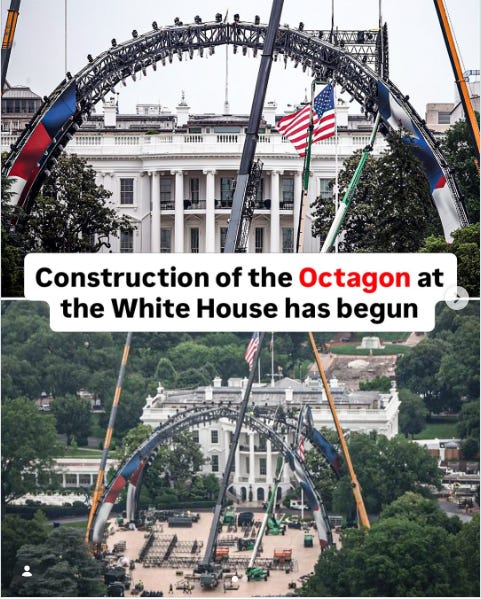
Donald Trump’s plan to stage a UFC fight on the White House lawn on June 14 is more than a stunt. It is a warning. When a president turns the People’s House into an arena for spectacle, profit, and personal branding, politics stops looking like public service and starts looking like a pay‑per‑view.
Virginians should care, because a Washington‑based public‑interest law firm, the Public Integrity Project, has filed a federal lawsuit on behalf of two Virginia residents to stop the event in federal court. Their case is not about whether anyone likes mixed martial arts. It is about whether public property, public symbolism, and presidential power can be bent into a made‑for‑television promotion for political allies and possibly for the president himself.
The picture is on the nose. A massive steel arch now looms over the South Lawn, dwarfing the White House. Crews are building an arena to hold thousands, with an even larger “fan fest” on the Ellipse for tens of thousands more. The event is branded “UFC Freedom 250,” timed to the 250th anniversary of American independence and scheduled on Trump’s 80th birthday so he can stand at the center of the celebration.
And it does not stop at the South Lawn. Promotional plans call for weigh‑ins and a press event at the Lincoln Memorial—turning one of the nation’s most solemn monuments, a shrine to the end of slavery and the unfinished work of equality, into a backdrop for fight hype and stare downs. Trump’s “beautification” project has even turned the Lincoln Memorial Reflecting Pool “American flag blue,” conveniently doubling as set design for the broadcast.
In Rome, rulers understood the value of grand public entertainments. Juvenal, a Roman satirical poet from the later First Century CE, gave the formula a name that has survived for two millennia: bread and circuses—using diversion and spectacle to secure public approval instead of practicing serious civic life. Turning the South Lawn and the Lincoln Memorial into a fight campus for a pay‑per‑view production is bread and circuses with better lighting.
This is not just tacky. It is corrupt in spirit, and in law. UFC’s parent company and event backers expect the show to be enormously lucrative, with global broadcast rights, sponsorships, and premium ticket packages priced in the six and seven figures. Reporting has raised questions about Trump’s personal financial interest in the company’s stock and the role of corporate sponsors with business before his administration. When a sitting president helps design and promote an event that may enrich his private associates—and potentially himself—on public land, the line between public duty and private gain is not blurred. It is crossed. At the same time, guidance from the Pentagon shows commanders recruiting hand‑picked troops as a backdrop for the show, offering free tickets only to those who meet strict body‑composition standards and requiring them to pay their own way to Washington.
Federal law and ethics rules exist for exactly this reason. Statutes and regulations limit commercial exploitation of national park lands, restrict using public resources for partisan or personal purposes, and bar officials from using their position to benefit themselves or their businesses. The lawsuit filed by Virginians and an anti‑corruption group argues that the White House fight project dodged required approvals and environmental review, violated National Park Service rules, and effectively turned the South Lawn into a private arena. Those claims will be sorted out in court. But the larger democratic damage is already in plain sight.
Trump understands, better than most politicians, that spectacle can substitute for governing. Keep the cameras rolling. Keep supporters entertained. Keep opponents outraged. Keep everyone talking about the event, the visuals, the personalities, the ticket prices, the gate. The show becomes the message. The attention becomes the victory.
That is the real bread‑and‑circuses trap. It trains citizens to become fans. Fans pick sides, boo on cue, and measure success by whether their champion dominates the highlight reel. The message to the ranks is just as clear: if you look at the part and help fill out the crowd shot, you might get a seat at the games—if you can afford the trip. Citizens do something harder. Citizens ask who benefits, who pays, what precedent is being set, and what happens to republican government when public office and public places are used as props for a ruler’s birthday party.
Virginia has its own stake in resisting that drift. This commonwealth sits in the long shadow of the federal government. Virginians know that institutions matter because so many families here serve them, work in them, and depend on their integrity. When the White House lawn and the Lincoln Memorial are repurposed as a two‑day fight festival to celebrate a president’s birthday and his favorite promoter’s business, that is not just Washington absurdity. It is another lesson in how quickly public institutions can be hollowed out when politics is reduced to theater.
If the president insists on keeping a cage on the South Lawn, there is only one exception the country should entertain: he can keep it only if he climbs in himself and fights for the presidency. The very fact that this sounds absurd is a reminder that the presidency is not supposed to be a gladiator title, and the White House is not supposed to be a permanent arena.
There is nothing wrong with sports, and nothing wrong with political leaders enjoying them. But there is something deeply wrong with using the presidency itself as a promoter’s backdrop and the nation’s 250th anniversary as a marketing hook. A republic preparing to celebrate its quarter‑millennium should not be imitating the Roman emperors. It should be proving that self‑government still means something more than spectacle, profit, and the crowd’s roar.
***
Phil Huber is a retired U.S. Army colonel, former civil servant and consultant who now devotes his retirement to promoting civic education and appreciation. He served in Bosnia and elsewhere in Europe, and his many visits to Italy—including the Colosseum—inform his perspective on how republics rise and fall.
Once again, thank you, Colonel.
I too had noted the Lincoln Memorial issue. Surprised so few others have.
As galling as Trump's wanton destruction of the White House has been, still - it has precedent.
By its nature, there is a known duality in that house's purpose.
If America chooses a guy with morals unfit for a trailer park and gives him the keys to the People's house; we can't be surprised when he proceeds to make that home into a crass trailer park reject.
Because as obnoxious as it is - it reflects both him and the people who chose him.
So be it.
But the Memorial was special.
As is who it memorialized.
In our Pantheon of leaders, where could be more solemn, more special, than the place built to remember the President who gave his life for our most core ideals?
Our dreams?
Held in trust by him until the last full measure of devotion?
A truth more tragic than any tale.
Never to enjoy what was purchased, nor savor a laurel's rest.
If it hadn't of happened, we would have had to've created it.
For us.
People need a purpose, a reason, a belief.
And we had one.
Until now.
Defiled, debased, degraded.
To be nothing more than the backdrop of a paid performer starving himself to perform for our would-be king's games to glorify himself.
An irrational amoral felon raised up by self-serving billionaires as an emperor of old in what was once a proud Republic.
I wonder how Suetonius would describe him? Swimming with Tiberius's little fishes? Seems apt.
Though I see now that there are some who will never see it.
Who cannot. A note too clear. An ideal too pure.
But Lincoln did give his life. Or rather had it taken.
And we do remember. Or at least we used to.
Can we eve n know how much have we built upon that blood spilled, that spark extinguished?
How has that shaped us?
Our beliefs, our lives.
In ways both big and small.
What can't we do, if we only believe?
What can we do, if we do not?
Looks like we'll finding out, as we once again debase ourselves and fall further into the abyss of Republicanism.
When Jimmy Stewart is having his crisis of faith its not the Garden of Gethsemane where he finds his strength. But in the closest thing that America has. Hard to believe its been almost a century since Capra had that vision.
The ideal the Reflecting Pool was built to make us reflect.
In the last 10 years, we've seen feces smeared on our Capitol by them.
The White House destroyed without so much as a "by your leave", much less respect for laws that they had foresworn to be defend.
Now they demand an arch to celebrate themselves whilst mocking and blocking the cemetery of our Nation's fallen.
So I guess they HAVE to defile the Lincoln. Just to show they can.
I can only assume the Tomb of the Unknown was too far away for porta-potties. I guess we gotta save something for after the midterms.....
Unparallelled corruption, suppression, entitlement that would put the maddest tyrant to shame.
If there's speck of decency left in this country this plague has not defiled, its only because they haven't thought of it yet.
I guess, in that light, this monument MUST be insulted.
Kinda surprising it took them so long.
Couldn’t write about this one straight, so I wrote it sideways: the suburban street, and the neighbor who turns the nicest house on the block into a fight cage one permit at a time, until you realize the house was never his and you let him have it. Short fiction — every detail in it is real, just moved to a street where you can see it.
https://rossboulton1.substack.com/p/there-goes-the-neighborhood?r=2leuaj&utm_medium=ios