Bruce Saller, ADVANCE CONTRIBUTOR
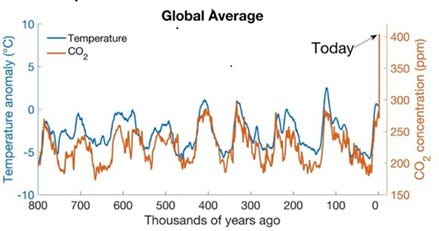
Does a warming earth increase atmospheric carbon dioxide, or does carbon dioxide cause increasing temperatures? For millions of years the earth has gone through warm and cold periods mainly driven by three variations in the earth’s orbit known as the Milankovitch cycles:
Eccentricity—how much the elliptical path is stretched from circular
Obliquity—changes in the tilt of the earth’s axis
Precession—changes in the direction of the earth’s axis of rotation
Scientists have been able to accurately measure the earth’s temperature and the atmospheric carbon dioxide during the last 800,000 years from Antarctic ice cores and plant fossils. The graph above shows the comparison.
There are two reasons why temperature changes normally lead to carbon dioxide changes:
1. As the oceans warm, they release carbon dioxide.
2. As the permafrost melts, microbes break down the previously frozen organic material resulting in carbon dioxide and methane being released.
So, under normal conditions, rising temperature causes an increase in atmospheric carbon dioxide. But this does not mean that increased carbon dioxide does not cause an increase in temperature. In 1856, scientist Eunice Foote placed glass containers of various gases in the sun and found that carbon dioxide heated up the most and retained its heat the longest.
In 1896, scientist Svante Arrhenius hypothesized that certain wavelengths of light caused carbon dioxide molecules to vibrate, generating the heat. This theory was refined for decades until 2024 when the final piece of the puzzle (why carbon dioxide is so good at trapping heat) was explained. Carbon dioxide also absorbs some of the light being reflected from the earth and re-directs it back towards earth, generating additional heat.
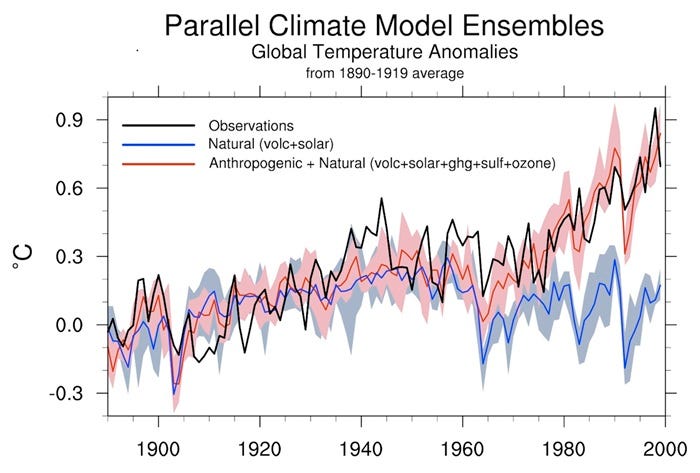
Based on where the earth is in the Milankovitch cycles, the temperature should be slowly decreasing, but instead it is rising rapidly as seen in this graph:
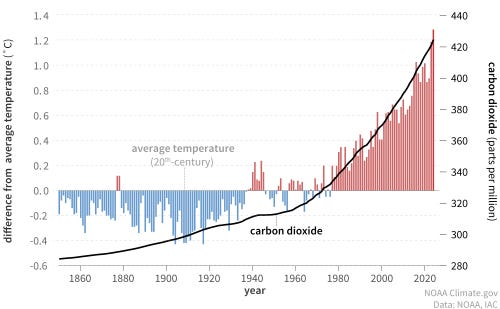
The following graph shows how the global temperature has followed the rise in carbon dioxide since 1850.
Keith Isaacs/US Department of Veterans AffairsU.S. carbon dioxide emissions had been declining since 2004, mainly due to the closure of coal power plants and the addition of renewable energy generation. Carbon dioxide emissions increased in 2025 and are projected to be basically flat through 2027 with new clean energy generation being offset by increased natural gas usage for data centers.
The current super el Nino could cause this year to be the hottest ever, and 2027 is expected to be even hotter. The higher global temperatures cause stronger storms, more wildfires, and higher sea levels, resulting in more extensive damage.
The world has already exceeded the Paris Accord limit of a 2.7 degree increase. Please do what you can to reduce our carbon footprint to help prevent more serious damage to the environment.
***
Bruce Saller is a retired systems engineer with degrees in electrical engineering and computer science.