By James Noll, ADVANCE CONTRIBUTOR
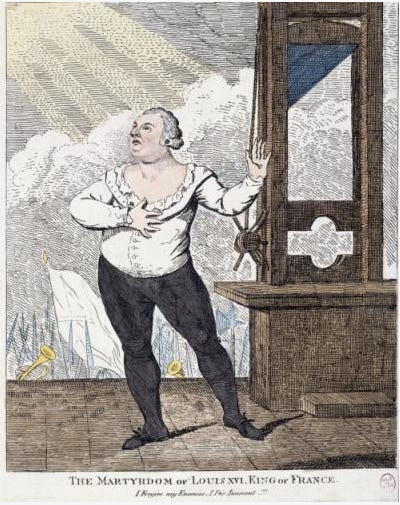
Of the many illustrious mob events throughout history—The Dancing Plague of 1518, The Corpse Riot of 1788, The French Revolution, The Straw Hat Riot of 1922, The Tanganyika Laughter Epidemic of 1962, The Disco Demolition of 1979—my favorite is the one going on right now: The Great Internet Anti-AI Mob of 2026.
I love watching these brave, intrepid souls confronting The Guilty from behind the safety of their computer screens, expertly copying and pasting fishy prose into AI-run AI detectors to root out the base and ignoble, and expose them for what they really are: Prevaricatious filth.
Scarlet Quinn. Mia Ballard. Jerry Falade.
Each of these writers has been embroiled in one kind of AI scandal or another of late, and each has suffered the career-crushing weight of the digital pile-on.
Quinn deserves the backlash. She left a prompt response from the AI tool she used to write her book The Lines We Do Not Cross IN THE MANUSCRIPT, and it got printed.
The case against Ballard seemed fuzzy at first. Her novel Shy Girl, initially garnered rave reviews and a respectable score on Goodreads. But then passages were exposed by readers as AI slop, and her book deal got cancelled. Ballard claimed the passages were created by a friend who edited the book—which, okay. But didn’t she read at least a few of the offending edits herself?
Just in case she didn’t, I did, and I agree that the transgressive prose does indeed exhibit hallmarks of AI writing: An over-reliance of magic threes, confusing metaphors, and too many “It’s not X but Y” constructions. (One passage used the word “rot,” so lest I miss my chance to join my first mob, even if it isn’t as cool as corpse rioting (whatever that means), I’d like to pile on: ChatGPT loves to use the word “rot.” It loves “rot” a lot. Cancel the book! Burn the witch!)
Falade’s cancellation is the most questionable of the three. His publisher pulled his crime novel Call Me, I’ll Hide the Body due to suspicions about “how the manuscript evolved.” Falade contends that the doubts about his work were due to Yorùbá, his native language, and its common use of “It’s not X but Y” constructions. That and the AI he used. But only for research!
Snark aside, I agree with many of the arguments against using AI in creative work.
Anthropic and their ilk trained their products on stolen material. Even though Anthropic has somewhat settled the matter by paying affected parties $1.5 billion, it doesn’t settle their eggheadian attitude towards the arts and humanities. The written word only exists for them to exploit.
I know of no living writer who has thought, “Boy, am I glad guys like Sam Altman and Elon Musk are cashing in on our work. Maybe they’ll use their millions to undermine our democracy!”
Someone who uses Claude to pump out a story can no more call herself an author than someone who has mastered the complexities of the pocket calculator can call himself a mathematician.
However, that we should condemn authors who use AI as part of their writing process is murky thinking at best. Using AI to spellcheck or just employing a program that has AI baked into it seems easy to forgive. The thornier question is whether or using an LLM (that’s Large Language Model) for constructive feedback is acceptable. AI critics flat out say no. But is a note provided by AI less valuable than the same one from a human editor?
Some indie authors (and a few traditionally-published authors, too) don’t see the difference. If anything, those who use AI to help develop their work see it as a way of removing barriers and subverting snooty literary gatekeepers. If there is anything I was ever for, subverting literary snoots is it.
I do not mean only to antagonize AI critics. I listen to them and take their concerns seriously. But I do have a problem with the hypocrisy of the anti-AI mob. The writers and editors and the Internet Brave who are suddenly so concerned with tech bros taking human jobs most likely downloaded songs on Napster in 1999 and now probably pay for at least one music streaming subscription. Where was their outrage when their creative contemporaries in the music industry were displaced by Apple and Spotify algorithms?
I wonder how much of the music they love contains drums created with the push of a button, synthesizer parts created with a push of a button, vocals auto-tuned with the push of a button, and entire songs mixed and mastered with AI-driven plugins… with the push of a button? Aren’t humans supposed to be doing all of that without assistance? Why isn’t anybody calling out musicians for allowing their songs to be produced with AI?
Well, that’s different, an anti-AI crusader might say. Surely there’s a human behind it all, right? Flesh and bone and brain piloting the creative engine?
Yeah.
Kind of like it’s a part of their process.
***
James Noll is a writer, musician, and teacher. A tinnitus sufferer and mountebank aesthete, he lives in Fredericksburg where he spends most of his time napping and trying to avoid responsibility. Sometimes he goes to the gym. He shills his books online at www.silverhammerstudio.com