
By Ranjit Singh
ADVANCE ENVIRONMENTAL COLUMNIST
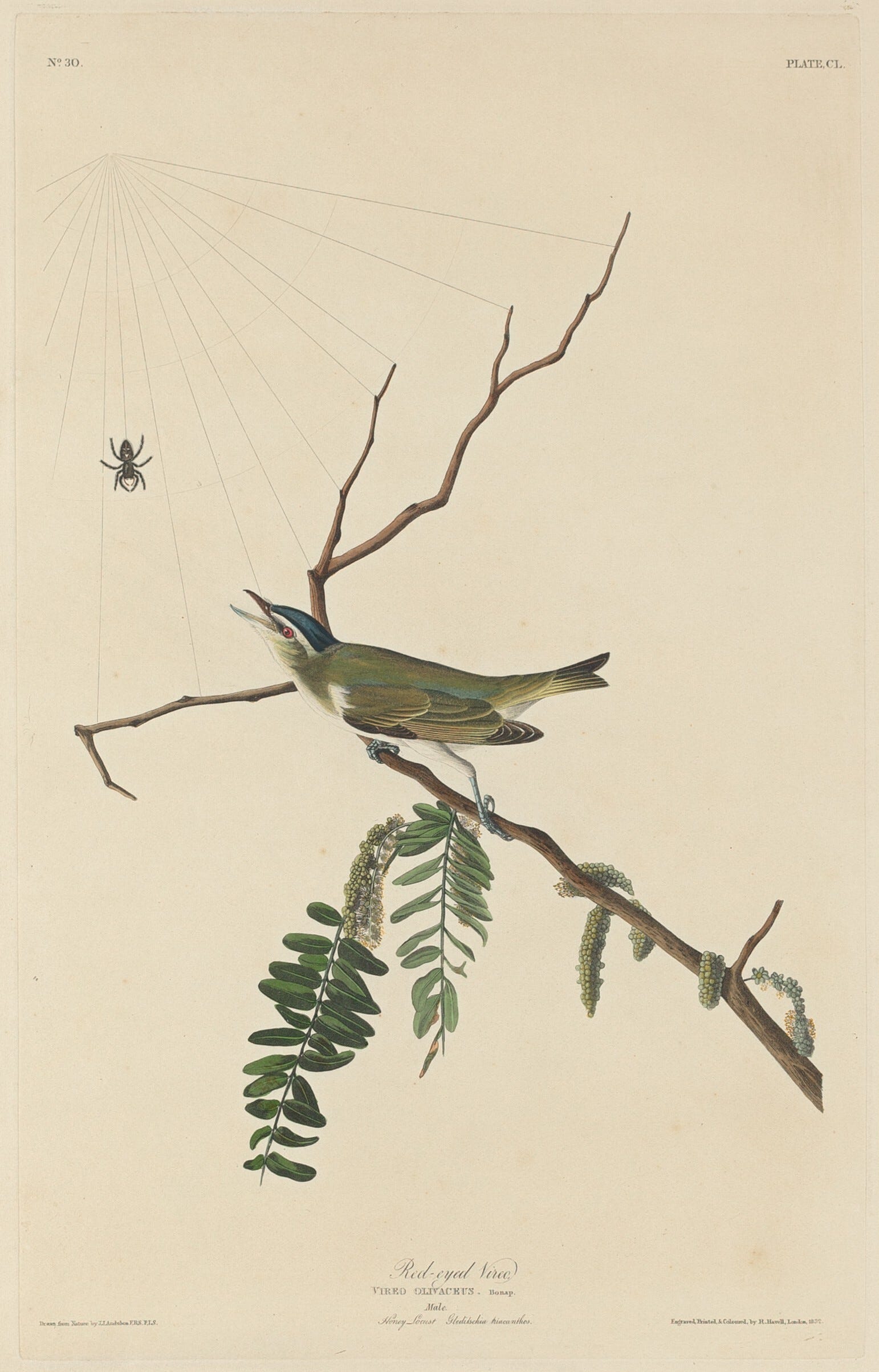
I spent weeks this winter learning about a little bird, and it’s led me to question how animals experience beauty.
It started when I asked an ornithologist friend what bird might be considered most emblematic of Potomac Creek, Virginia, site of our family farm. I expected him to say Great Blue Heron, or maybe Bald Eagle.
Instead, after a moment’s thought, he replied: “Red-eyed vireo.”
Off we go, down the rabbit hole!
Red-eyed vireos are regular summer residents of Potomac Creek. “Obligate” migrants, they arrive here each spring having traveled all the way from Amazonia. The long journey is incredibly stressful; many don’t make it.
Yet this ordeal alone doesn’t separate red-eyed vireos from the other migratory birds who come here. Warblers, flycatchers, osprey, and avians of many kinds, including the brilliant scarlet tanager, also undertake arduous spring and fall migrations, sometimes in the company of vireos. Nature doesn’t hand out sturdy wings for nothing (well, mostly, anyway).
Rather, what makes the species extraordinary, even in the company of its migratory peers, is its musicianship.
Red-eyed vireos are not just exceptionally powerful singers. They’re songwriters, too. In some ways, the male vireo rivals the most prolific human stars—our Lennon & McCartneys and Taylor Swifts.
Consider song production. The red-eyed vireo is commonly thought to hold the songbird record for prolificacy. Have a listen.
This talent was revealed by Swedish-born nurse Louise de Kiriline Lawrence, an unlikely star in ornithology circles. An emigré to Canada, Lawrence escaped the Bolsheviks who killed her first husband. She also helped raise the world’s first surviving quintuplets. (Here’s a short documentary on the life of this extraordinary woman.)
And Lawrence was also a very influential naturalist.
On May 27, 1952, she sat intently in woods nearly two hundred miles north of Toronto and listened as a recently arrived vireo sang his heart out. Over nearly 14 hours between predawn and the bird’s late afternoon rest, Lawrence observed an astonishing 22,197 distinct calls. (The typical songbird sings between 1,000 and 2,500 times per day.) At times, the vireo in question sang at a clip of 70 songs per minute.
Lawrence marveled at the male bird’s determination to sing. His treetop performance suggested much more than simple, repetitive vocalizations; Lawrence believed she was hearing something closer to art.
Her vireo review reads like an evening at the opera:
He sang, phrase following upon phrase, with just enough interval to mark a disconnection between them. He sang with an aloof intensity and confluence that seemed to divorce his performance totally from any special objectives and reasons. This bird sang simply because self-expression in song was as much a part of his being as his red eye.
Inspired by Lawrence, ornithologist Donald Kroodsma recorded 200 songs of a single male vireo he chanced upon during a trip in Massachusetts. This allowed him to identify 20 individual songs, supporting reports that a male’s repertoire may reach 30 or 40. Kroodsma’s tapes also confirmed that each male red-eyed vireo has his own, distinct set of songs. Neighboring vireos sang their own, different tunes. Even more astonishing is that the males improvise their tunes. It’s not all mimicry.
So, why does this articulate little bird sing so obsessively? And what is he singing for?
A confession: I struggle to memorize bird calls and songs. My kids once had a cute book that electronically reproduced the calls of American songbirds. We enjoyed learning them together, recognizing melodic tweets and chirps from our time outdoors. But I quickly forgot nearly everything. I have the same problem learning Celtic fiddle tunes. The names of jigs and reels simply don’t provide enough info for easy recall of their melodies. Is “Drowsy Maggie” the one that begins with the quick da-da-dum, then jumps to the D string? Or is that “Cuckoo’s Nest?”
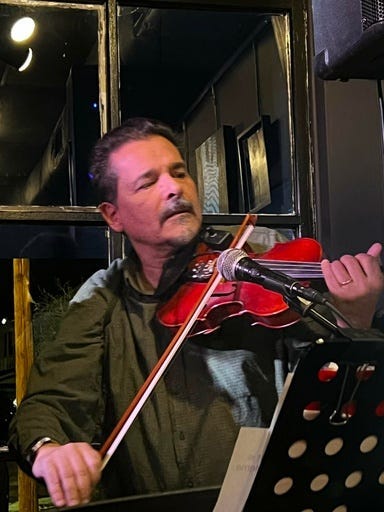
This deficiency limits my ability to know the wider world brimming with animal sounds and voices.
Of course, our planet wasn’t always so musical. Biologist David George Haskell writes that for more than 90 percent of its history, Earth was silent apart from the elemental sounds of “stone, water, lightning, and wind.”
Now, nearly all life creates sound. Up to 90 percent of insects communicate through a “vibroscape” of shaking ground or foliage. Even bacteria, we have learned—once we had the right equipment to know and bothered to ask—make measurable noise by waving their tiny flagella.
The greater question, then, has to be why anyone sings.
The ancients defined “animal,” a word derived from the Latin animalis, as the living thing “having breath.” To die was to lose breath—to become exanimalis, or lifeless. But animal voice only appeared after billions of years of evolution. Noisy animals probably outcompeted quiet ones.
Accordingly, sound now connects much life into networks of connection and conversation. Its varying pitches, timbres, rhythms, and amplitudes carry nuanced messages.
We humans evolved, and have always lived, within nature’s musical theater.
Yet even vireos must first learn to deliver such messages. Vireo young are babblers. They imitate and improvise “subsongs” as they try to define their own tunes. Dopamine, the “feel good” hormone behind learning and motivation, plays a key role. It makes learning pleasurable. The mature male bird, on the other hand, has a lengthy set-list of established songs. Like an aging pop star bound in his ways, he may prefer to run through his whole set list before starting another bout of singing.
That said, relentless piping expends energy, a resource vireos must husband carefully given their taxing lives. All this calling and singing must therefore serve a purpose.
For the most part, it’s not too hard to guess why the birds vocalize. Male vireos scream at rivals who approach their territory, for example. Little mystery there. The compulsion to organize our space on earth is a well-known spring of creative sound making.
But the singing continues long after the territories are defined, and—unusually for songbirds— even after vireo mates are paired off.
Why would the male vireo sing so prolifically when his greatest needs already seem to have been met? (They even continue to sing, albeit less than before, in the lush abundance of Amazonia.) Ornithologist Kroodsma notes that the sheer amount of song produced suggests there’s still much at stake for the male bird.
Kroodsma’s own guesses center on the female vireo. Perhaps she’s always listening to him sing. Perhaps his musicianship informs her egg-laying choices. In essence, he may always be courting her. If she likes what she hears, the male’s odds of becoming a successful father may increase.
In humans, “groovy music” is associated with heightened arousal. Why not for love-struck vireos?
If these hypotheses are true, then male red-eyed vireos call to define place, and sing to attract and communicate with mates. Like the peoples of Potomac Creek have always done.
***
But here’s what intrigues me most: It’s also possible—likely, even—that the little birds simply enjoy singing.
This shouldn’t be controversial. Nature embraces emotion and pleasure, including—but not exclusively—for purposes of sex. Charles Darwin watched his first child’s earliest emotive beginnings with intense interest, convinced “that the most complex and fine shades of expression must all have had a gradual and natural origin.” (The mental image of this giant of science observing his primate son with such detachment is irresistible.)
Some sounds please or displease animals. At the chemical level, the act of singing enhances pleasure even in adult songbirds, measured through raised dopamine levels. Many studies confirm sound’s effects on animal behavior, too.
Science aside, pet owners also have ready windows into the world of animal sound preferences. As a boy, I delighted in how our Afghan hound Cici howled in unison with me. Cici plainly enjoyed our extended duets. She soulfully tossed back her elegant head and long, blonde hair to project her voice into the heavens.
Today, our house cat Minou illuminates what might be called musical taste. She never leaves her favorite napping spot when my son plays guitar. She doesn’t mind hearing someone play the electric piano, either. In fact, if the piano is left on, she will happily pussyfoot across its keyboard, creating amusing, dissonant “tunes.” But whenever I bring out my fiddle Minou skitters downstairs into the basement, tail flying.
Minou’s behavior proves that fiddle sounds—or at least the ones I make—are not at all to her liking.
Sadly, we can’t know what emotions the listening animal feels. Our technology and imagination simply aren’t there yet.
But in Sounds Wild and Broken, biologist David George Haskell notes that the assumption that humans alone can experience beauty is improbable and scientifically unsupported. Scientists today argue that animal aesthetic appreciation was likely a major driver in the evolution of sound. The communicative chirps, roars, buzzes, clicks, and whistles found in nature co-evolved with aesthetics. Animal likes and dislikes helped power nature’s incredible sonic diversity.
There’s a role for sound in animal social learning and culture, too. A whale’s call, for example, may reveal to others of its species “its individual identity, clan affiliation, and, in some species, whether it is up-to-date on the latest song variants.” Presumably, whales receive some calls with pleasure, but not others (like picking up the phone and hearing a friend or a telemarketer).
And when sound is attached to subjective, aesthetic, and emotional meaning, it becomes music.
In fact, philosopher and jazz clarinetist David Rothenberg, a proponent of “interspecies music,” has been improvising with animal singers for decades, including birds and whales. In 2000, a rambunctious duet he shared with a white-crested laughingthrush helped spur a lively debate about bird consciousness. It reframed how many scientists approach animal music.
All this is to say that animals may exhibit musicality—the capacity to produce and enjoy music. Put another way, art doesn’t wait for humans to begin.
Nature is no stranger to artistic expression; it envelopes us in sound and voices its emotions openly. On Potomac Creek, the return of exuberant animal music heralds spring—the season of new life—as surely as green leaves budding on tree limbs.
***
All winter I was in waiting. Now, I’ve learned to listen.
To walk alone and hear the fairy song of the wood thrush carrying through the forest is to hear God’s voice; it is to bend our ear towards earnest tunes of love, joy, and place. We are awakened to the music of creation.
Here, have a listen to the wood thrush.
***
Ranjit Singh teaches in the Department of Political Science and International Affairs at the University of Mary Washington. He’s also an active environmentalist. His “No Lines in Nature” Substack blends history, science, and philosophy to explore our relationship with the natural world. You can find it HERE, and an earlier version of this essay HERE.