
By Martin Davis
EDITOR-IN-CHIEF
Email Martin
When the Dahlgren Naval Surface Warfare Center Dahlgren faced the prospect of losing its charter as a result of proposed changes in Section 319 of the FY 2026 National Defense Authorization Act (NDAA), and the roughly $3 Billion financial impact on this region that goes with it, the regional Military Affairs Council (MAC) went into action.
Joe Caliri, the MAC Chairman, working with then-CEO of the Fredericksburg Regional Alliance (FRA), Curry Roberts, modeled out what losing that charter would do not just to Dahlgren, but to the community as a whole. Together with the Fredericksburg Chamber of Commerce, they advocated with elected officials to help stave off any risk to the warfare center. A follow up meeting with Senator Kaine proved to be informative and supported increasing awareness.
“This region,” Caliri told the Advance — “not just the base and not just the technologies, not just the warfighting capacity, but … all the companies that rely on Dahlgren” — would have been devastated.
The negative consequences were avoided in part because of the MAC and FRA’s work.
Dahlgren was spared the damaging effects of losing its charter, but Caliri came away from the experience with an understanding that reacting to challenges is not as desirable as getting ahead of them. So he has been working to make the Fredericksburg Region MAC a more proactive organization.
Military, Community, and Connections
A proactive posture is critical because the military’s role in the Fredericksburg region’s economy is significant.
According to MAC’s 2026 overview, the defense presence in the Fredericksburg region generates more than $9 billion in annual economic impact. That impact includes payroll, contracts, federal funding, local commerce, and tax revenue. The region’s defense assets also support approximately 33,000 government, contractor, and military personnel while sustaining key industries such as research and development, construction, manufacturing, real estate, and professional services.
“These numbers matter because they tell part of the story,” Caliri said. “But behind those numbers are people, families, businesses, missions, and relationships. Our job is to help the region see the full picture and understand how important these defense assets are to both the nation and our community.”
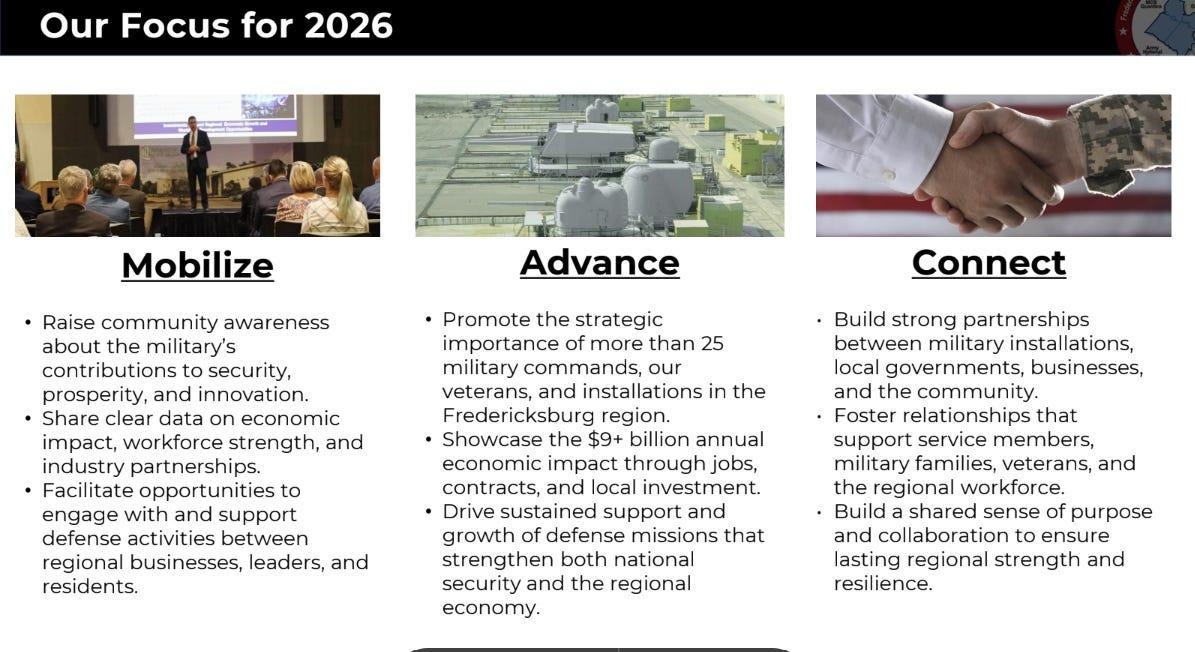
“The Fredericksburg area is uniquely positioned,” Caliri continued. “We have military commands, federal partners, state and local government, academia, industry, professional organizations, and entrepreneurial entities all contributing to a broader ecosystem. When those groups are connected and aligned, the whole region becomes stronger.”
Building those connections is where MAC’s real work lives. The range of connections runs from the social — “Tech Brews” that bring together individuals across the military and community who work on military tech projects — to lobbying. As a 501(c)4, MAC is able to lobby legislators and important issues to military vets, their families, and the military business community.
The importance of those connections is displayed in a chart that Caliri uses when talking about the organization.
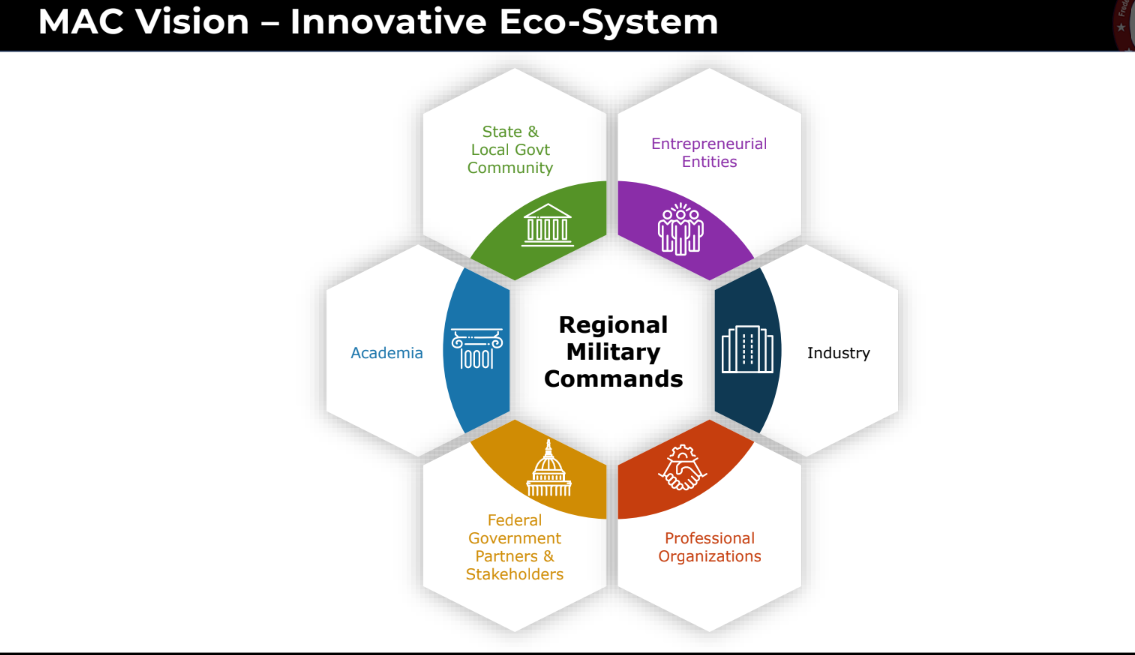
By developing a better understanding on the part of academia, the federal government partners and stakeholders, professional organizations, industry, entrepreneurial entities, and the state and local government community about MAC, Caliri hopes to create stronger synergy among these groups and MAC.
“We want service members, veterans, families, businesses, and local leaders to know they are part of the same community. When we understand each other better, we can support each other better.”
Caliri, like all MAC leaders, has responsibilities outside MAC. His full-time job is as President and CEO of SimVentions, a 100% employee-owned and -operated company that develops, integrates, and transitions new technology to war fighters.
While MAC’s time-demands on him are significant, he does it because “I believe in it,” he told the Advance. “If we’re not focusing on a community approach, people are going to get left behind, and sometimes, when you’re not involved, we’re not properly mobilizing, and we’re not properly advocating. We’re not properly connecting things.”
While the work means long hours on top of the hours he spends running SimVentions, for Caliri it’s time well-spent.
“The military has shaped my life, my career, and the work we do as a company,” Caliri, also a navy veteran, said. “Serving as Chairman of MAC is a way to give back and help strengthen the relationship between our region and the military community that is so important to it.”


Local Obituaries
To view local obituaries or to send a note to family and loved ones, please visit the link that follows.
