
By Jeff Eastland, ADVANCE CONTIBUTOR
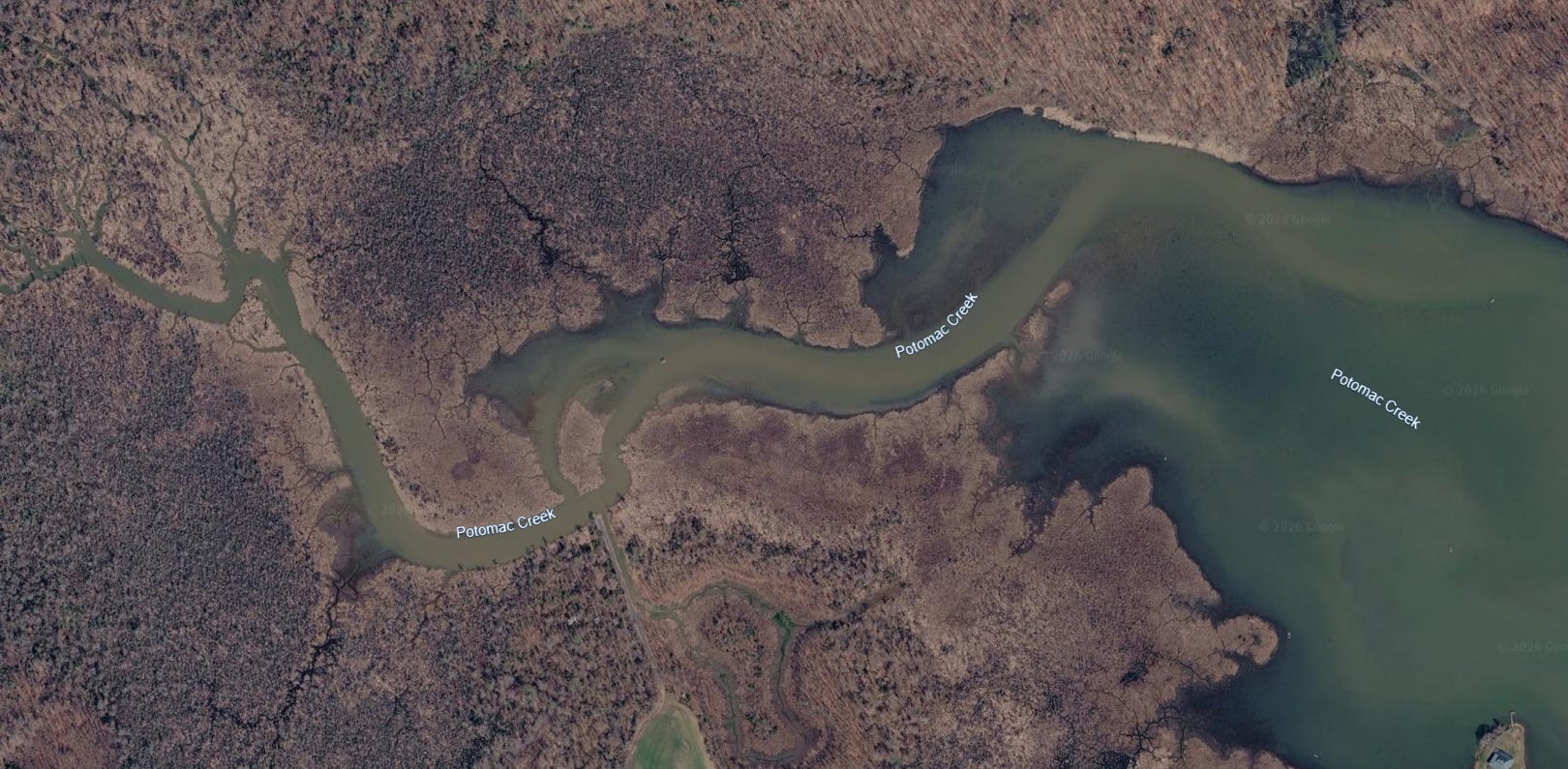
We have another local data center controversy: A 99-acre data center campus is proposed to be built in the Falmouth district of Stafford, where it would threaten Potomac Creek.
The matter came before the County Board of Supervisors on July 7. The applicant is Metts LC of McClean, Virginia. Metts LC is requesting that the relevant property be rezoned from A-1 (Agricultural) to M-2 (Heavy Industrial). They want to construct three data center buildings and an electrical substation there.
Despite there being no dense housing nearby, I argue this application is deeply flawed for several reasons.
First, the applicant is requesting a Comprehensive Plan amendment to add the site to the Urban Services Area and the Central Stafford Targeted Development Area.
Significant changes to the Comprehensive Plan should not be taken lightly—they will directly affect our futures. That’s because the Plan, as described by the County itself, is “arguably the single most important document in a locality besides the County Code.”
Want to know what Stafford County will look like 20 years from now? The Comprehensive Plan is your best guide. Now, let’s look at what the developer wants to do.
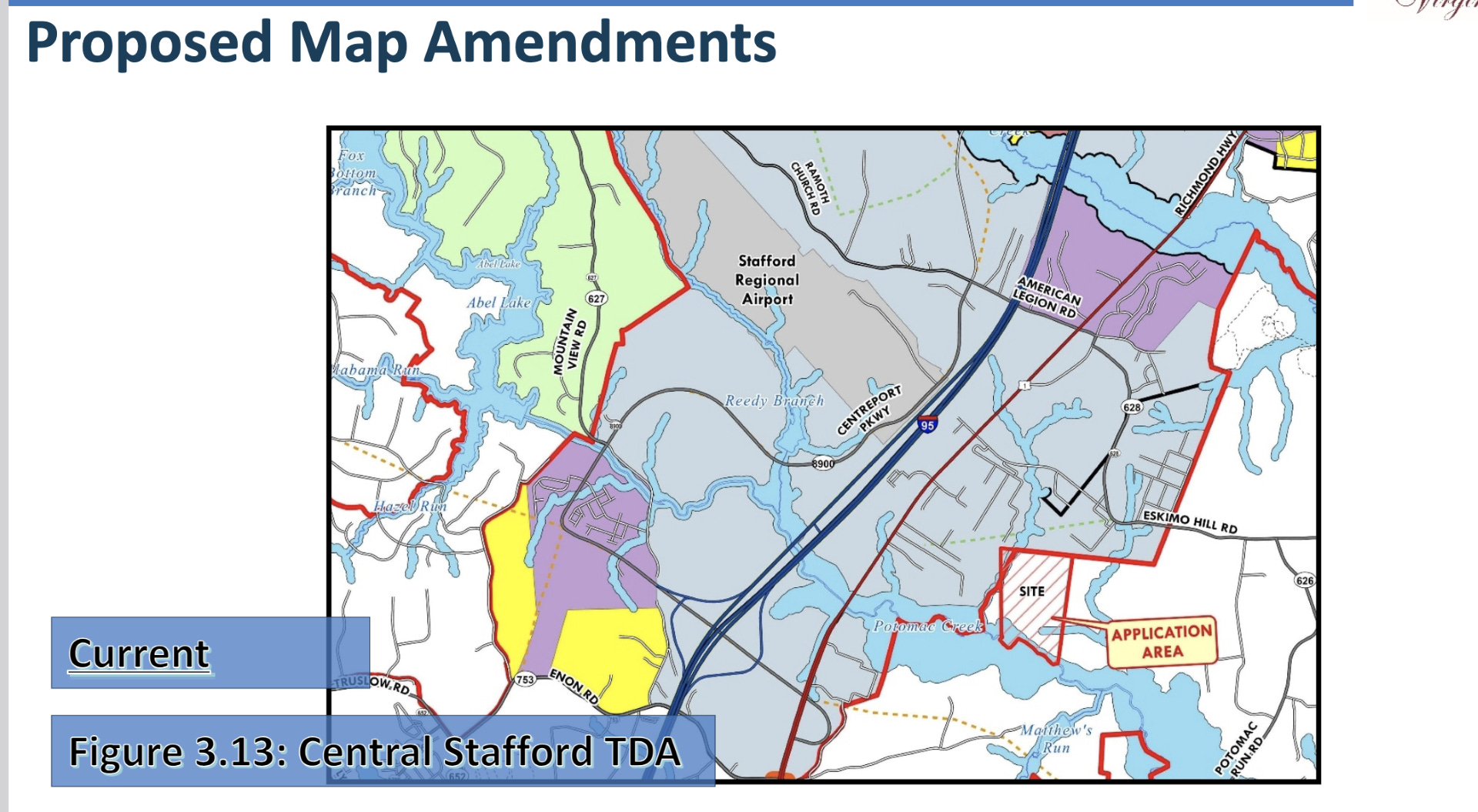
The current Urban Services Area and Targeted Development Areas are in blue. As you can see, the county has been trying to push much new development around the the Centreport Area. The proposed data center site is outlined as the “Application Area.” It lies directly on Potomac Creek, and almost entirely apart from the areas slated for development. Just downstream is the Crow’s Nest Natural Area Preserve, a 3,000 acre nature park fed by the creek and one of the state’s ecological crown jewels.
This is not what the Comprehensive Plan plans or intends for our county. Approving the developer’s request would be, in effect, moving the goalposts to favor a private interest.
This discordance was pointed out by a member of the Board itself at the July 7th meeting. And I made the same point in my three-minute presentation during the public hearing for the application.
Second, constructing an invasive industrial data center would severely degrade an ecologically sensitive area and the creek itself, causing downstream impacts that would affect the water quality of the county and the Chesapeake Bay.
The developer’s application complies with the minimum standards regarding setbacks from the creek. But these standards are only that: the bare minimum. The heavy activity needed to complete and run an industrial data center entails soil disruption, tree and vegetation removal, herbicide application, new roads, heavy equipment, and much more.
It’s important to note that the proposed work—if approved—would be done adjacent to a Resource Protection Area (RPA). RPAs are “regulated environmentally sensitive land that lie alongside or near the shorelines of streams, rivers and other waterways which eventually drain to the Chesapeake Bay.” We need these RPAs to be respected because, as the county website says, in their natural condition they “reduce runoff and filter pollutants, providing an essential function to restoring the health of the Bay.”
We also know that the water quality in Potomac Creek is already impaired. It has received the EPA’s worst designation for water quality. Undoubtedly, building this large data center campus would further and severely degrade the RPA and the creek itself, harming water quality in the county and far downstream. It’s hard to imagine any reasonable person arguing otherwise.
Third, and of equal importance, the Seddon family cemetery sits in the middle of the parcel.
In remarks I made during the general public comments period on July 7, I focused on the recent past, and the unfortunate removal of Buzzard’s Roost, an iconic Civil War site.
Buzzard’s Roost was a 40-foot rocky outcropping that served as a lookout during the Civil War and contained inscriptions from Union soldiers in 1862 and 1863. The Roost represented a very significant historical resource in a county that prides itself on heritage. However, in 2022, this unusual feature was cut out and removed from its original context to permit the construction of an enormous warehouse, an act then decried by history buffs. My intent was to compare that historical and cultural atrocity with elements of this current application, as you will see.
The Seddon family cemetery is over 200 years old. It is considered the most historic cemetery in Stafford County. As yet another rare cultural resource, it contains the remains of the Seddon family, a noted white Stafford County family that held local, state, and federal positions throughout the eighteenth and nineteenth centuries. But it also holds nearby at least 12 unmarked known graves (as of July 7) believed to be those of people enslaved by, and buried with, the Seddons. Such cemeteries are very unusual in the South.
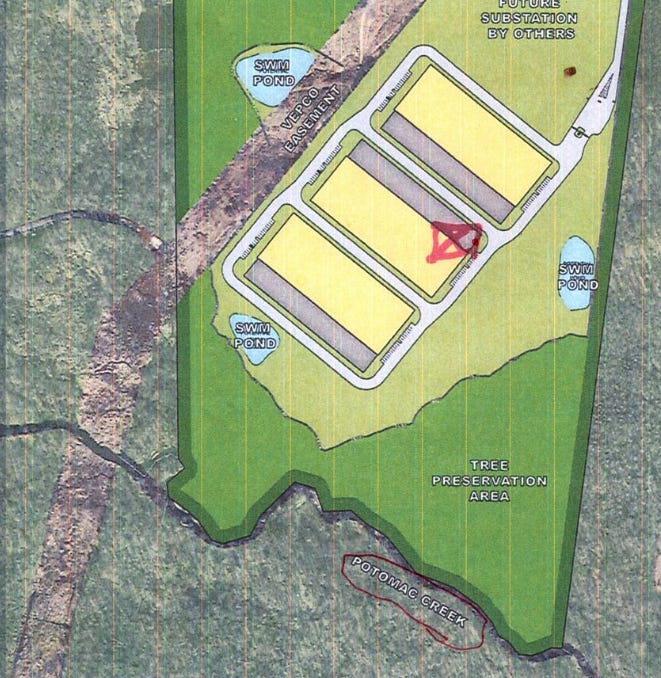
The above document shows the original Generalized Development Plan, a county document, with the Seddon cemetery marked in red. It lies right in the middle of one of the proposed data center buildings.
Since Virginia law prohibits building over cemeteries, the original plan from the developer was to relocate the graves. This was met with outrage, huge pushback and opposition. Ultimately, the Board deferred the matter to allow the developer to conduct a complete evaluation of the cemetery.
The resulting work, done by Rivanna Archaeological Services LLC together with NAEVA Geophysics, Inc., showed that, through ground penetrating radar, 109 graves were located.
Despite an initial motion for denial at the July 7th meeting, there was just enough opposition to hold off the developer. Some very good remarks were made at that meeting, including by Anita Dodd, chair of the Historical Commission, members of the Cemetery Committee, and Kim Taylor-Wilson, who spoke eloquently about the dignity for the enslaved buried there. Alyson Azzara from the George Washington District spoke definitively about various problems with the application, including lack of a proper sound study. The Board eventually voted 4-3 to defer the matter until the applicant could do a full investigation of the cemetery and surrounding grounds.
What happened to Buzzard’s Roost a few years ago was wrong and so now is this data center proposal. For the integrity of Potomac Creek and our county’s wetlands, and for the preservation of our historical resources, I feel it imperative that this application be denied.
Many seem to agree. On July 15, 2026, a special meeting of the Stafford Historical Commission was called to discuss the Potomac Creek data center application and the results of the July 7 Board of Supervisors meeting.
The Historical Commission addressed the archaeological evaluation on Oct. 1 when it was brought back to the Historical Commission, and now it heads to the Board of Supervisors for a final vote (scheduled for Dec. 1 as of this writing).
This is an active proposal, with much at stake for our county both in principle and on the ground. As of this writing, the plan is for the developer not to relocate the graves, but to build around the large cemetery. Not a good option either.
Rest in Peace?
***
Jeff Eastland is a graduate of the first Environmental Studies program in the US-San Jose State ‘73. He is a lifetime climate activist, a former probation officer, a retired antique dealer, and an independent journalist who lives on a 7-acre farm in the Rock Hill district of Stafford Va that’s a certified wildlife habitat. He shares his home with his wife, Elena Prokos, who taught in Stafford Schools for 40 years.
This article was originally published in Environmental Columnist Ranjit Singh’s Substack, No Lines in Nature.

A compelling argument.