
By Martin Davis
EDITOR-IN-CHIEF
Email Martin
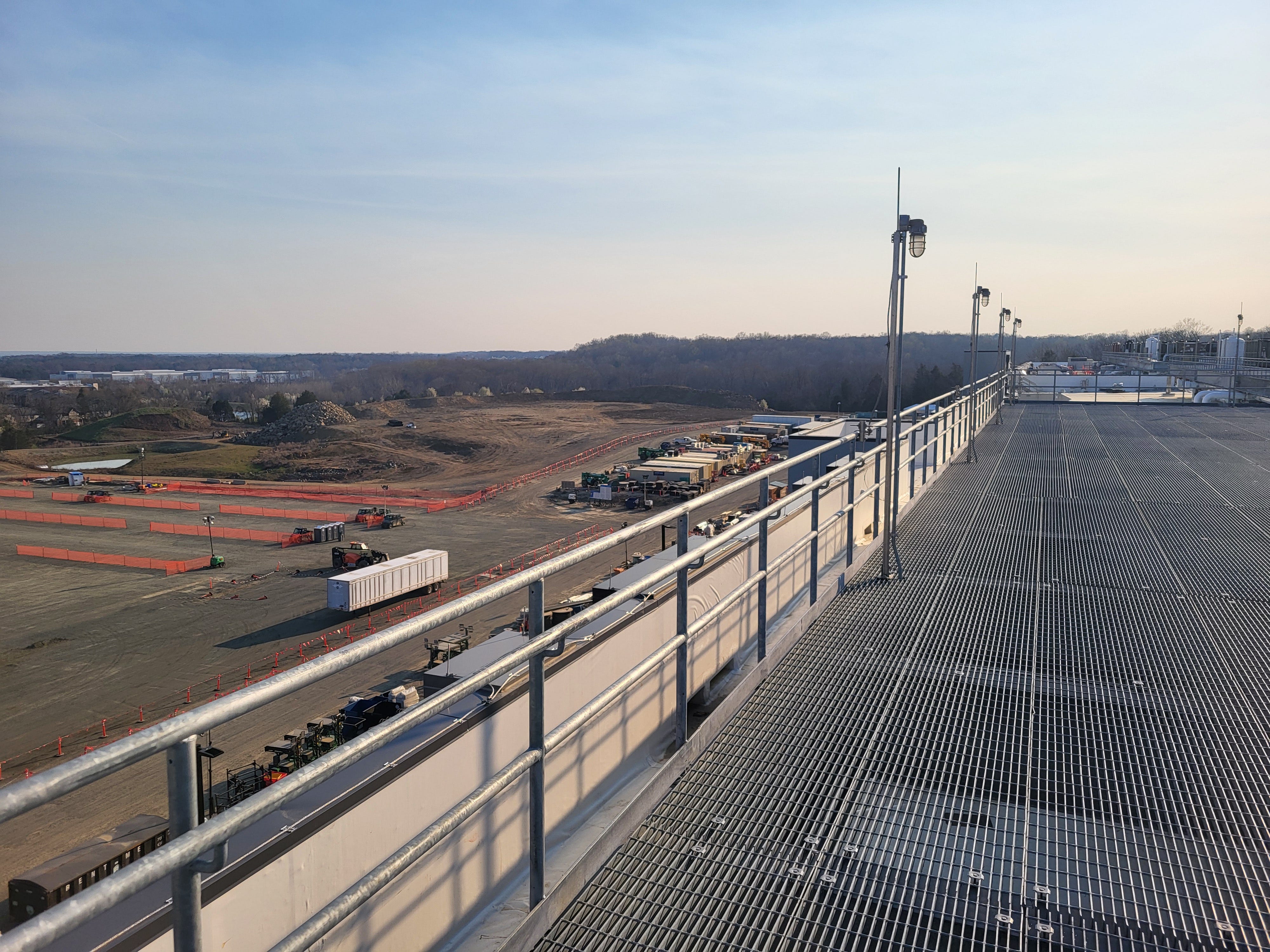
Harry’s on William Street was still a novelty when Curry Roberts invited me to join him for drinks and a discussion about data centers.
As the then-CEO of the Fredericksburg Regional Alliance, Roberts and I had connected on several issues related to economic development and the Fredericksburg region since my joining the Free Lance-Star in 2022.
On this day, he brought information about a new mixed high- and middle-school recently raised in Mecklenburg County, Virginia, that was paid for mostly by the data center tax revenue generated in the county. His pitch was simple — here’s an example of the kind of impact that data center tax revenues are bringing to local communities.
With Fredericksburg and surrounding counties beginning to approve these centers, the tax benefits of the data centers offered an intriguing hook. But as Opinion Editor at the Free Lance-Star, I was not yet ready to weigh-in.
What I knew of data centers was limited to understanding that they housed “the cloud.” But how they worked, how people accessed them, how much of our society and economy used them were largely unknown to me.
More familiar were the environmental concerns pushed by the Sierra Club and other groups — noise, water usage, energy consumption — that were mustering forces against data center growth.
Journalists aren’t the experts, and aren’t expected to write as experts. But journalists are expected to know enough to be able to contextualize and explain their subject-matter. Before writing, there was research to be done.
What I could not know then in 2022 was that this research would consume nearly a year.
Searching for Context
For a reporter just starting to explore the issue, those early days of research were challenging. Concerns about data centers were easy enough to find. News reporting focused heavily on that angle, and online searches for “data centers and water,” “data centers and energy,” and related issues delivered a rush of information.
Learning the details of what data centers actually did, however, and how they functioned was more difficult to come by. While white papers were numerous, and more-technically-oriented publications provided exquisite detail, they were geared toward the expert — not the journalist.
What they did offer, however, appeared to be a picture starkly different from the alarmist cries from the environmentalist community. What I needed was a foothold into the world of data centers that I could relate to and begin to work from.
I found that foothold in an unexpected corner of my previous work—automotive journalism.
Prior to joining the Free Lance-Star, and before starting the Fredericksburg Advance, I had spent six years at U.S. News & World Report as a senior editor in the automotives vertical. While much of my time was dedicated to reviewing cars and explaining the buying process, I was also doing reporting on electric vehicles and the promise of automated driving.
The promise of self-driving cars was gaining traction in the mid-2010s. Effectively implemented, “smart cars” would significantly lower automotive deaths, and accidents would plummet as technology removed human misjudgment — which is responsible for the majority of automotive accidents — from the driving equation.
The technology was certainly there, but the challenges associated with delivering it were substantial.
Bringing self-driving cars to scale depended upon bringing electric cars to scale. And that meant substantially strengthening America’s grid system and generating a lot more energy.
Research at the time showed that should every American suddenly begin driving electric cars, the grid would crash under the weight of trying to deliver the necessary power.
Where would the energy come from?
Further, what many were calling “self-driving,” wasn’t. The National Highway Traffic Safety Administration has established a 0-5 scale to measure a car’s ability to self-drive. Zero means the driver is fully responsible. Three is conditional self-driving, meaning the car can function but the driver must be able to take control. Five is fully self-driving.
In the mid-2010s, there were only a few cars that scored 3. Still today there are no cars that score 5, and only a few that score 4s. The 4s are mostly limited to automated taxis and delivery vehicles. In short, a decade later, we’re still far from realizing the dream of widespread self-driving vehicles.
Finally, self-driving cars also depend on “smart technology,” and that in turn requires data centers. Few automotive journalists were writing about data centers at the time.
I pursued conversations with my former colleagues in the automotive journalism space to find out how data centers were shaping the self-driving debate and learned that like me, most were tangentially aware of data centers, but had little understanding of how data centers actually worked.
However, knowing the potential of smart technology and self-driving vehicles, and appreciating that data centers were necessary to drive that vision, gave me a conceptual framework for better understanding what data centers do, and what they make possible.
I was also becoming aware, however, of a growing disconnect in the data center discussion.
The environmentalists were increasingly attacking the very infrastructure that held the promise of helping us manage greenhouse gases and make life safer, easier, and more productive for everyone.
The tax benefits angle was a story worth telling, but it did little to help people better understand the richer story of how the data center industry sat at the core of our future.
In short, an enormously complex, multidimensional shift in the U.S. and global economy was being framed in the public imagination as a simple two-dimensional story.
There was a richer, more-important story to write.
Leaning into Complexity
Feeling more comfortable with what data centers were, I wanted to know more about how they operated. Roberts arranged for me to tour one. That tour became the basis for the first data center story I would write — nearly a year after that first conversation with Roberts at Harry’s.
The opening paragraphs of that story leaned into the disconnect between what data centers are, and the misunderstandings that surround them.
Data centers are both hailed as our region’s financial saviors, and spurned for their impact on local environments as well as their ever-growing real-estate footprints.
Perhaps more than any other industry, however, they also sit at the nexus of what may prove to be a revolution not unsimilar to the First Agricultural Revolution 5,000 years ago, the invention of the printing press in the 15th century, and the development of the personal computer in the 1990’s.
Since then, my reporting has continued to focus on raising people’s understanding of what data centers are and how they operate, the role they play in our economy and personal lives, while also exploring the challenges and innovations that the industry itself is wrestling with.
It’s a path I could not have imagined four years ago when I first sat down with Roberts. But this is what journalism involves. Setting one’s preconceived notions aside, working to understand the unfamiliar, going where the evidence leads — and most important, bringing readers along on that journey.
Done properly, the journalist’s work is not to convince people to accept a particular narrative — pro or con — about data centers (or any other controversial topic), but to help them enter more fully into the debates that define an age.


Local Obituaries
To view local obituaries or to send a note to family and loved ones, please visit the link that follows.

The fact that Slack funds your data center series, the electrician’s Union (major data center supporters) helps fund the Advance and Charlie Payne (Godfather of the regional data centers) is on you advisory board gives lie to your objectivity and transparency on your reporting.
UMW Fredericksburg Regional Alliance's Curry Roberts is THE one who came up with the idea to 'socialize' Fredericksburg's PTA, the teachers' association and the NAACP to 'the positives' of DATA CENTERS. Vice Mayor Chuck Frye, Councilors Gerlach and Holmes were assigned this task. (FOIAed email 10-1-2024).
and here they came out to the 2-25-25 public comment mic, wearing their 3"-pin-back buttons, in James Monroe HS colors of orange and black, braying 'I support DATA CENTERS!'.
Some of them did catch those of us who had taken the time to learn both sides (forums, lit review, on-site PW backyards near DATA CENTERS) as we were leaving Council at 1 AM on the sidewalk outside Council Chambers. This was after a 7-0 ALL IN, done deal rah-rah vote, almost shaken in disbelief, that they did not know 'the other side of the story' to the drawbacks of DATA CENTERS.
and thanks to Bill Wright, activist in Prince William County who took the time to answer Fredericksburg Neighborhoods Coalition's emails to the truth re: these 'silent killers'.
Bill gave us the info to show the DATA CENTER industry strategies of how these poison Goaliths try to fool the David stakeholders.
Here's the latest from:
The Coalition to Protect Prince William County
ProtectPWC.org
Dear Coalition Friends and Supporters,
Ever heard the term "Tombstone Legislation" - ?
We had not either, until early 2024 when a new friend on LinkedIn reached out and wanted to have a conversation about DATA CENTERS. He was curious about what was happening in Prince William County and Northern Va.
After an extensive discussion, he said "Virginia looks like it is headed for tombstone legislation."
In response, the Coalition member replied, "I have never heard the terminology, but it doesn't take much imagination to understand the underlying meaning. Legislation won't happen until someone ends up dead. Is that correct?"
Reply "Yes. Exactly."
Well, here we are folks. And, for any elected leaders to feign ignorance or shock at all the facts that point toward a crisis, it simply doesn't pass the smell test. We have all been warning of an unfolding crisis - to our air, our water, our faith in local governance, and our overall quality of life.
Many local and regional nonprofits, including the Coalition to Protect PWC, have been shouting this from the rooftops. We are relieved to see a major newspaper bring the facts and science.
Let transparency and accountability steer these critical public conversations!
'As DATA CENTERS boom, Virginians breathe the exhaust of 10,000 diesel generators (5-28-26)
- The Washington Post
"Diesel exhaust contains nitrogen oxides, which help form smog, and fine particulate matter, including soot, which are linked to respiratory and heart disease. DATA CENTER generators in Virginia could trigger 14,000 episodes of asthma symptoms each year, according to a separate study from researchers at the University of California at Riverside and the California Institute of Technology that is undergoing peer review."
“When you look at the cumulative effect of all these DATA CENTERS close together, the result is significant exposure to communities nearby,” said Damian Pitt, associate director of the Institute for Sustainable Energy and Environment at Virginia Commonwealth University, who obtained the emissions permits from the Virginia Department of Environmental Quality. “What we found particularly shocking is that it is even more pollution than you would have living near a large natural gas power plant.”
"Wright (no relation to PW activist Bill) told Bloomberg in December that he wants to “unleash” the dozens of gigawatts of diesel generation that is largely sitting idle at DATA CENTERS to power the vast expansion of AI infrastructure.“The massive DATA CENTER build out over the next few years — most of it we can meet with generators,” he said.
Virginia has permitted enough of the generators to create 27 gigawatts of power, roughly the equivalent of 27 LARGE NUCLEAR REACTORS."
and look who has to put up with that proximity. It's part of the DATA CENTER billion-dollar industry's 'playbook' to locate them near communities of 'historically marginalized' folks, as is projected for the children and their families living in the apts in 'Celebrate Virginia' where the Technology Overlay District will have 8-12 DATA CENTERS going in. Three of which surround the apts on 3 sides.
Contrast that image with the 'socialized' commenters at the city's 2-25-25 Council mic, fervent but misled, in keeping them ignorant: 'It's for the schools! It's for the children!'.
Hmmmm, Whose children?