
By Claire Marshall Watkins, ADVANCE CONTRIBUTOR
Harvesting memories for over 40 years!
That’s what it says on the Belvedere Plantation website. But maybe not for much longer, as the Fulks family, which has owned the property since 1968, announced last week that they’ve “begun working with a very reputable organization that is looking to properly site a technology campus on this property.”
Belvedere, located off Route 17 southeast of Fredericksburg, is 645-acres, and at least for now most notable for its pumpkin patch.
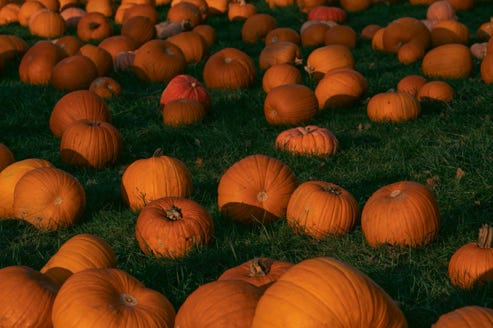
Since 1983, the Great Pumpkin Patch––as it’s creatively named––has been an autumnal staple of the greater Fredericksburg area. During Belvedere’s Fall Harvest Festival, which is still set to commence on September 12 this year, visitors can test their sense of direction in the Great Adventure Maize Maze, pick their own pumpkins, slide down Pumpkin Mountain, and watch the Swine Speedway––just to name a few attractions.
The Swine Speedway is Belvedere’s official name for its pig races, which for some reason were always my vegetarian-self’s favorite part of visiting every fall as a kid. The pig I chose never came in first, so I never won the plastic pig-nose reward, but I had fun nevertheless.
Each year, after my family wandered around for a few hours, we’d take a tractor ride to the Great Pumpkin Patch and pick the best ones we could to make Jack-O-Lanterns at home. Before weighing our pumpkins and paying for them in the shop by the exit, my little sister and I would look down every aisle of the gift shop for fun sweets and tchotchkes, although we always left with the same rock candy.
I haven’t been the the Fall Harvest Festival in a long time, now. The last time I went was nearly a decade ago—I must have been 15—with the St. George’s Episcopal Youth Group. My friend Bella’s dad ran the group, so my sister and I tagged along to a lot of their activities. I remember getting lost in the Adventure Maize Maze with Bella, distracted and talking about all the things that teenage girls talk about. When we finally got out, a bunch of us kids took turns riding the pedal carts. Another kid from the Youth Group worked at Belvedere that fall and he was in charge of them, so naturally, we all gave him a hard time.
Visiting Belvedere was just something that we did back then. It was somewhere that––to our little kid knowledge––had always been there and would always be there. We didn’t think critically about its history or its future.
My family eventually started buying pumpkins from the grocery store instead of going to the pumpkin patch. By that time, my sister and I were both teenagers, and I did start to think critically about what Belvedere’s history must entail, and I never went back on my own.
Belvedere Plantation was built in the 1760s by a man named Col. William Dangerfield. The narrative around him, according to Belvedere’s website, of course, is that he was “noted for his kindness and hospitality.”
Besides the Belvedere website, I can’t find much on its history other than a few portraits of Dangerfield and his wife, and excerpts from a diary kept by a man named John Harrower, a Scottish immigrant who was an indentured servant to Col. Dangerfield (spelled “Daingerfield” in this account). Harrower is described on the Belvedere website only as “the in-house tutor to the Dangerfield children.”
The Dangerfields also enslaved a number of African-Americans, whose stories aren’t recorded or acknowledged in the official history of Belvedere plantation, just as much of American history has been purposefully erased and rewritten to favor men like Dangerfield and other colonial figures. Much of the truth must still be dug for and the history of Belvedere Plantation is no exception. What one can find by scouring the internet is that both Belvedere’s past and future appear to disenfranchise those who don’t benefit from the privileges afforded to its owners.
Although the Fulk family has announced plans for a rather vague “technology campus” and not specifically a data center, Virginia already has the largest concentration of data centers on Earth, and has been dubbed the Data Center Capital of the world. Many Fredericksburg residents are fighting back against proposals for more to pop up––in fact, Fredericksburg City Council rejected a proposal by Penzance Development company for a data center on Gateway Boulevard just last week. But not every fight can be successful.
One immediate concern about the placement of a “technology campus” at Belvedere Plantation is that it directly borders sacred land next to the Rappahannock River belonging to the Patowomeck Indian Tribe of Virginia. Last year, the Virginia Outdoors Foundation and Trust for Public Land announced that 870 acres of ancestral homeland along the Rappahannock River were officially––and rightfully––returned to the Patowomeck Indian Tribe of Virginia as its owners.
Time, money, and tech greed will tell what is to become of Belvedere and the land it sits on. So goodbye, pig races. Goodbye, hay-filled tractor rides. Goodbye, rock candy. Goodbye, pumpkin patch. And goodbye, Belvedere Plantation.
Snead’s Farm is better, anyway.
***
Claire Marshall Watkins is an alumna of the University of Mary Washington, currently pursuing her master’s in journalism at Goldsmiths, University of London. You can read more of her writing on her substack, Virginia Magnolia.

“Snead’s is better anyway”. I love it! 🤣