
By Martin Davis
EDITOR-IN-CHIEF
Email Martin

Public school teachers have become a convenient whipping board, and it is taking a toll both on those who are in college making career choices, and those who currently are involved in the work.
Research by the American Association of Colleges for Teacher Education shows that students are running away from careers in education. In 2012-13, there were 611,296 students enrolled in a teacher preparation program at a comprehensive higher education institution. In 2022-2023, that number had fallen to 407,556.

There is some good news to be found in that the growth of people pursuing education careers through alternative means — so-called alternative licensure — has grown by roughly 81,000 people over the same period. Good, but not nearly enough to make up for the reduction in students studying for education careers — 203,740 fewer over the same time period.
Why are people not going into the profession? It’s complicated, but the lack of respect for teachers certainly plays an important role.
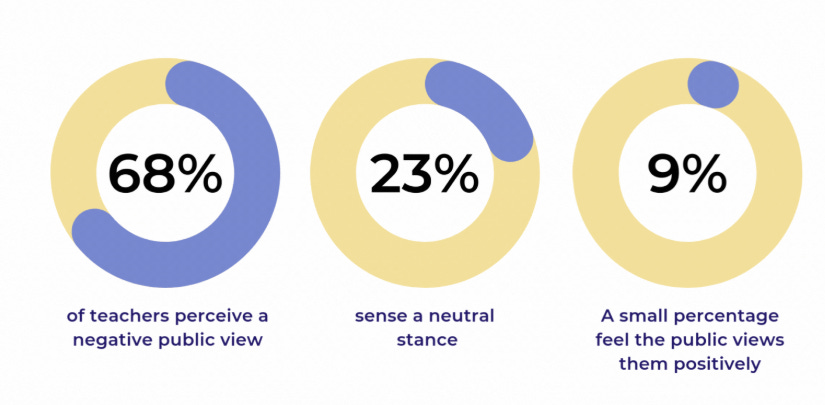
Teachers in the profession feel this disrespect most deeply. A survey conducted by Education Week in 2024 found that 68% of teachers feel the public has a negative view of them and their profession, an historic low.
Research by Matthew A. Kraft and Melissa Arnold Lyon paint a more-robust, and even bleaker, picture. Their work shows that “the current state of the teaching profession is at or near its lowest level in 50 years.”
They identify four overriding factors for teachers’ feeling that they are unappreciated; lack of professional prestige/respect is one.
And when professions are not respected, the bashing comes easily.
One need not look to national surveys to see how pervasive and significant a problem teacher-bashing has become. Over the past five years in Spotsylvania County, the criticism and mischaracterization of teachers and their work led to a wave of resignations and teachers leaving for greener pastures — Stafford County in particular benefited from the county’s brain-drain.
It’s a lesson that the new Spotsylvania Board members seated in January apparently didn’t learn. At Monday night’s meeting, two new board members — Rich Lieberman and Lawrence DiBella — again put teachers in a defensive position.
Updated report shows minimal cause for concern
Lieberman had requested earlier in the year that the district provide a report about substance-abuse issues in the schools.
A similar study was done in 2024 when Lisa Phelps was Board chair. The district’s staff updated that report and delivered it Monday night. Here’s the top-line finding. Substance abuse is not much of an issue in the school district.
Here’s how we know.
Bus drivers are required by law to be drug-tested. In 2024, pre-employment testing turned up four positive tests. There were three in 2025, and just one to date in 2026.
Random testing of bus drivers turned up one positive each in 2024 and 2025, and two in 2026. These people were dismissed for failing their random drug tests.
On the teacher and support-staff side, the state does not require drug-testing, though districts can choose to do so. Tellingly, none of the 131 school districts in the state has mandatory testing for all employees.
Spotsylvania does, however, track personnel dismissed for drug- or alcohol-related incidents, as well as people coming to the employee assistance program reporting drug or alcohol problems.
The numbers in each category are minimal—one employee in 2024, one in 2025, and one in 2026 were terminated for a drug- or alcohol-related incident. And over the same three-year period, there have been no employees coming to the assistance program for drug- or alcohol-related issues.
After the first report in 2024, the district implemented a number of steps to address potential issues, including mandatory training on a drug-free work environment, annual training for administrators in recognizing what constitutes reasonable suspicion of an individual with a substance-abuse problem, and updated posters and information at school sites about substance abuse awareness and staff resources.
“We have the best people in front of the kids and they’re safe,” said board member Carol Medawar (Courtland District) on Monday. “This is not the problem we need to go chasing.”
The data aren’t deterring DiBella and Lieberman, however, who are chasing it.
Data evidence meets anecdotal evidence
Following the report, DiBella suggested that the data presented were inaccurate.
“I have some concerns about the data presented,” he began. Citing his 13 years working in law enforcement in the schools, he continued:
I’m aware of multiple situations where the school division has become aware of people with a substance abuse issue. And while we didn’t terminate them so their number wouldn’t show up on a stat like this, they’re paid for the rest of the year and their contract not renewed. I know of multiple times that has happened, so it wouldn’t show up as a termination.
These are extraordinary accusations.
The use of the word “multiple” suggests the problem is widespread. Claiming that administrators or others intentionally did not report the information — even though they are legally required to do so — suggests the district is conspiring to cook its books.
They’re extraordinary for other reasons as well.
When DiBella used the word “multiple,” he doesn’t define what that means. Is it two instances? More than two? And over what time period? He made a point of saying he has been working in the district in law enforcement for 13 years. Are the incidents from the tenures of Scott Baker? Mark Taylor? Interim Kelly Guempel? Current Superintendent Clint Mitchell? All or some subset of that group?
The answer matters. If DiBella personally knows of 10 cases, but those cases are spread over 13 years, then that averages out to less than what the county has identified over the past three years.
Another pressing question. How would a School Resource Officer “know” that substance-abuse issues were handled this way? Personnel decisions are handled by the Human Resources department.
The Advance reached out to DiBella and asked: “How many is ‘multiple’? How do you ‘know’ the reason they were not fired for substance abuse?” As of publication, he has not responded.
Lieberman followed a similar line of casting doubt.
“I had a situation a few years ago,” he began, “where I had an encounter with an educator on school grounds during the school day in their official capacity. And in this case it was alcohol. Clearly alcohol. It was the aroma and the behavior was no question in my mind.”
He then went further, stating: “When I reported it, the response I got was, yeah, you’re not the first one to complain on that. And there was nothing else done to that person.”
We reached out to Lieberman via text message and asked: “Who brushed [the incident] off? Who did you speak with? And how long ago was this? Was it your only encounter with someone you suspected of [substance] abuse?”
His reply — “For personnel reasons, I can not go any further with that information.”
We then reduced the questions asked to one. “Have you personally had any other encounter with a teacher or administrator that you suspected of having a substance abuse issue beyond the one you mentioned?”
Lieberman referred to his previous response.
Again, the number matters. One incident does not a crisis make.
Weighing anecdotes versus facts
There’s a legal adage that says if you have the facts, pound the facts. If you don’t have the facts, pound the table.
The district pounded the facts on Monday night. It gathered the data that it currently has and presented it to the board as requested.
Data, of course, is not pure. Like every fact or collection of facts, it requires context. (See my previous column on this issue.) How information is gathered, how questions are framed, and, when conducting longitudinal studies, ensuring the same questions are asked year-after-year are valid concerns. Anyone referring to a data set should look to those questions and more to ensure that the data is valid.
If any board member has concerns that the data sets are poorly constructed or not gathering the correct information, those questions should be put forward.
DiBella and Lieberman, however, chose to pound the table.
Rather than question how the data was put together, each referred to personal experiences to suggest the data presented was flawed.
Such anecdotal evidence is not useless, but as noted above, it raises far more questions than it answers.
None of this is to say that DiBella or Lieberman didn’t have these experiences. It is to say that comparing anecdotal evidence that cannot be fact-checked and cross-referenced save through the people making the accusation cannot be weighted evenly with documented evidence that can be cross-checked and verified.
Which brings us back to teachers
If you’ve made it this far, a quick refresher. Teachers are feeling less appreciated than at any time in recent memory. Part of the reason for that feeling of disrespect is tied to both a lack of appreciation for the profession, and the ongoing willingness of parents and school boards and administrators to heap problems on the backs of teachers.
DiBella and Lieberman are pressing for drug testing of teachers not because there is a bevy of concrete evidence to demonstrate that there is, indeed, a problem. But rather because of anecdotal experiences that require more information in order to act on them.
Should Spotsylvania decide to become the first, and only, district in the state to go down the path of drug-testing based on little more than anecdotal evidence, it will serve as yet one more sign that this School Board does not have faith in those who are required to undergo extensive training to be certified, undertake ongoing training to remain certified, while being expected to complete reams of paperwork — mostly from the state level — at pay that is generally below what a professional should expect.
It’s not hard to imagine what the consequences would be.
Superintendent Clint Mitchell spoke directly to that issue.
“We worked our tails off for the last 18 months to work on teacher retention,” he began. “Implementing a [drug-testing program] would completely negate the work we have done.”
Currently, some 94% of teachers in Spotsylvania County say they intend to stay next year. That’s a reflection of the strengthening of the school district’s culture — teachers want to stay.
Demanding drug-testing undercuts the very culture that teachers say they appreciate, and it is likely to re-ignite the exodus the district established several years ago.
And as previously noted, there isn’t a growing pool of candidates to replace them.
Whether intentional or not, what transpired Monday evening is teacher-bashing.
And teachers — underpaid, over-stressed, and over-blamed — don’t deserve it.
There are real problems in the school district that the board needs to address. Creating problems based on anecdotal evidence and then crafting policies that will punish the very people a school system most depends on — its teachers — is not a solution.
It’s a pathway back to the chaos the citizens of Spotsylvania roundly rejected two years ago.


Local Obituaries
To view local obituaries or to send a note to family and loved ones, please visit the link that follows.

The deterrent impact of random drug testing should not be overlooked. Exposure to random drug testing is a powerful tool to conform conduct to what employers deem essential.
Anecdotal ’evidence’ is exceptionally dangerous. It becomes more suspect when the speaker of the ‘evidence’ invokes privacy, privilege or other shields to justify not answering ‘put up or shut up’ challenges.
Senator Joseph McCarthy led the nation on career ending chases of Communists by waving purported lists of Communists employed by the federal government. McCarthy used ‘anecdotal evidence’ while refusing to disclose names of his targets. The nation became so fearful of the consequences of Communists within the US that it became okay to crucify citizens based upon unchallenged ‘anecdotal evidence’ alone.
Required drug tests prerequisite to employment is a snapshot of testing date and time known to the person being tested. Random testing takes away preparing for testing at an unknown date and time.
I appreciate Lieberman’s and DiBella’s concern for the safety of all SCPS people. I suggest that in the future if they are not prepared to identity time, place and circumstances of their concerns, they refrain from using anecdotes to raise concerns.
I appreciate SCPS’s concerns about attracting and retaining teachers. Let’s not use children, teachers and tilting at windmills as reasons to not do all it can to prevent drug-fueled incidents by adults in SCPS.
I warned people that Lieberman would be similar to the recently departed Lee Hill board member and would cause drama.