
By Martin Davis
EDITOR-IN-CHIEF
Email Martin
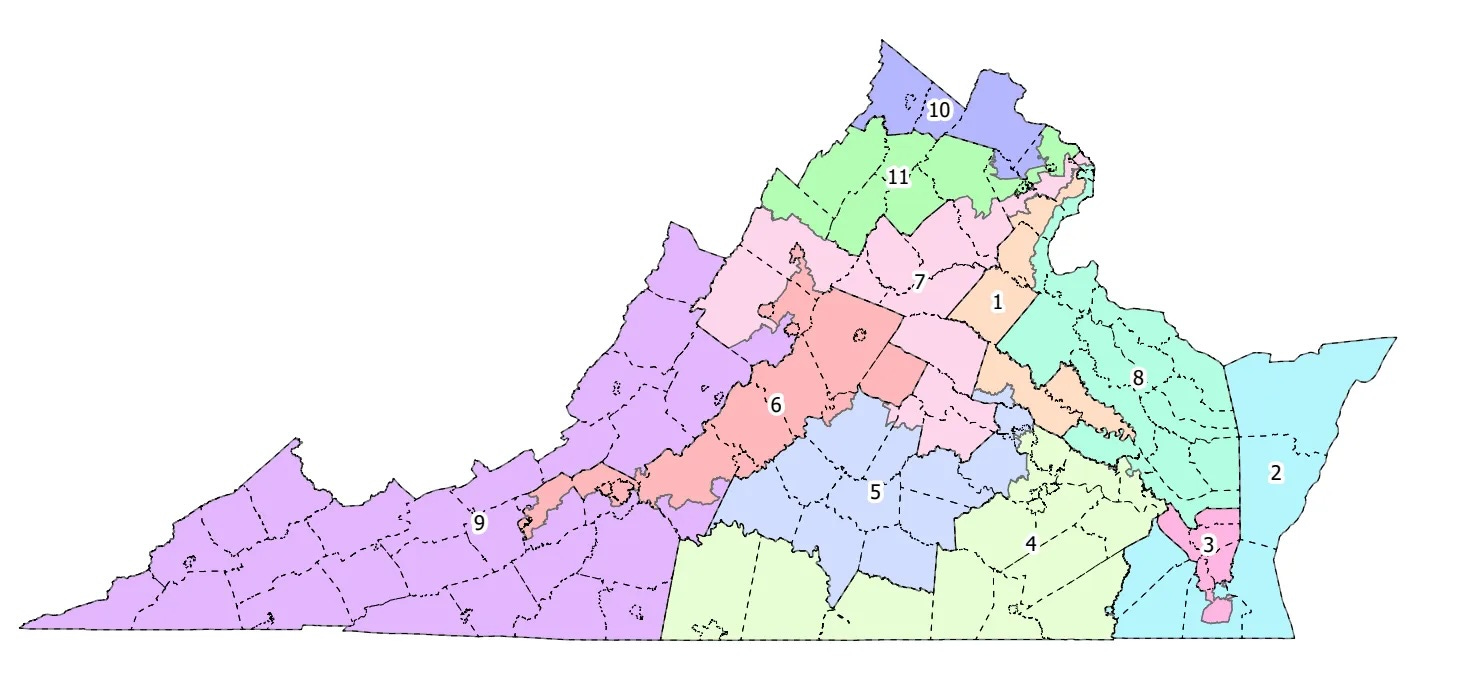
Decision Day for redistricting in Virginia is 14 days away, and there is no clear line on how this election will end. More pressing than the result of the referendum, however, may be whether Virginians are turning against Gov. Abigail Spanberger.
Recent polling suggests that the redistricting battle is souring voters on the governor, who ran for office touting her bipartisan credentials. Whether that souring is limited to distaste for the referendum on redistricting or runs deeper is a challenging question.
Redistricting, Early Voting, and Current Polls
The fight to gerrymander Virginia’s Congressional districts so that Democrats have a better than fair shot at winning 10 seats this November began — as too much of our politics these days begin — with Donald Trump.
Last June Trump pressed Texas to redistrict so that Republicans might pick up five seats in the midterm elections. This set off a domino effect, with seven states — inclusive of Texas — pursuing voluntary redistricting. As of now, four states have new maps (California, Missouri, North Carolina, and Texas), while three states (Florida, Maryland, and Virginia) are pending.
Spanberger had not been a vocal supporter of redistricting, getting into a verbal tiff with Rep. Rob Wittman (R - Va. 1) this past December about the issue. However, she did sign-off on the legislation that provides for the April 21 redistricting election.
This has angered some Republicans who see in this election Spanberger’s backing away from bipartisanship in favor of more-partisan politics. This, one theory goes, explains why early-voting turnout has been high.
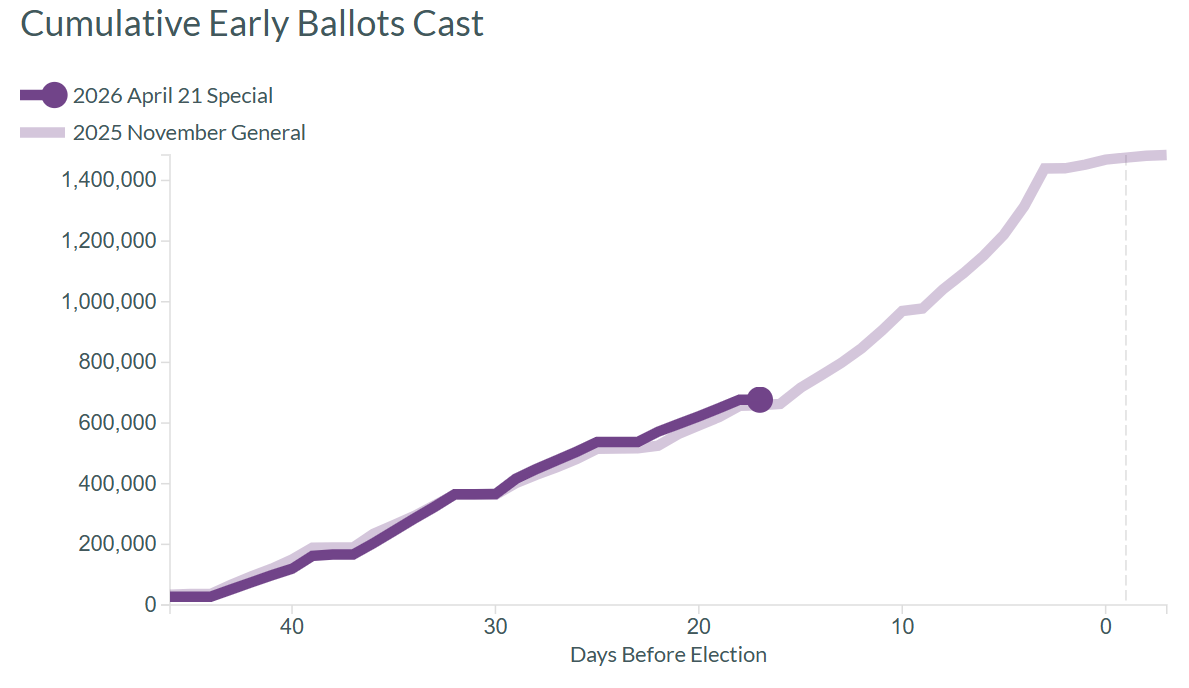
As of Monday, early-voting numbers for the April 21 election are edging slightly above those for the General Election last November. Who that favors, however, isn’t easy to judge.
The latest Washington Post-Schar School poll shows the race a virtual dead-heat.
Among Likely Voters (LV), 52% support the initiative while 47% don’t. Among Registered Voters (RV) it’s 53% versus 44%.
The poll’s margin of error for both groups is 3.4%, meaning the race is very much up for grabs.
Part of the reason that the race is as close as it is rests in Republican-leaning districts, where State Navigate — a nonprofit that closely tracks state-level elections — has found that Republican voters are more motivated than voters in Democratic-leaning districts in early voting. This estimate is made by tracking the increase or decrease in early-voting turnout by precinct relative to how it voted in the 2025 gubernatorial election.
No precinct has realized a greater jump in early voting, for example, than Fort Blackmore in far southwestern Virginia, where nearly 72% of voters went for Republican gubernatorial candidate Winsome Earle-Sears in November. There, early-voter turnout is up more than 320%. Impressive, until one considers that a total of just 25 people have early-voted in Fort Blackmore to this point.
While Republicans in red-leaning districts may be more motivated than the Democrats in blue-leaning districts, they are not outnumbering Democratic voters at the polls. State Navigate estimates that 59.6% of early votes cast are by Democrats.
This is likely due to Democratic turnout in 2025 being unusually strong, and Republican turnout being unusually weak. Republican turnout, in other words, has room to climb relative to turnout in November — significantly in some places. Democratic turnout, by contrast, has less room to grow. For Democrats, therefore, holding serve relative to their performance in 2025 may prove enough to carry the day.
Holding Serve?
In and around the Advance’s readership area, Democrats appear to be doing a bit better than holding serve.
In Spotsylvania County — until 2025 a traditionally Republican county — where early-voting turnout tracks slightly above 2025 early voting turnout, Democrats are overachieving. Spanberger won the county by 4 percentage points in 2025. State Navigate estimates that to this point Democratic early voters are +13.3 percentage points better than Republicans in the county.
A similar trend is showing in Stafford — a county that appears to have shifted from
Red to Blue — where Democratic early voters are +22.1 percentage points better than Republican voters. Spanberger won that county in 2025 by +11.
In Caroline County, Democrats are +8.9 over Republicans in early voting — Spanberger won that county in 2025 by +0.04.
In talking with Democrats in the region, however, many admit to feeling conflicted about the vote. For some of these, ensuring a Democratic majority in the U.S. House to serve as a check on Trump is more important than maintaining the current Congressional map which better reflects the partisan split in Virginia. Even if they realize that gerrymandering is a less-than-perfect solution.
Others, however, aren’t buying that argument.
That tension is captured in the Post-Scharr poll, which asked respondents whether Virginia Congressional districts should reflect the political makeup of the state or balance out other states that were drawn to favor one party. Fully 57% said districts should reflect the political makeup of the state.
So yes, more Democrats than Republicans are showing up at the polls. But more than a few Democrats are likely pulling the “no” lever on redistricting.
Low Approval
The anger among Republicans about the referendum, coupled with conflicted Democratic voters, may well help explain why Spanberger’s approval numbers are low.
The Post-Scharr poll shows that Spanberger’s disapproval numbers at this stage of her career are higher than for any of her predecessors’ since Gov. George Allen (1994 - 1998).
Fully 46% of registered voters disapprove of Spanberger, while 47% approve. No governor between Allen and Glenn Youngkin has had a disapproval at this stage above 39%.
But does her disapproval reflect frustration with her policies as a whole, or the frustration with the redistricting push?
For now, it appears that the redistricting fight is to blame. The base that Spanberger built and rode to the Governor’s Mansion is holding. And while Republicans in Virginia’s deepest red localities are turning out in force to make their displeasure over redistricting known, that anger does not appear to have seeped beyond the base to the moderates who decide elections.
Further, the Post-Scharr poll shows that among Virginians, Spanberger is far more popular with voters in Virginia than is Trump, whose disapproval rating sits at 57%.
In addition, aspects of her affordability policies are playing well with voters.
Should the referendum fail on the 21st, Republican hardliners won’t likely forgive Spanberger, but among Democrats and independents expect the issue to be quickly forgotten. And Spanberger’s approval ratings return to the above-50 range.
If redistricting carries the day, however, how Spanberger responds will have much to do with whether the growing resentment over gerrymandering extends beyond the Republican base to the large number of independents on whose backs Virginia elections swing.
Democratic leadership pushed the redistricting agenda, and Spanberger went along — begrudgingly, but she went along. If the amendment passes and the governor continues to give leadership what it wants when it cuts against her principles — as redistricting does — could prove a heavy weight to carry for four years.


Local Obituaries
To view local obituaries or to send a note to family and loved ones, please visit the link that follows.
