
By Martin Davis
EDITOR-IN-CHIEF
Email Martin

The Fredericksburg Area Association of Realtors recently released quarterly housing sales reports for the region, and the data for Spotsylvania and Stafford counties — the most dynamic in the region — raise an interesting question when juxtaposed to population data.
Will a housing market that is focused on supporting large families be the market we need for the near future?
Let’s begin with a closer look at what is happening to the populations in the two counties.
Lots of Children, A Lot More Graying People
According to data gathered by the Weldon Cooper Center and presented by Virginia Works, both Spotsylvania and Stafford counties are projected to see significant growth heading into 2030 and further out to 2040.
That isn’t surprising. What is noteworthy is the age distribution of that population growth.
Let’s begin with Spotsylvania, where by 2030 the county is projected to see a sharp increase in the numbers of men and women across three broad age groups: newborn to 9; 30 - 49; and 65 and older.
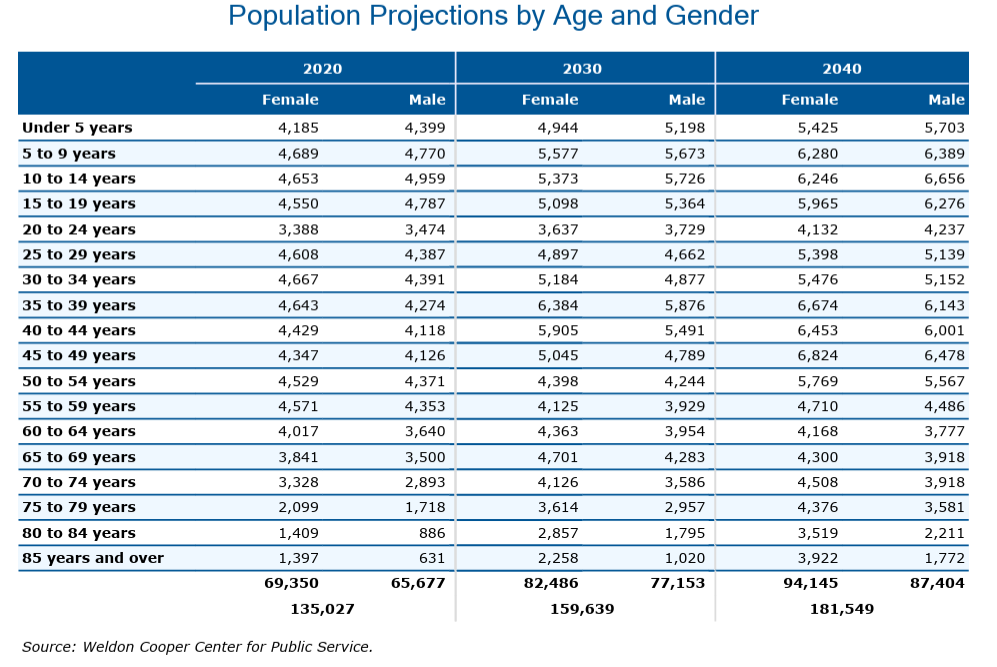
Compared with 2020, the population of children ages newborn to 9 in Spotsylvania will grow 18.6%, from 18,043 to 21,392.
For people ages 30 to 49, the growth is 24.4%, from 34,995 to 43,551.
Both pale on a percentage basis, however, to the surging retirement-age population. By 2030, the percentage of people over 65 is set to grow by 43.7% — from 21,702 to 31,197.
The story only gets more pronounced in Stafford County.
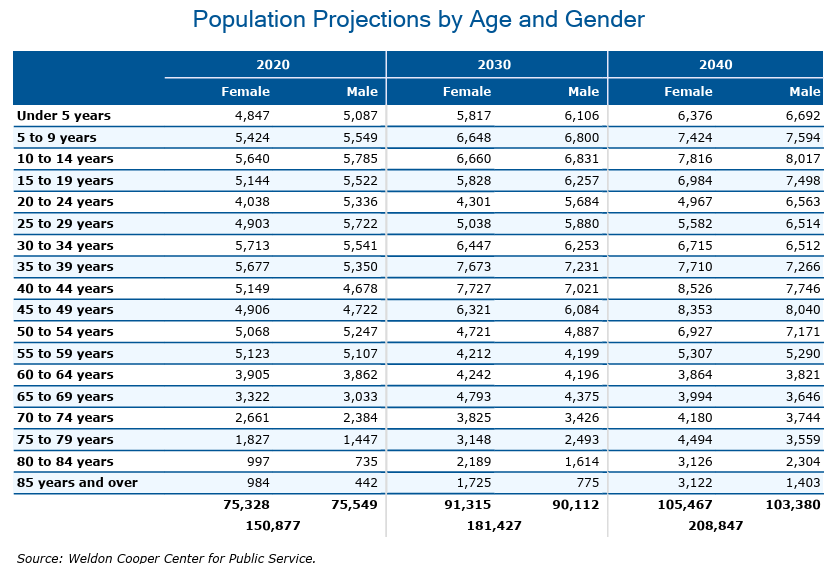
Compared with 2020, the population of children ages newborn to 9 in Stafford will grow 21.4%, from 20907 to 25371.
For people ages 30 to 49, the growth is 31.2%, from 41,736 to 54,757.
Again, both pale to the surging retirement-age population. By 2030, the percentage of people over 65 is set to grow by 59% — from 17,832 to 28,363.

For the young families that are moving into Spotsylvania and Stafford, the larger homes they are looking for to raise their families in exist — even if their costs continue to rise.
In Spotsylvania County, 65% of detached homes sold in the first quarter of 2026 were four bedrooms or larger. In Stafford, the figure is 70%.
With the average sold price well over $600,000 in each county (roughly $610,000 in Spotsylvania and $644,000 in Stafford), both localities continue to attract more well-off families who can afford to buy. That should be a plus for the overall economies of both — higher-value homes should bring more taxes, and the families who live in them generally have more disposable income to draw from and spend in their communities.
But these large homes are likely not what the surging graying population is searching for. They are more likely to look for smaller, single-floor options that are easier to move around in and maintain.
Creating that housing, however, may prove challenging in the current environment.
Pinched Budgets
Spotsylvania and Stafford face the unusual challenge of population growth among the two sets of people demographers refer to as “dependent,” because they’re generally not contributors to the economy, but rather place pressures on it.
Growing families with young children, for example, mean more pressure on schools to serve their children. That means more buildings, more employees, and more supporting structures that schools need to be successful.
At the same time this is happening, however, both counties are going to face more pressure from their aging populations.
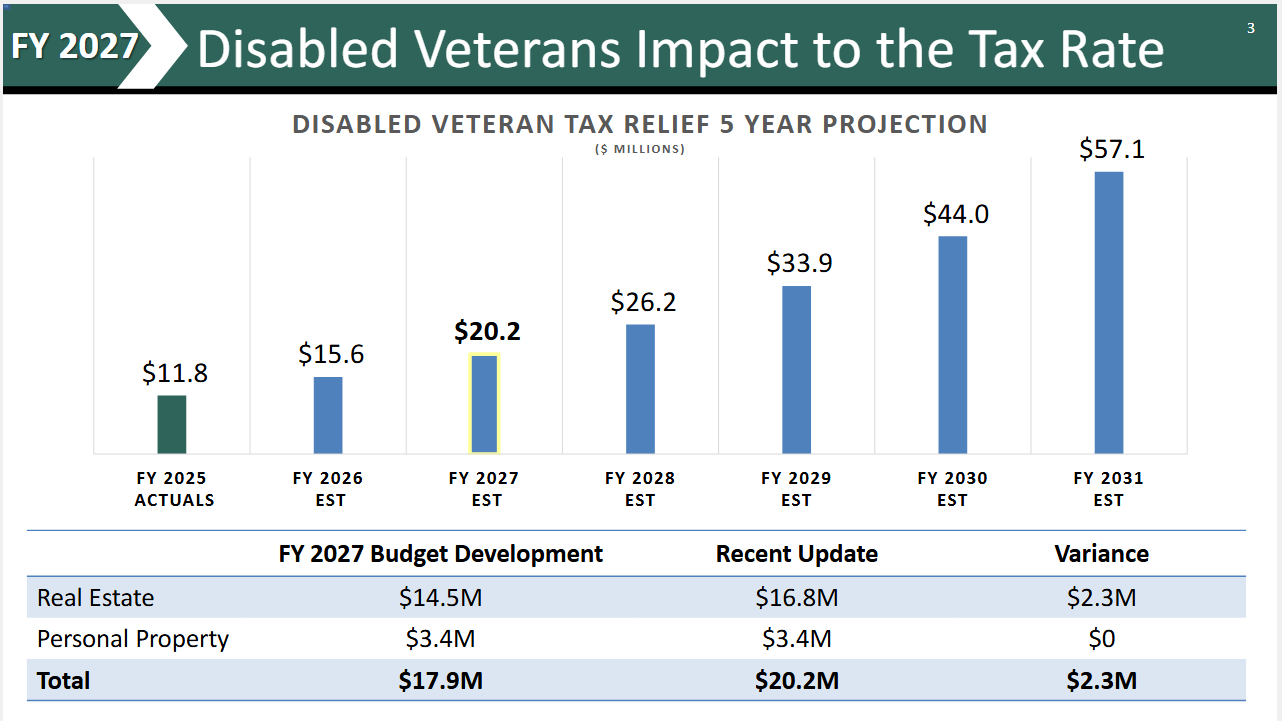
Currently, Stafford County’s budget crisis is acute. Spotsylvania is somewhat better off, but it is clear that the same problem that is plaguing its neighbor to the north is now knocking on Spotsylvania’s door — namely, tax relief for disabled veterans.
Disabled veterans in Stafford are expected to be relieved of $40 million this year in real-estate taxes. Though a good thing to do, the county has to find a way to fill the hole this creates in its budget.
The budget proposed in Spotsylvania County shows that it, too, will be facing a similar problem in just three short years when tax relief for disabled veterans is expected to be $44 million. That’s more than double what’s expected in 2027.
And then there are the pressures that aging populations place on localities. As people grow older, they require communities to provide adequate access to medical care, offer transportation options that meet seniors’ needs — especially those who are less mobile — and housing that is both affordable and adapted to seniors’ living needs.
Those smaller homes, however, generate less tax revenue and are generally frowned upon by local Boards for that reason.
The take-away?
While the cost of housing remains a significant challenge, the graying of populations in Spotsylvania and Stafford adds a new dimension to the affordability discussion — growing pressure on infrastructure to accommodate people’s needs, and building houses that are better suited to their needs. Houses that likely generate less tax revenue than the large homes so popular currently in the two localities.


Local Obituaries
To view local obituaries or to send a note to family and loved ones, please visit the link that follows.
