
By Rebecca R. Rubin, SPECIAL TO THE ADVANCE
Before our in-laws came to Fredericksburg last spring, we sent them pre-visit emails designed to convey a sense of our city: a Washington Post article suggesting that “Fredericksburg might want to start hyping itself as Brooklyn on the Rappahannock,” and one from Southern Living describing “America’s Most Historic City” downtown area as “... alive with antique shops, art galleries, and farm-to-table dining.” All of this is true, of course. Fredericksburg is indeed filled with art, food, history, culture, music, and antiquing venues—not to mention, a campus-community connection with the University of Mary Washington. So much to love!
Alongside this truth, though, lies another and equally important one: Fredericksburg has diminished but still significant conservation assets, and these require every bit as much knowledge, thought, forward planning, involvement, ambition and partnership-building as the city’s cultural, historic and built structures.
CONSERVATION CONSIDERATIONS
Of Fredericksburg’s 10.5 square miles, or about 6720 acres, a little less than 1/5 is held in managed parks and green space, under stewardship of the city’s parks maintenance division.
After heavy losses between 1996 and 2009, our overall tree canopy (including both private and public property) has been partially restored thanks largely to Tree Fredericksburg and lies between 36 percent and 44 percent, depending on the neighborhood, with a goal of closer to 49 percent overall. Our Urban Forest contains an inventory of each tree planted in a public area, together with their collective benefits, including storm water runoff, CO2 removal, and air pollution mitigated.
Adjacent lands are equally important for habitat, wildlife and recreation. The city owns 4200 acres of riverfront lands outside the city limits, the so-called river conservation lands, with the easement held by The Nature Conservancy, the Virginia Outdoor Foundation and the Dept of Wildlife Resources.
These are protected, forested shorelands on both sides of the river, the intent of which is to safeguard upstream raw water supply—that is, to protect the city’s drinking water supply, as well as for flood control. (Showing a great deal of foresight, the city acquired these lands from VEPCO in March of 1969 and placed them under easement in April, 2006.)
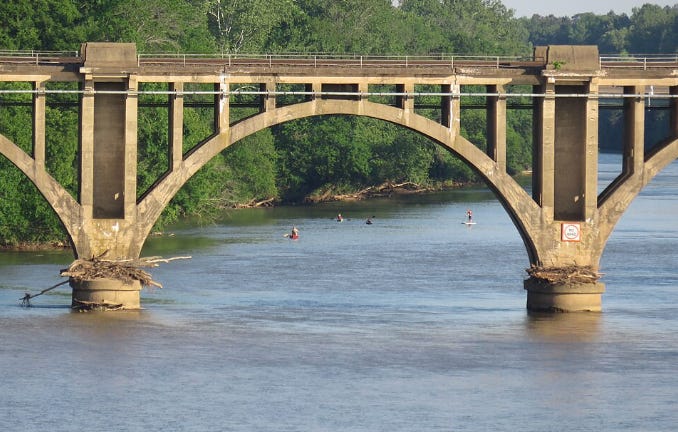
The river running through town, the Rappahannock, is the longest free-flowing river in the East because of the conscious decision to blow the Embrey Dam and “let the river run free.” In 2025, the environmental nonprofit American Rivers named it the sixth most endangered river in America due to a combination of declining groundwater levels, rising demand, and lack of basin-wide planning. Beginning in the Blue Ridge Mountains and flowing into the Chesapeake Bay, it is essentially one long, fluid, wildlife corridor—its waters providing a critical source of drinking water, its footprint an ecological buffer against the forces of fragmentation brought on by development, and its banks and wetlands serving as habitat, forage and nesting grounds for diverse wildlife from the better known (and seen) Great Blue Heron, Canada Geese, Red Shouldered Hawks and Bald Eagles to the more elusive Tri-colored and Big Brown Bats and North American River Otters.
And, the adjacent National Park Service lands add significantly to our outdoor public culture, as well as providing critical areas for wildlife. While the numbers are hard to come by because the NPS manages Fredericksburg and Spotsylvania National Military Park as a single, cohesive unit, the Fredericksburg portion alone probably runs between 1200-1500 acres, including three places where in-towners are fond of recreating: Lee Drive and the adjacent woodlands, Sunken Road and Marye’s Heights, and Chatham Manor and grounds. These areas call out for partnerships with the city of Fredericksburg, especially as regards the rapid growth of invasive plant species which cross-pollinate between city and NPS lands.
As the city has grown and populations have expanded, these conservation lands have become buffers against the mounting pressures of suburban growth. Collectively, they form a conservation mosaic critical for habitat and wildlife – and for us, its residents. To put that differently, they are assets.
In some sense, each decision made by the city regarding proposed new development must be balanced against our need for these conservation lands, factoring in ecological impact with intentionality, requiring a thoughtful, in-depth look at underlying ecology and its contributions to the quality of our lives and supportability of wildlife and habitat.
Somebody recently described Fredericksburg’s conservation challenge as “a battle for the soul of the city,” and I think that’s accurate. As an employer for three decades in this and other cities ranging in size from small to large, I learned that a highly developed city isn’t necessarily what attracts people; what they tend to like is outdoor places to recreate and to raise their kids as measured by open space, parks, and access to nature. Yes of course, an economic base is critical – to a point. At some stage, people start to feel the imbalance when places they walk, hike, bike or stroll have development at their edges; where there is more noise, traffic, crowds, heat, and overall incursion into their recreational space; where there is little to no shade as would be offered by forested areas; where there is eerily decreasing birdsong.
FORWARD PLANNING
The reality is, we have been planning this city for almost 300 years—and each year has brought another diminution of our conservation assets. Now, as we plan for the next 300 years, a more explicitly protective approach to conserve and potentially to grow these conservation assets is needed.
Given the import, one wonders where a planning commission and city council might obtain ecological information that would help inform their decisions. Nationwide, the composition of these bodies tends to reflect more of a business development orientation and less so ecological knowledge and information.
If indeed conservation priorities are desirable, then some suggestions could include:
+ Framing efforts as pilot programs initially, which can be grown to scale over time. For instance, the city should be commended for planning an upcoming invasive plant management work effort on September 9th from 9:00 to 11:00 a.m., with help and inputs from Tree Fredericksburg and volunteers, with the idea of beginning to control the rapid infiltration of invasive plants on city lands. (Invasives compete with native plants and provide comparatively less shelter and food for wildlife. And some invasives, such as Tree of Heaven, are the primary host for invasive insects such as the spotted lantern fly.)
+ Taking advantage of American Planning Association resources to help planners integrate natural solutions into urban planning This is not a far-fetched concept. As many have pointed out, the City council’s recent voting down of a data center also served the dual purpose of preserving (for now) conservation lands, underscoring that nature and informed planning decisions often run together.
+ Monitoring forums such as the C40 Cities Climate Leadership Group and Cities With Nature offer climate-resilient solutions—enabling us to read and learn about relevant examples if we focus on those cities operating at our scale.
+ Establishing advisory councils—since almost every form of development has ecological implications, a number of cities utilize environmental advisory committees—varying in form and purpose— to help advise city councils, planning commissions, and mayors. To be effective, their focus cannot be solely on green spaces but, more broadly, on identifying ecological impacts of proposed development, thus requiring inputs from the ecologically knowledgeable souls among us—biologists, ecologists and other so-called “ologists “—and those versed in environmental justice.
+ Using common sense helps, too—the knowledge that all of human life depends on ecology, and that we would be wise to treat our local ecology as the asset that it is.
Gradually and over time, the upshot might be something of a cultural shift in planning, to embrace what is sometimes called ecological urbanism, where cities are viewed not just for their built infrastructure but essentially as an entire conservation mosaic, interleaving nature and ecology into planning decisions.
It might also help us to see that the name a planning area is given – such as an industrial park or a technology overlay district—may have nothing to do with its underlying ecological value, and that closer scrutiny of all of our assets, regardless of their nomenclature, is merited. A good example here is our industrial park, with its significant conservation acreage thanks to the Belman Road campus of Downtown Greens; the last working farm inside the historic district thanks to Braehead Farm; and a nature-based school campus just on its outskirts, thanks to Brompton Community School. Add a few thousand more trees, and we’d have the beginnings of a climate preserve without ever sacrificing the existing buildings.
How well, or how poorly, this or any city embraces conservation as a critical factor in decision-making will help define long-term outcomes for us all. As former Interior Secretary and conservation giant Stewart Udall said: “Plans to protect air and water, wilderness and wildlife are in fact plans to protect man.”
***
Rebecca R. Rubin is a landscape-scale conservationist and a board member of several non-profit conservation organizations.

Excellent piece. Made me think about the Seventh Generation Principle and how valuable it would be for our leaders to make decisions with that in mind.