
By Martin Davis
EDITOR-IN-CHIEF
Email Martin
My years in Columbia, South Carolina, were wilderness years as far as politics go. After each election, my wife and I would look forward to picking up the next day’s edition of The State newspaper — one of the great newspapers in America that, like the Free Lance-Star, is now being gutted — and read the voting breakdown by precinct.
In our precinct, Democrats barely registered. Following one election, the results showed just 10 votes cast for Democrats. “Who are the other eight?” we collectively wondered while laughing.
The laughter masked our frustration. Democrats in South Carolina at that time were poorly organized and didn’t offer much by way of counter-vision to their Republican counterparts. Among those I knew in the local party, the sentiment was, “Why bother?”
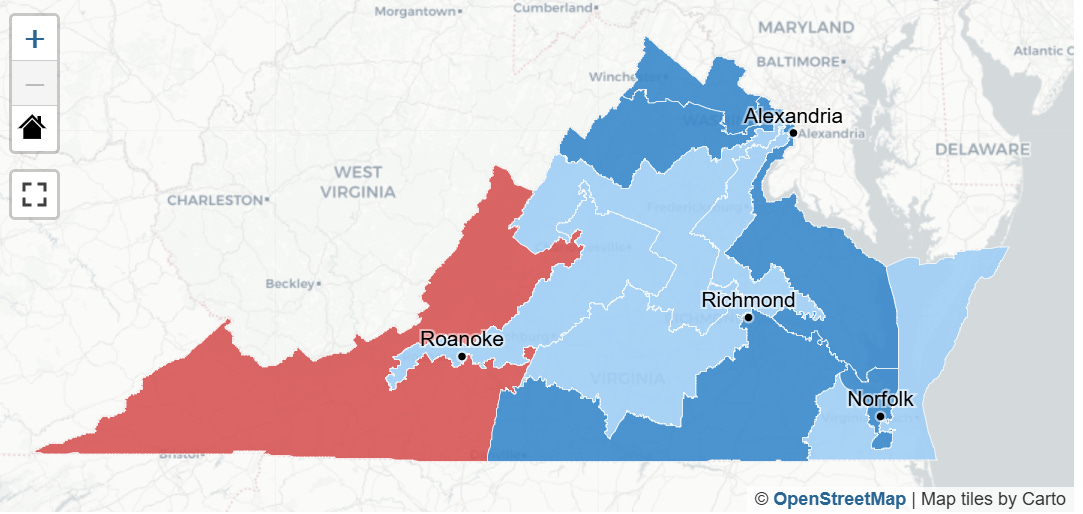
Last Tuesday’s vote clearing the way for the gross gerrymandering of Virginia did not sit with many Republicans the way elections sat with me in South Carolina. There, being in the minority was the result of living in a culture that widely agreed with the Republican platform in the 1990s — a world away from today’s Republican Party.
Knowing that made keeping election results in perspective a bit easier. Personally losing election after election — though there was the occasional surprise — certainly wasn’t fun. But I didn’t take it take personally. And it didn’t stop us from being friends with our neighbors.
We were in the minority not because we had been forced there, but because we happened to live in a community that largely didn’t share our political values as Democrats.
For many of my Republican friends, last Tuesday’s election that authorizes redistricting was personal. And alienating.
“My neighbors just told me my voice doesn’t matter,” said one prominent local Republican who is intelligent, civically engaged, and a frequent source for my reporting.
Political debates are going to be intense. But when politics becomes alienating, it’s important to recalibrate what is happening.
Who Is My Neighbor?
The core of the Democrats’ argument for redistricting is based on a national problem — the move by President Trump to cajole Republican states into gerrymandering their states mid-cycle so as to retain power as his administration spirals out of control and continually fails to deliver on its campaign promises. Ending the Ukrainian War. Lowering prices. Keeping America out of “forever” wars.
Moving to stop a failing president from acting to tilt the playing field is not an unreasonable argument when the fabric of American democracy is on the line. The question becomes, are we truly at that point? That question helps explain why so many Democrats voted yes, but reluctantly.
Many of us voted for the redistricting referendum in Tuesday’s out-of-season statewide general election holding our noses as we did. That we felt we had to is an indictment on the applied politics of this age.
Let’s be clear: The most divisive and toxic president of the United States in my lifetime (yes, I was around for Nixon) had his name all over this. Without Donald Trump’s frightening and chaotic second term, this statewide referendum would be unimaginable.
While Lewis and many other Democrats believe that President Trump pushed the state to this vote, that Virginia moved ahead still didn’t sit well with many Dems demands an explanation. Again, Lewis:
With this narrow victory for “yes,” we in urban/suburban Virginia imposed our will on fellow Virginians outside our corridor of relative privilege by sheer force of numbers. We’ve got to own that.
Democrats who supported this referendum are also going to have to own the consequences of imposing their will on their neighbors.
The alienation of their Republican neighbors.
Elections are about trade-offs — some issues are worth risking losing the trust of your political opponents. Redistricting was not one of those issues.
Why the Referendum Wasn’t Necessary
Start with what happened last November.
Gov. Abigail Spanberger took the oath of office riding the crest of a November landslide victory — at least, as big a landslide as one is likely to see in our current times. She won principally because she put together a campaign focused on things that matter to today’s voters — affordability.
More important, she won because she has a well-earned reputation for knowing how to lead. In Congress she worked across the aisle, called her own party to account, and did so without compromising the progressive politics that center her governing philosophy.
At the same time she is surging, Trump’s administration is flailing. Virginia Congressional Republicans have largely continued to stand by the White House as day-to-day costs continue to rise for most Americans, and we are being dragged into an ill-conceived war in Iran.
Nothing is ever sure until the votes are counted, but all the indicators are that Democrats stand to rack up a substantial number of seats in November.
The site 270toWin is projecting that Democrats will win 216 seats in November to 202 for Republicans, with 17 races listed as “Toss-ups.” Remove the four seats Virginia’s redistricting is projected to give the Democrats, and that still gives them a 212 to 206 advantage.
The Kalshi prediction is even more stark, with 234 seats projected to go to Dems against 196 for Republicans, with just 5 races listed as Toss-ups.
Even prior to redistricting, it seemed likely that Virginia was going to pick up at least one seat this November, and as many as three. That’s how potent the combination of Gov. Spanberger’s platform and Trump’s flailing policies were on Virginia voters.
With Democratic control of the House on a smooth glidepath to November, it’s right to ask if the result — a gain of four House seats when the Dems in Virginia looked to pick up one to three — was worth the price of alienating our Republican neighbors.
Learning How to Win
For some, Democrats worrying about how Virginian Republicans feel given that the Trump Administration routinely speaks about the Dems in vile and dehumanizing language makes little sense.
Because Trump is so unrestrained, the Dems’ argument goes, it justifies using Machiavellian measures to put a stop to it.
What that response actually shows, however, is that they have failed to learn the most important lesson from Gov. Spanberger’s victory.
Sound policy and listening across the aisle still wins elections.
It worked in 2025, and it was working in 2026. Abandoning this approach to pound Trump — while alienating Republicans, especially those who either voted for Spanberger in November or simply stayed home, thereby de facto strengthening her run — is how parties end up losing elections.
It’s hardly a Democratic problem. In the 1990s and early 2000s, the Republican Party rightly earned the reputation of being the party of ideas. The party learned to run on those ideas and win, but it never learned to govern effectively. That opened the door for Obama in 2008, and arguably the door for Trump in 2016.
Democrats in Virginia would do well to admit the damage the redistricting campaign has done, and from there govern in a way that reflects the governor’s bipartisan nature.
If they can learn that lesson, then perhaps Virginia Republicans will feel as I felt in South Carolina. Frustrated when they lose, but not alienated from their neighbors, and motivated to raise better solutions to the problems that face us all.


Local Obituaries
To view local obituaries or to send a note to family and loved ones, please visit the link that follows.

So you think we should bet the future on polling? Ask Hillary Clinton how that turned out.
I'm sorry but drastic times demand drastic action. If Mike Johnson and John Thune get two more years of cowering and abdication to Russell Vought (he is the one calling the shots to implement Project 2025) and putting up with the incompetence and sycophancy of the leadership of the Executive Branch there's no telling how far our democratic institutions will have fallen. The people spoke for "blue" Richmond and the legislature and governor have responded. Take any and all steps. Reminder: Look at who brought the tens of millions to the Commonwealth in advertising to defeat the referendum--Peter Thiel, the billionaire financial backer of J.D. Vance and all things far right and the founder of Palantir who is under multiple contracts to the Federal security apparatus to take away liberties and deport citizens. His advertising campaign brought up decades old statements from President Obama and had old white men in ball caps saying a "yes" vote would bring illegal immigrants to our communities to rape and pillage and government thugs to take away AR-15s. THAT is what we are up against. Drastic times.
Sadly, I’m beyond caring about alienating Republicans. For the greater good. This is temporary and if we are all willing to have a little grace, so will be the alienation.