
By Martin Davis
EDITOR-IN-CHIEF
Email Martin
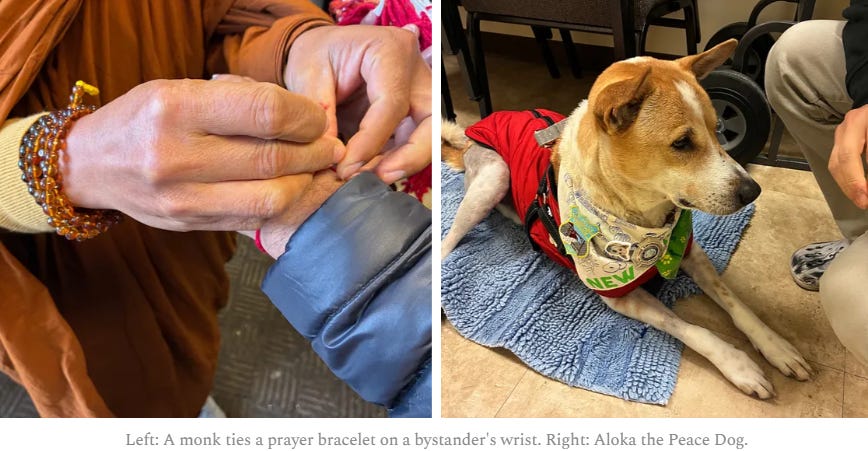
For much of last week, a group of monks walking for peace captured the imagination of the Fredericksburg region — all along the way they’ve offered an important lesson in what change looks like. And I got it wrong.
Rewind to a bitterly cold evening this past week, and the open house at the Fredericksburg Visitors Center where I’d gone to peruse the activities being planned for the 250th birthday celebration this year.
Walking out I spotted a friend and stopped for some small talk, when the topic turned to the monks. As the conversation developed, my friend sensed some skepticism on my part about their time in the city. “Do you think they can bring positive change?” — or something to that effect — he asked.
“No,” I said.
While I admire what they are doing, and would never downplay a feel-good moment, the idea that any significant type of lasting change could emerge from a group of Buddhists covering 2,300-plus miles by foot struck me as far-fetched.
By Friday evening, when I was editing Adele’s fine piece about the monk’s visit to the Unitarian Universalist Fellowship in Stafford County and perusing the excellent photos Cori Blanch has taken for us — as well as seeing shots from others across Virginia — I became aware of what my friend saw, and what I had clearly missed.
Seeing Change in Three Dimensions - Bad Bunny
We often fail to appreciate significant moments when we see them, because we are so locked into one-dimensional thought, we miss the three-dimensional forces at play. This is particularly true when we are talking about cultural change in times when tensions are high.
As I write this, I’ve just finished watching Bad Bunny’s halftime performance. I hadn’t planned to watch it — I watch the Super Bowl for football and have routinely tuned out the halftime show and TV commercials since I started watching the game (Super Bowl V was my first — and I’ve seen every one since) because, well, I like football — until I read Noah Shachtman’s essay in the New York Times, “The Culture War Is Over. Bad Bunny Won.”
Bad Bunny’s performance isn’t just the story of the ascendancy of a single performer, or of one genre, or even of Latin music more broadly. It’s the sign of something bigger still. America’s pop culture today is multilingual, polycultural and international at its very core.
… Donald Trump … isn’t too happy about it. (“Terrible choice,” he told The New York Post, announcing he’d skip the game.) That’s the cultural equivalent of raging about the end of the eight-track tape. The change has already happened.
What Shachtman has identified is something critical about change — more times than not, it isn’t instituted from above and then trickles down in planned fashion. Rather, it flows in various ways through societies.

By the time forces are marshalled against it, those standing in protest have already lost, because they failed to understand the complex interplay of ideas and cultures.
Scholars who study how culture migrates have found two broad ways this happens — Relocation, which involves the movement of people, and Expansion. Expansion is the more complex, as there are at least four different ways ideas move across physical barriers, sometimes long before the people responsible for the ideas ever move.
Bad Bunny is a great example of what is deemed “contagious diffusion.” His music moves through populations like the common cold. Once exposed, people “catch it” and are drawn into its originality and power. (Let me confess that I even found myself enjoying Bad Bunny — an artist three days ago I was going to ignore in favor of a second bowl of chili and a cold beer while I waited for the second half to get underway.)
Efforts to turn back cultural ideas — like Bad Bunny — are not just futile, they’re foolish.
Those who would try — and usually fail — do so because even when confronted with evidence to the contrary, they cannot get outside of the singular dimension they live in to appreciate what is happening.
Creating Hope
How do the monks fit into this?
In the same way that people fail to understand the complex ways cultures can cross boundaries, I failed to appreciate the complex ways change can occur.
When asked if I thought the monks could create change, my mind went immediately to the political. The thought that these monks can touch Donald Trump’s heart seemed ridiculous to me when I was talking with my friend — it seems no less likely now.
But this is far from the only way that change occurs.
Sometimes, simply creating hope within those without power is a vital form of change.
“This is just the most hopeful thing,” Marylise Cobey told the Advance. “You read a headline these days and your heart just drops. But this is hopeful.”
Cobey is hardly alone.
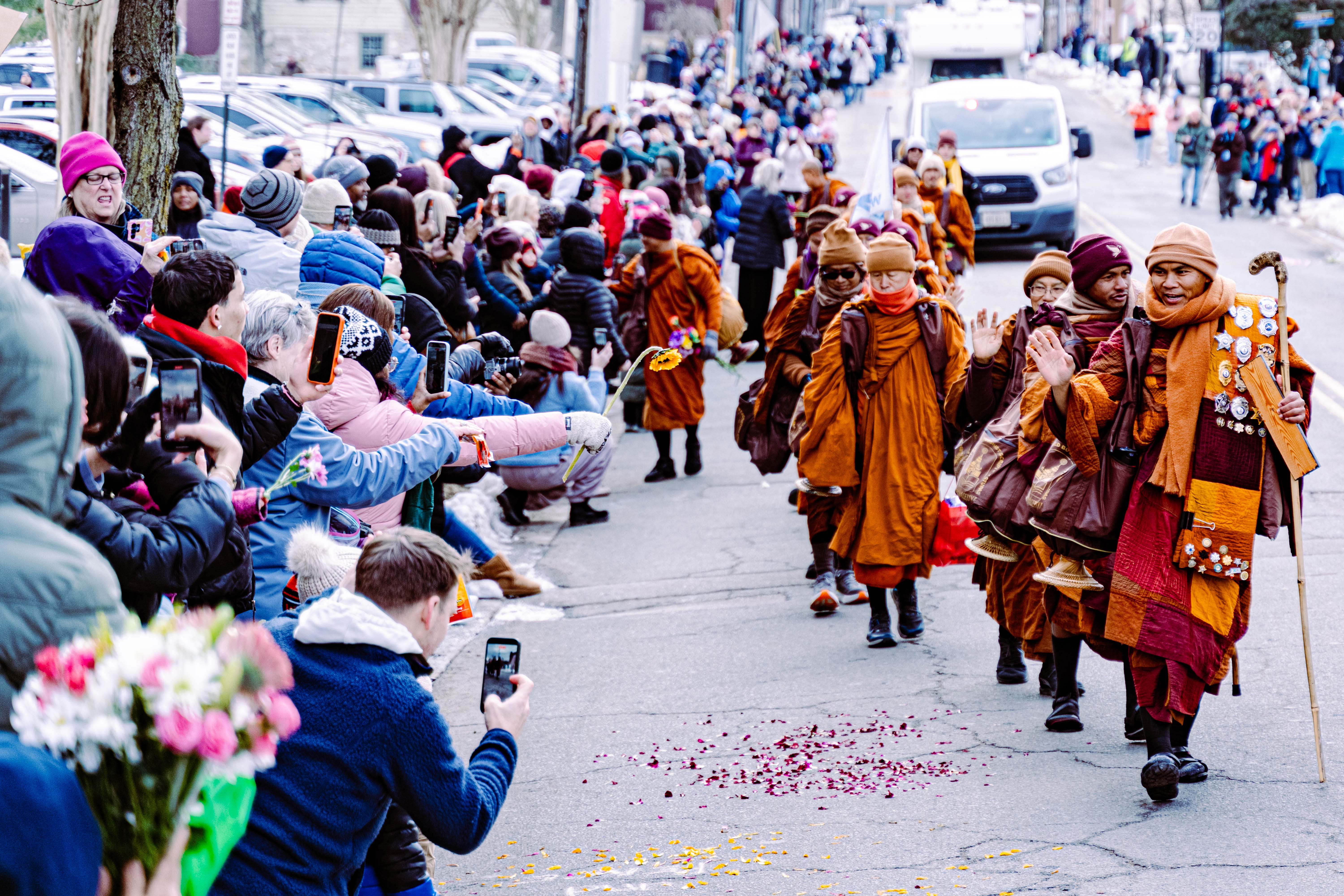
Over 2,300 miles, it’s difficult to know how many people have found hope in viewing the monks — tens of thousands, hundreds of thousands, millions?
It suffices to say: enough.
Enough that the horrible news daily flowing from Washington, from Minneapolis, and from detention centers hasn’t dimmed people’s ability to find hope in something deeper than the reality they live in.
Enough that the ideals set forth by James Madison and Thomas Jefferson and George Washington, and fully animated by Martin Luther King Jr., Malcolm X, W.E.B. DuBois, Caesar Chavez, Ida B. Wells, Susan B. Anthony, Harvey Milk and more are in no immediate threat of being dimmed.
Enough that even a cynical newspaper man can be taught to see what he missed.
Enough that the endless barrage of doom-speak that has defined too much of public conversation over the past decade has failed to strip the people of hope.
Even in trying times, there are more who choose love than those who choose hate.


Local Obituaries
To view local obituaries or to send a note to family and loved ones, please visit the link that follows.

...one step at a time.