

By Martin Davis
EDITOR-IN-CHIEF
Email Martin

Let there be no mistake — there is a coordinated, intentional effort to rewrite the history of Black Americans in the nation.
The methods are at times as glaring today as they were in 1950, when the Virginia Senate created the Virginia History and Textbook Commission to craft books that perpetuated the “Lost Cause” mythology and argued that Blacks were better off as slaves.

President Donald Trump, under the guise of purging Diversity, Equity, and Inclusion programs from schools, has overseen the removal of nearly 400 titles from the library at the United States Naval Academy. The list of removed books is a who’s who of black American writers and ideas that dare to suggest that racism remains a problem in American society.
He’s further ordered reviews of displays at National Park sites that people perceive as “negative about either past or living Americans or that fail to emphasize the beauty, grandeur, and abundance of landscapes and other natural features.”
Unsurprisingly, references to slavery are frequently targeted for removal.
Most efforts are less blatant than the president’s.
Former Gov. Glenn Youngkin in 2022 signed Executive Order One, which sought to end the teaching of “inherently divisive concepts” that, according to the order:
… instruct students to only view life through the lens of race and presumes that some students are consciously or unconsciously racist, sexist, or oppressive, and that other students are victims.
The order was in reaction to some schools that were shaming students into feeling bad about their past. But rather than correcting that limited problem, the order overreached, putting history teachers, in particular, in impossible positions.
The order recognized that slavery and the treatment of Native Americans were “horrors,” but it rested on an assumption that the effects of those historical realities are no longer affecting minorities.
That assumption is demonstrably false.
Slavery certainly was a horror, but so, too, is redlining. This blatantly racist tactic that has historical roots in slavery, was baked into policy in the early 1930s, and was practiced into the 1980s; it denied Black Americans opportunities to buy homes and build generational wealth well. It helps explain why Black Americans are disproportionality more likely to live in poverty than white Americans.
It’s not the only example of how racist treatment of Black Americans continues to affect them today.
The well-documented unethical, inhumane medical experimentation on Black Americans at the turn of the 20th century has created a deep distrust within that community of modern medicine. To suggest it did not is to turn a blind eye to the obvious.
To deny teachers the ability to teach these realities — which was an outcome of Executive Order One, as many teachers struggled to understand where the line was — is to undermine what Youngkin himself said he wanted. To teach “critical thinking.”
No doubt, for many white Americans coming to grips with these realities is uncomfortable. It should be. But discomfort is no grounds for ignoring historical reality.
Facing such truths awakens us to the reality that we all fall short of the ideals of American freedom. And in so doing, we can strive to be better. Denying this struggle, however, can lead to the loss of the freedoms we have gained.
A Long Time Coming
At Saturday’s inauguration, Gov. Abigail Spanberger gave a history lesson to those in attendance about the length of time it takes to first reach legally, and then strive to win broader support for, equality.
The first female governor made people fully aware of how long it took for Virginia to finally reach Saturday’s historic inaugural.
While the 19th Amendment gave women the right to vote in 1920, “it would not be until 1952 that Virginia finally ratified it,” she said, before noting that “the right to vote was not truly secured until the passage of the Voting Rights Act of 1965.”
Yet even today, women’s suffrage is again under attack — this time from conservative evangelicals. What began as a fringe movement among evangelicals to vote by household — with the husband casting the vote — is now backed by the U.S. Secretary of Defense.
It’s hardly the only movement to relegate women away from the halls of power. The so-called trad-wife movement is dedicated to traditional gender roles that keep women at home and focused on raising children, as opposed to pursuing careers.
The emergence of these ideas is a reminder that what is fought for and earned cannot be taken for granted.
A Clarion Call
Last week, Spotsylvania County Board of Supervisors Member Deborah Frazier and NAACP chair Mo Petway gave as powerful a lesson on the fragility of equality as Spanberger delivered on Saturday.
Despite serving seven years on the Board, Frazier was again denied an opportunity to serve in a leadership role as either chair or vice-chair. The snub led to a rebuke of her fellow Board members.
But it was the comments of Mo Petway, head of the Spotsylvania NAACP, that stood out.
“It took over 220 years to get the first African American to serve on this Board…. I can assure you Ms. Frazier is more qualified, has more leadership experience, than most of you that’s on the Board.”
Two hundred and twenty years.
Jackson, Mississippi, is further along than Spotsylvania County in Black representation on its City Council. So, too is Wilmington, North Carolina. And Tulsa, Oklahoma. And Farmville, Virginia. All sites infamous for their roles in America’s troubled history with race.
Why has it taken so long? It’s a question for every person who calls Spotsylvania home.
Perhaps we don’t do enough to talk about Spotsylvania’s own troubled history with race.
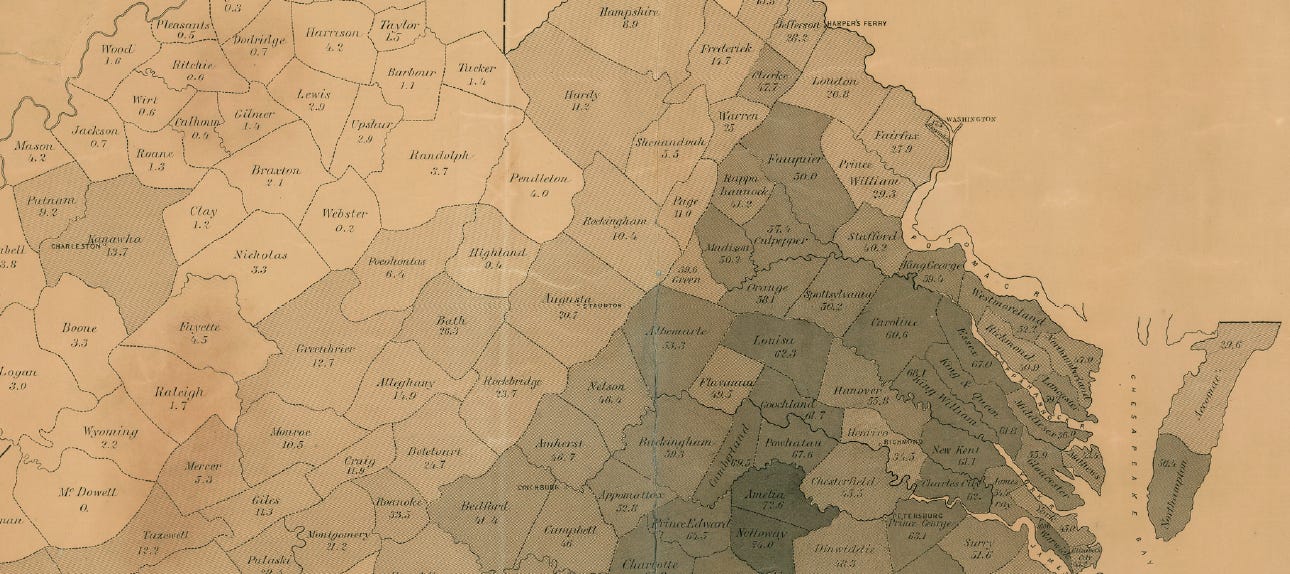
The county commemorates the Civil War with high-profile memorials and preserved battlefields, but where are the high-profile memorials denoting that on the eve of the Civil War more than 50% of Spotsylvania’s population was enslaved? A fact spelled out in the following map of Virginia showing the concentration of slaves in the state based on the census of 1860.
Perhaps we don’t do enough to celebrate the rich stories of Black Spotsylvanians and those who engaged in the struggle for equality.
How many in the county’s community are aware of the story of George Boxley? A Spotsylvania slaveholder who for reasons not clear turned against the Peculiar Institution and in 1816 was arrested for working to free slaves in the county?
How many know that Black Spotsylvania native Benjamin Brown won the Medal of Honor?
The county has documented some of these stories, and many others, and put together a 75-mile driving tour that allows people to discover the rich story of African Americans in Spotsylvania.
But there is more to be done. Perhaps these names should be as common to school children in Spotsylvania as George Washington and James Madison and Thomas Jefferson.
That is the nature of struggle.
Justice above All
What Martin Luther King knew was that the civil rights movement was about more than equality for Black Americans, it was a struggle for justice for all. And that struggle is about more than laws and rights, it is at its core about understanding the extent to which the struggle is ongoing, and can never be turned away from.
That awareness cost King support later in life. When he turned against the Vietnam War, and tried to launch a Poor People’s movement, he was chastised by Black and white alike for turning against “the movement.”
King remained steadfast.
The struggle for freedom on the part of oppressed people in general and of the American Negro in particular has developed slowly and is not going to end suddenly. Privileged groups rarely give up their privileges without strong resistance. But when oppressed people rise up against oppression there is no stopping point short of full freedom. Realism compels us to admit that the struggle will continue until freedom is a reality for all the oppressed peoples of the world.
Further, that struggle requires a commitment to nonviolent action grounded in love.
At the center of nonviolence stands the principle of love. In struggling for human dignity the oppressed people of the world must not allow themselves to become bitter or indulge in hate campaigns. To retaliate with hate and bitterness would do nothing but intensify the hate in the world. Along the way of life, someone must have sense enough and morality enough to cut off the chain of hate. This can be done only by projecting the ethics of love to the center of our lives.
Yes — there is a coordinated, intentional effort to rewrite the history of Black Americans in the nation. But there will always be efforts to undermine freedom. And freedom is what today is about.
That struggle is as much with us today as it was at King’s birth, at his death, and in the years ever since. That struggle will always be with us, because it is for all of us.


Local Obituaries
To view local obituaries or to send a note to family and loved ones, please visit the link that follows.

Support Award-winning, Locally Focused Journalism

The FXBG Advance cuts through the talking points to deliver both incisive and informative news about the issues, people, and organizations that daily affect your life. And we do it in a multi-partisan format that has no equal in this region. Over the past year, our reporting was:
First to break the story of Stafford Board of Supervisors dismissing a citizen library board member for “misconduct,” without informing the citizen or explaining what the person allegedly did wrong.
First to explain falling water levels in the Rappahannock Canal.
First to detail controversial traffic numbers submitted by Stafford staff on the Buc-ee’s project
Our media group also offers the most-extensive election coverage in the region and regular columnists like:
And our newsroom is led by the most-experienced and most-awarded journalists in the region — Adele Uphaus (Managing Editor and multiple VPA award-winner) and Martin Davis (Editor-in-Chief, 2022 Opinion Writer of the Year in Virginia and more than 25 years reporting from around the country and the world).
For just $8 a month, you can help support top-flight journalism that puts people over policies.
Your contributions 100% support our journalists.
Help us as we continue to grow!


This article is published under Creative Commons license CC BY-NC-ND. It can be distributed for noncommercial purposes and must include the following: “Published with permission by FXBG Advance.”
Well thought, well said, and not said enough. Decency must lead the way.
Thank you for this excellent commentary.