By Rebecca Rubin, ADVANCE CONTRIBUTOR
There are relatively few things that I know for certain. One is that my daughter’s room is a testimony to controlled chaos. The second is that I will sorely miss that chaos when she heads to college. And the third is that there are unlikely to be long-term solutions for land conservation at a scale large enough, in any city, without private landowners taking steps to contribute to the overall conservation mosaic.
“Private lands” doesn’t only mean vast lands—although, those are good too. Think instead of a back, front, or side yard of any size, whether owned or rented. Decks, porches and community gardens also pull their own weight.
Enter Fredericksburg, where—by 2011—roughly half our city lands had been given over to impermeable surfaces. This is more than just a loss of scenery. Impervious cityscapes mean more toxic wash-off, thermal pollution, ecosystem mortality, and habitat fragmentation. They also mean more extreme rainfall, flooding, and storm water runoff.
Private lands can help mitigate some of this. Conceptualize a conservation mosaic consisting of private lands with native habitat across Fredericksburg: How much acreage would this be? It’s hard to say with precision, but a crude calculation points to about 30 percent of Fredericksburg’s 6688 acres. A little less than 20 percent of our city lands are in public parks and recreation, and another 48-50 percent are paved/impervious, leaving a hypothetical amount of roughly 30 percent or about 2000 acres to work with.
If an initial 10 percent of that were planted with intention to support wildlife, create habitat ,and reduce urban runoff, that would yield 200 acres—comparable to an 18-hole golf course or 200 football fields—although not laid out side by side. That’s a good start. A better one would be 20 percent, or about 400 acres.
It’s also the case that native plants have ambitions of their own. Left to their own devices, they will tend to spread naturally, such that 10 percent grows to 20 or 30 percent with relatively little tending.
Conservation has many levels, and elsewhere I’ve written about what the city can do to safeguard Fredericksburg’s conservation future. The focus here is on how city residents can make a personal commitment from the convenience of their own yards.
What Can I Do?
There is a human tendency to over-engineer things, and native plantings are no different. Plot maps, seasonal charts, and a sense that conversion to native habitat must be immediate and complete rather than incremental can all lead to throwing in the trowel. Instead of “How to,” think “How easy.”
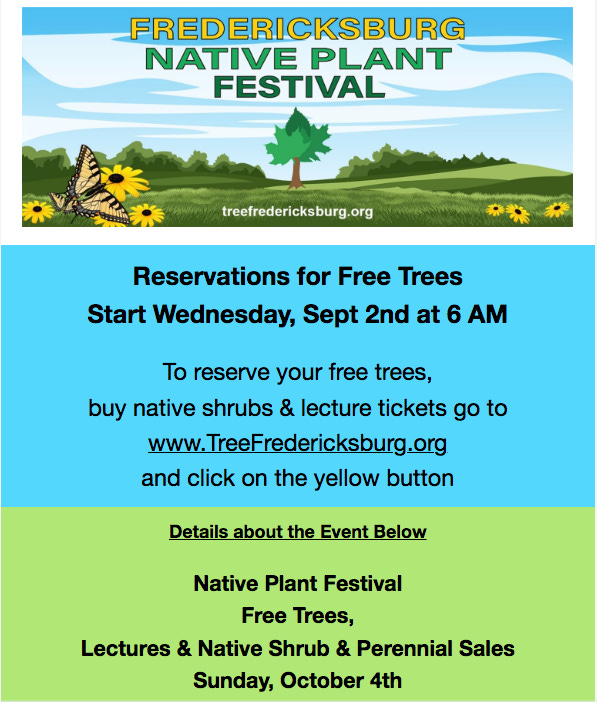
1. Where to Start? Tree Fredericksburg makes choices simpler and more accessible via its fall (and spring) native plant festival menu featuring free native trees, many of which are keystone species (those that have a disproportionately large, beneficial effect on local biodiversity ) and low-cost native shrubs. This year’s fall pickup date is Oct 4, and a handful of plants can transform a yard: Oak, Black Cherry, Spicebush, Elderberry, Highbush Blueberry, and Canadian Serviceberry, to name just a few.
2. Prefer seeds? Test out a small plot, say 5 by 5. Spring or fall, sun or shade, rake the ground to bare earth or cover it with a few inches of soil, add some seeds of your choice, water it and walk away. Let it expand naturally from there.
Where to find native plant seeds? Try a neighbor’s native plant garden, or look into free and low cost seeds:
The seed library at the Central Rappahannock Regional Library enables both giving and receiving seeds that are native to the ecoregion. It’s currently unstocked. but presumably will be replenished during the fall season.
Save Our Monarchs has a wide offering of milkweed seeds (and will send some for free if a self-addressed, stamped envelope is included).
The Alliance of Native Seedkeepers offers thirteen seed packets native to Virginia. (More about the seedkeepers’ story here).
For other seeds and mixes appropriate to the ecoregion, try Ernst Conservation seeds.
3. Unsure what flowers to plant? The non-profit Plant Virginia Natives takes the guesswork out with a booklet highlighting natives in the Central Rappahannock Region.
Each of these natives provides both beautiful color and critical wildlife food sources: Swamp Milkweed, Wild Senna, Crownbeard, Sensitive Partridge Pea, Coneflower, Wild Bergamot, Common Evening Primrose, Early Goldenrod, Mountain Mint, Joe Pye Weed, and Blue Mistleflower. Spanish needles are prickly—but their vivid, late-season blooms are a magnificent pop of yellow. Horseweed and Burnweed can be left to stand for late season wildlife forage.
For a collaborative environment, the Homegrown National Park site has 52,000 joiners. The Virginia Land Conservation Assistance Network offers an impressive array of conservation tools, funding and expertise for private landowners.
4. Love fruit? Consider starting a small food forest with Virginia natives: Paw Paw, Black Cherry, Wild Strawberry, Sugarberry, Common Elderberry, American Persimmon and Plum, Muscadine Grape, Canadian Serviceberry, Black Huckleberry, Dewberries, Mulberries, Virginia Ground Cherry, Purple Passionflower, Indigenous Cranberry, Highbush or Lowbush Blueberries, Alleghany Blackberries and more. This list from the Feeding Appalachia substack offers comprehensive choices.
5. Prefer grasses? Check out PlantNova Natives and The Virginia Department of Wildlife Resources.
6. Non-native plants in the yard? Removing non-natives (which include many of the showy ones thrust at us by big box stores and nurseries, and which do little to provide habitat and support wildlife) slowly over time can have big benefits with relatively little effort. I’m reminded of a neighbor stopping by a few months ago and noticing that our non-native roses seemed to have acquired a systemic pathogen known as Witches Broom—characterized by alarmingly large thorns and gnarled, broom-like rose clusters. We replaced those roses with the native Rosa Virginiana (Virginia Rose), whose delicate pink blooms instantly attracted native bees.
7. Herbicides? Avoid them to the greatest extent practicable. Over time, they will tend to deaden a landscape and drive away wildlife. Use them not at all or in a surgical fashion.
8. Identification? A plant ID app can help avoid accidentally removing natives. Many in the native plant world use “Picture This” which has a higher degree of accuracy than most and the added benefit of also identifying birds and bugs, including the insects inside a home.
9. Winter habitat? Leave leaves and stalks to stand over winter. This simple act provides vital nesting and overwintering food, forage and shelter for wildlife.
10. Mulching? It has benefits, especially for street trees in utility strips (moisture retention, root protection and more), but the propensity to mulch under trees also undermines the natural relationship between trees and the plants underneath them. Check out this article on Soft Landings: “Defaulting to turf or mulch misses an opportunity to realize the full potential of the trees and our landscapes.” Try native plants under trees. The same article charts what to plant under a tree depending on soil condition and sun exposure.
More Habitat, More Hope
Personal stewardship of private lands makes a manifest contribution to our city’s, or any city’s, conservation collage. Each newly-created native habitat counts towards the longer arc of success. The idea is to change the balance, year on year.
And while the reasons to do this are many, Stevie Wonder put it best: “We’ve got to get it together for nature and humanity.”
*** Rebecca R. Rubin is a landscape-scale conservationist and a board member of several non-profit conservation organizations.