
By Martin Davis
EDITOR-IN-CHIEF
Email Martin

Tuesday’s announcement by the Virginia Department of Health that two new cases of measles have been identified in Stafford County brings the total number of exposures for the year to 19 in Virginia. That’s well ahead of totals for 2022 - 2025, when two cases appeared in 2022, one case in each of 2023 and 2024, and five cases in 2025.
The total for this year is two less than the 21 cases that were reported in 2021.
Measles is “the most highly transmissible infection that a person can get,” according to Tina Tan, a professor of pediatrics at the Feinberg School of Medicine of Northwestern University. “A person with measles can transmit the disease to as many as 18 other susceptible individuals with transmission in a household setting of 90% or higher.”
The most susceptible people to measles infection are people who “are too young to be vaccinated and those that are unvaccinated,” Tan said. This includes “children under five years of age, especially those under one year of age, pregnant people, unvaccinated adults over 20 years of age, persons with underlying immunocompromising conditions, and persons that are severely malnourished.”
The two new measles patients in Stafford County are of preschool age (0-4) and school age (5-12). Due to the age of the patients this is all the information the Virginia Department of Health is making available.
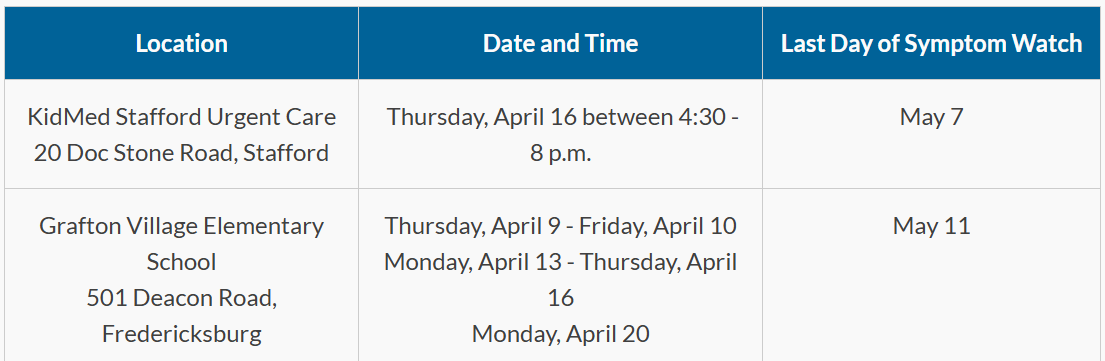
The VDH is alerting the public to possible exposure sites and timeframes, which are identified in the chart below.
Eradicated, Now Back
In 2000, measles was considered to be eradicated in the United States. However, since that time the disease is experiencing a resurgence.
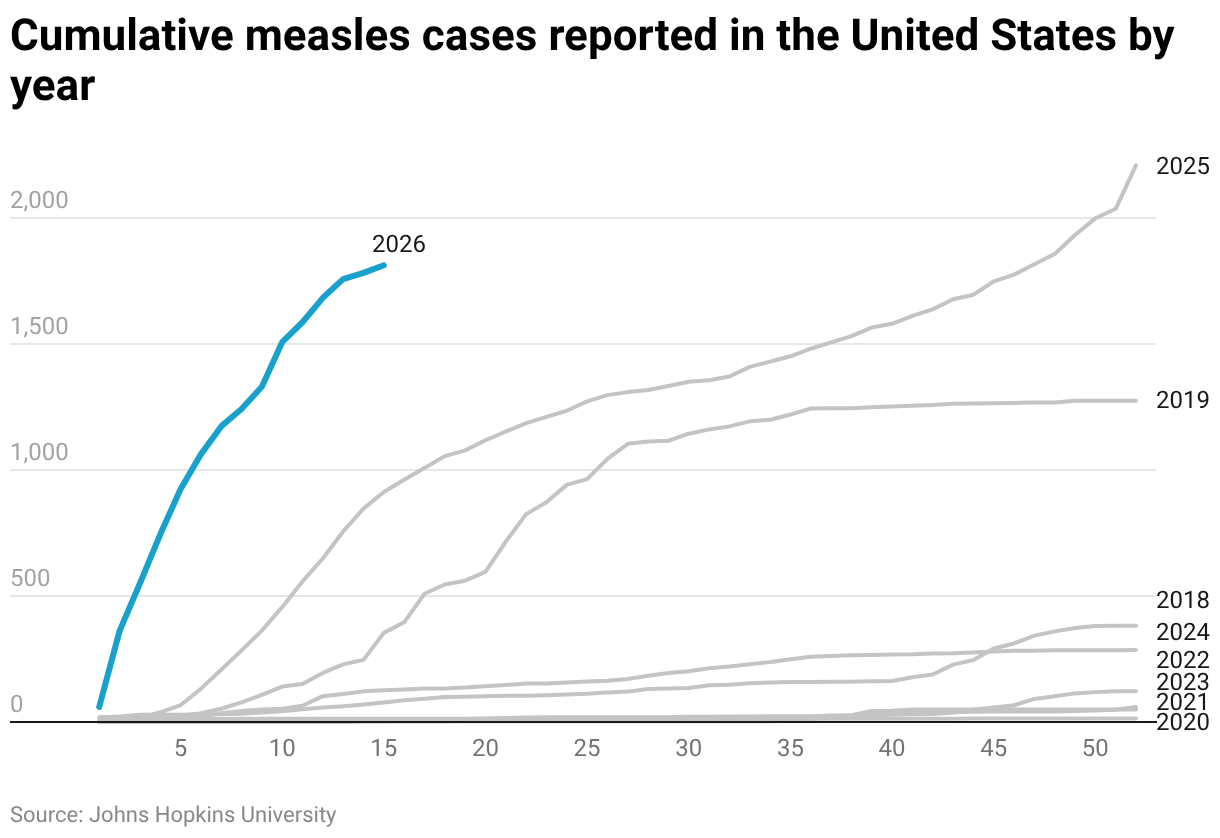
In 2025, the United States experienced the largest number of measles cases since 2019. This year, infections are well above the rate experienced this time last year according to data collected by the Johns Hopkins Bloomberg School of Public Health. (Nota bene: The Advance has historically looked to the Centers for Disease Control for this data, however, due to changes at the organization the Advance has chosen to look instead to Johns Hopkins.)
According to KFF, an independent organization dedicated to health policy, the rise in measles over the past several years is due to a number of factors:
Funding and staffing cuts for public health efforts at the federal, state, and local levels
Mixed messages from federal health officials such as Department of Health and Human Services (HHS) Secretary Robert F. Kennedy, Jr. regarding measles response at the same time there has been no Senate-confirmed leader at CDC for almost the whole period since these outbreaks began
Increased skepticism among the public about the safety and effectiveness of measles vaccines and a decline in trust of health authorities in general, which has contributed to lower measles vaccination rates and complicated outreach and communication efforts in addressing the current outbreak.
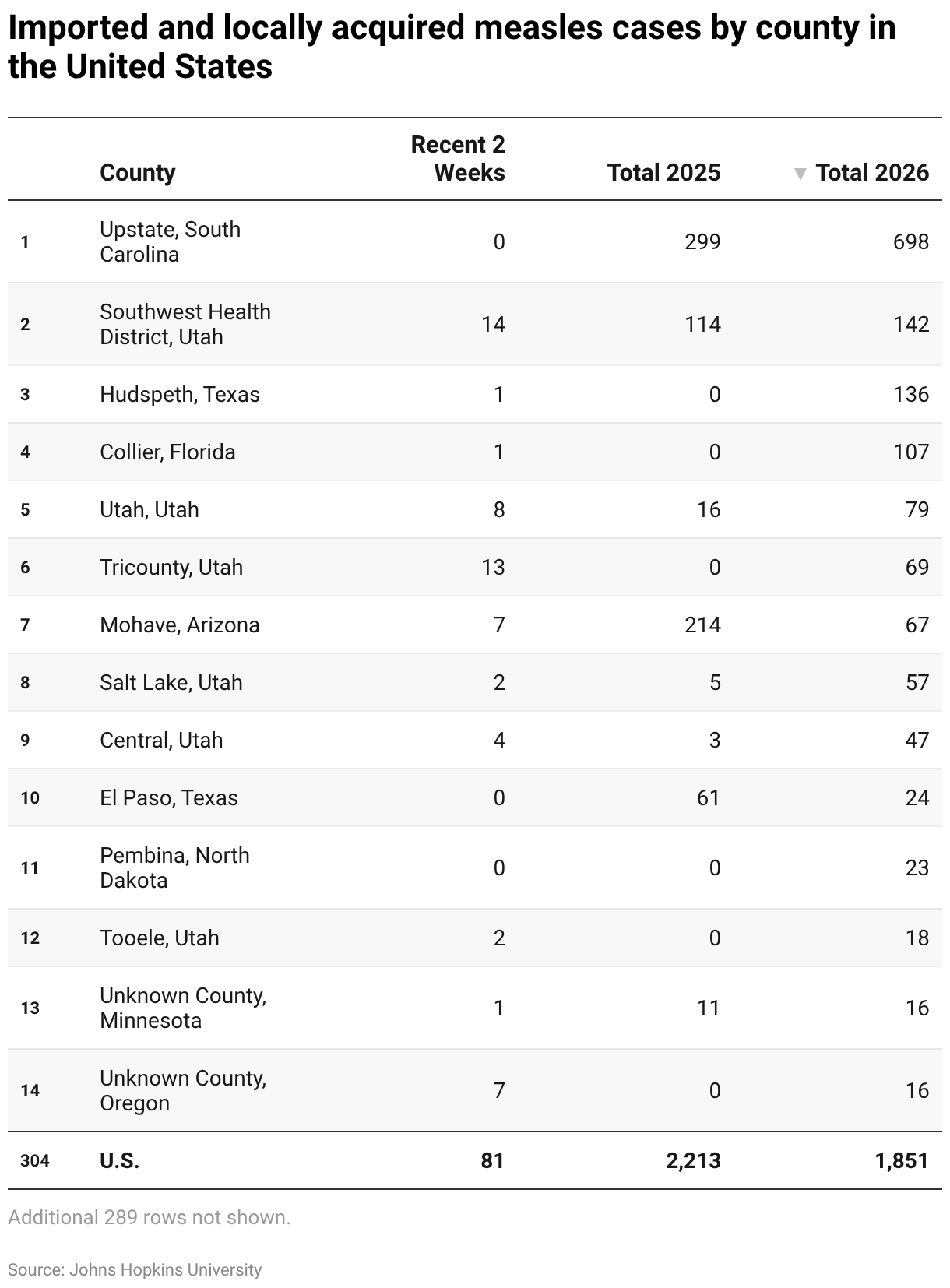
While the growth in measles cases is concerning, Virginia is not among the states facing the greatest outbreaks, according to Johns Hopkins. These counties and their states are:
If You Suspect Exposure to Measles
People concerned that they may have been exposed to measles should take the following steps, according to the VDH:
Monitor for symptoms: If you were exposed, especially if you are not immune through vaccination or previous infection, watch for symptoms of measles.
Report your exposure: Complete this short survey to notify your local health department. Public health officials will contact you if additional steps are needed.
If you are experiencing symptoms of measles: Contact a healthcare provider right away. Call ahead before going to your healthcare provider’s office or the emergency room. Tell them you may have been exposed to measles and ask them to contact the local health department. This helps protect other patients and staff.
Measles symptoms usually appear in two stages, according to the VDH. In the first stage, most people have a fever, runny nose, redness of the eyes, and cough. The second stage begins around days 3–7 when a red blotchy rash begins to appear on the face and spreads over the entire body. The rash generally lasts 5–6 days. Small white spots, called Koplik spots, also may be seen on the gums and inside of the cheeks.


Local Obituaries
To view local obituaries or to send a note to family and loved ones, please visit the link that follows.
