
By Steve Watkins, ADVANCE EDITOR
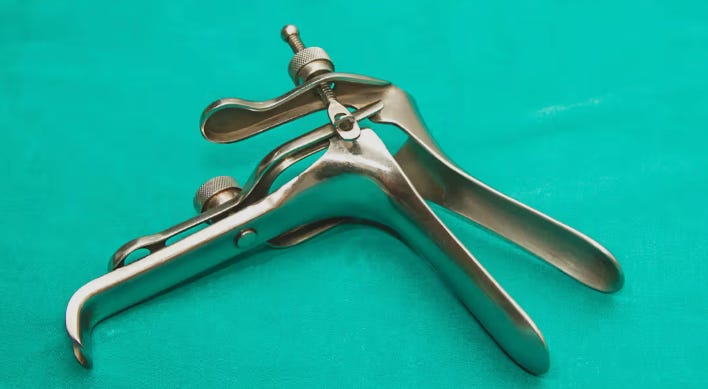
Mary Washington Healthcare officials are refusing to answer questions about their OB/Gyn clinics’ failure to spore-test autoclave machines used for sterilizing gynecological instruments—a serious breach of Centers for Disease Control guidelines.
The CDC calls for at least weekly autoclave testing to detect the presence of harmful micro-organisms that could infect patients. In confidential emails obtained by The Advance and published last week, a hospital administrator acknowledged that two of the medical corporation’s four OB/Gyn clinics had failed to do any spore-testing at all for at least two years, and maybe longer.
The discovery was made at least three months ago—along with other safety lapses—but MWHC never informed the thousands of patients on whom, and in whom, healthcare workers had used the gynecological instruments during that time, potentially exposing them to severe bacterial and viral infections.
Here are The Advance articles:
In a limited statement last Thursday, the hospital corporation told The Advance that in addition to their own investigation, they had consulted with “Infection Prevention, Infectious Disease and external sterilization experts” before deciding not to notify patients or the Virginia Department of Health about the years-long testing failure.
MWHC would not identify any of those experts for verification, however.
Here are the follow-up questions they have so far refused to answer:
1. Why did it take two years—and possibly longer as Dr. Kuhn acknowledged—before hospital staff and administrators discovered the lack of spore testing of autoclave machines, which CDC guidelines say should be tested at least once a week, more often with heavy use?
2. How will you be able to find out how far back the lack of spore testing actually goes? How far back do you have copies of test logs?
3. How do you account for proper spore testing and testing logs being maintained at the Cosner and Embrey locations, but not at Fredericksburg and Lee’s Hill?
4. Who made the discovery of the lack of spore-testing, and when was that? Who was responsible for the lack of spore-testing, and is that person or persons still employed at MWHC?
5. In your response to questions from The Advance, you wrote “Infection Prevention, Infectious Disease and external sterilization experts were consulted, and the machines underwent thorough inspection and testing.” What are the names of these experts? Please provide us with copies of their written reports.
6. You also wrote, “Repeated spore testing yielded negative results for all machines tested. MWHC also identified no evidence of sexually transmitted or other bacterial infections at either location related to this issue.” How did you go about attempting to identify evidence of sexually transmitted or other bacterial infections? Did you contact patients from two years ago? Five years ago? Who conducted this investigation?
7. You wrote, “Following its investigation and consultation with clinical experts, MWHC determined that notifying patients as well as the Department of Health was not needed.” Who made this determination, and on what basis? Please identify the “clinical experts” with whom you consulted.
8. And finally, for now, a layman’s review of NIH and CDC studies indicates that between 2/100 and 2/1000 spore tests on medical device autoclaves fail, with more than 90 percent of the failures attributable to human error. What studies are you and your clinical experts citing in your decision not to notify patients or regulators about this years-long testing failure.
***
We have read through a number of studies about auto-clave spore testing, and looked into the CDC’s sterilization guidelines, but could find no documents laying out the protocol for addressing failures of the nature and magnitude of the one at Mary Washington Healthcare other than this 2021 article published by the National Institutes of Health. The article lists three broad criteria for patient notification, one of which is “Provide information patients need to identify and/or mitigate a potential harm, including available information regarding the break or outbreak.”
The NIH article also included several “Patient Notification Scenarios,“ including this one, which involved reporting a testing “breach” to a state health department, something MWHC hasn’t done:
10. Breach in surgical instrument reprocessing:
As part of an accreditation survey, surveyors found that a hospital’s newly acquired satellite clinic was not performing biologic indicator testing as part of their instrument sterilization process. This raised concerns that the lack of testing meant that sterility of instruments could not be guaranteed and was reported to the state health department. The health department assisted with a risk assessment and performed a detailed review of the clinic’s sterilization practices. Following a surgical procedure, instruments were immediately transported in a closed container to the reprocessing room. Appropriate manual cleaning with a brush and enzymatic cleaner was performed; instruments were rinsed, wrapped, and steam sterilized following recommended parameters (eg, time, temperature); mechanical and chemical indicators were used to monitor the sterilization process. The facility had never used biologic indicators. During the health department visit, a typical sterilization cycle was run with a biological indicator; the biologic indicator was negative. The facility was instructed to commence using biologic indicators at least weekly. Based on the infection control assessment, a risk to patients was not identified. The facility was advised, for transparency, they could consider notifying patients; however, they elected not to perform a patient notification. No notification triggers were clearly met in this scenario.
We have reached out to the Virginia Department of Health, the Virginia Department of Health Professions Enforcement Division, and the local Rappahannock Area Health Department (RAHD) to inquire about any external investigation or patient risk assessment initiated by a MWHC whistleblower’s letter of concern—also shared with The Advance, with screenshots of the health care providers’ and administrators’ emails discussing, and confirming, the sterilization testing failure.
The state health office said they couldn’t confirm any ongoing action. The local RAHD director, Rachel Stradling, hasn’t returned calls or responded to messages with specific requests for comment. The hospital corporation, in refusing the answer any further questions, send a one-sentence email: “Our previous statement stands as is.”
The Advance included that statement in the original article. Here it is again:
Autoclave Sterilization
When Mary Washington Healthcare leadership learned that autoclave machines at its Fredericksburg and Lee’s Hill practices were not meeting routine spore-testing requirements, immediate action was taken to investigate and address the issue. The machines were removed from service, disposable instruments were put into use, and reusable instruments were sterilized at another MWHC location.
Infection Prevention, Infectious Disease and external sterilization experts were consulted, and the machines underwent thorough inspection and testing.
Repeated spore testing yielded negative results for all machines tested. MWHC also identified no evidence of sexually transmitted or other bacterial infections at either location related to this issue.
Following its investigation and consultation with clinical experts, MWHC determined that notifying patients as well as the Department of Health was not needed.
MWHC has addressed the testing and compliance issues identified during its investigation and reinforced sterilization procedures through additional associate training and education. Patient safety remains our highest priority, and we are committed to maintaining rigorous standards of care across our practices.
Rhogam
Regarding Rhogam, we identified a patient safety concern and addressed it swiftly with zero harm to our patients. Only one Rhogam dose from a box of five was found to be not at proper temperature. Out of an abundance of caution, all 11 patients who received doses from that batch were immediately contacted and provided a second dose.
***
Here also is the text of the whistleblower letter received by The Advance last week, addressed to the Virginia Department of Health. A couple of passages that contain unsupported allegations against MWHC have been left out, as indicated by ellipses.
To Whom It May Concern,
I have attached to this letter numerous direct messages from Mary Washington Hospital’s OBGYN department chief outlining . . . a years-long unreported safety violation committed at their outpatient obgyn office.
. . . .
The hospital has not been keeping the required cleaning testing logs and it was confirmed that spore testing has not been completed in years. No one noticed this wasn’t being done. There is no way to know whether or not these instruments have ever been properly sanitized before being put inside of patients. The CDC suggests that these spore tests should be completed weekly at a bare minimum. Again, spore tests at Mary Washington were not completed for at least two years, but potentially over 5 years.
In addition to the lack of proper autoclave testing, the hospital was not monitoring the medication refrigerator to make sure it’s holding the required temperatures to keep the medications safe and effective. There has been at least one occasion where multiple pregnant patients were potentially injected with improperly stored Rhogam that was held at the incorrect temperature. Some of these patients were allegedly notified about this and offered another dose of the medication, but no proof of notification was shared. I would strongly suggest that your office request proof of these notifications and then follow up with the affected patients to ensure they know the potential ramifications of an ineffective dose. This is a medication which has extremely time-sensitive guidelines as far as the timeline for injection. The incorrect dosage timeline can potentially kill future babies of these patients and they need to be warned of this possibility. This is a life and death issue. There should also be an investigation into which women have received the medication from Mary Washington in the past to see if any of them had adverse effects that could have been caused by improper storage. There is no way to know whether or not these temperature issues were recent because there were no safety log entries.
These issues could lead to the suffering of thousands of women in Virginia. I request that the Virginia Department of Health urgently investigate this issue and hope the following will come from this letter:
1. Ensure all patients who have had these instruments placed inside of them at this office in the last 5+ years be notified and received STD testing. This includes all patients who came in for annual exams, pap smears, or any procedure that required a speculum, including those used during certain pregnancy exams. For pregnant patients, their children, spouses, and sexual partners should also be tested.
2. That all patients injected with Rhogam for the past 5+ years are notified of potential errors with its effectiveness. They should be prompted to get bloodwork done to confirm the appropriate antibodies are present from their Rhogam injections.
***
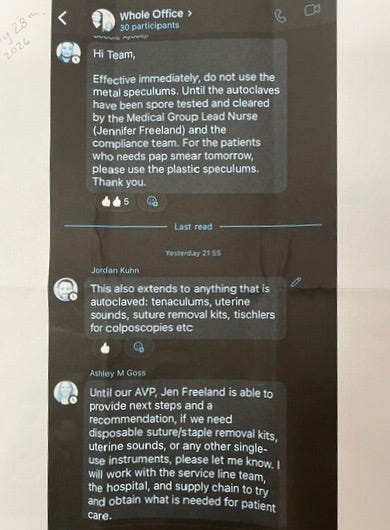
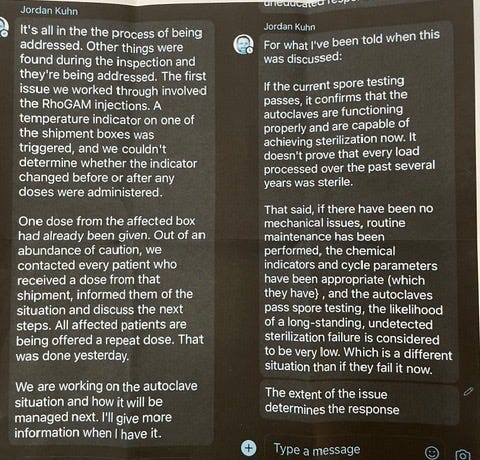
And here are screen-shotted copies of the MWHC OB/Gyn emails:
***
Steve Watkins is editor of The FXBG Advance. You can contact him HERE.

The typical MWHC response to embarrassing questions is to dismiss, deflect and deny.
That’s not an example of ethical leadership. It’s escapism from accountability for poor management and oversight.
The response from MWHC is disturbing. I’m surprised there’s no law forcing them to contact all patients who could have been affected at the very minimum.