
By Shaun Kenney
COLUMNIST

Data centers have arrived and it’s about time they did — and it’s your fault, too.
Well, not entirely your fault — but if you’re watching Netflix and Amazon Prime, using AI tools to generate images or research or God forbid term papers, you’re in on the joke.
…and they are everywhere.
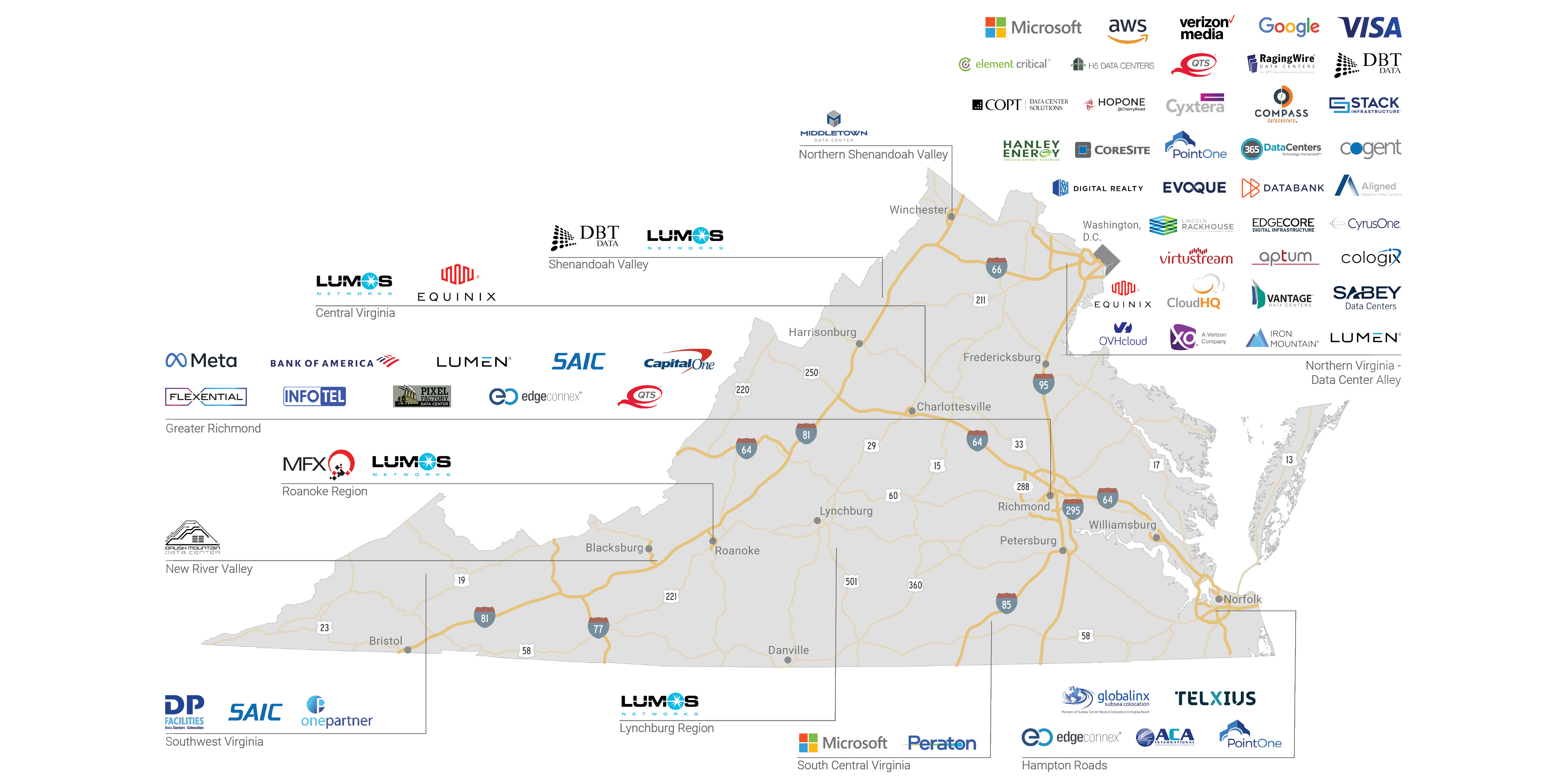
Of course, organizations such as the Piedmont Environmental Council naturally takes their place in the constellation of groups that have questions, though it is difficult to tell if they oppose data centers per se or whether they oppose the present means by which data centers are changing the economy.
One thing seems to be in agreement — the internet of things is here to stay, the energy problem isn’t as difficult to resolve as one might think, and the use of cool tech to cool the data centers is already here — even if the ubiquity of small modular reactors (SMRs) are at best a decade away.
Yet even if we wanted to go back to newspapers and the Res Publica Litterarum — and I certainly would be in line to do so — the fact of the matter is that artificial intelligence is going to be as serious a jump in technology as the automobile, the early internet, air conditioning, the steam engine, rural electrification, cell phone towers, public sanitation, and movable type.
It’s happening — the match will not be postponed.
The trick is that culture moves incrementally while technology grows exponentially, and just as surely as General Motors, Chrysler (now Stellantis), and Ford represent the “Big Three” the new titans of AI technology won’t just be Apple, Amazon, Google, Meta, and Microsoft — but Nvidia, OpenAI, Anthropic, Reflection, and Palantir.
So where are we going if there is no going back?
Suspend judgment for just a moment and scroll with me for just a moment as to what you might want to consider before making that call, because a lot of the things that we don’t like about the present economy are about to change in massive and enduring ways, and if we are smart about it? The future of work is about to change in very cool and very quick ways.
Reconsidering the Problem: The Technological Republic and the Critics
Two books you should probably take the time to read in 2026: The Technological Republic by Alexander Karp and Nicholas Zamiska of Palantir and Philosopher in the Valley by Michael Steinberger of the New York Times.
The former is a must-read, one that was recently distilled into a 22-point manifesto that summarizes quickly for thinkers but does not do the book itself justice. Alex Karp and by extension his business parter, Peter Thiel, give a great deal of insight on how they are grappling with the moral and ethical questions this new AI-driven economy are going to present to the public writ large. Steinberger’s distillation is a bit of a counterpoint — clearly left of center, the last chapter is unnecessarily over the top — but one that humanizes and grasps the depth of the man in a way Palantir’s competitors are simply not grappled with in any meaningful way. Partisan readers will do themselves a disservice bringing preconditions to either book.
Yet while it may be easy to decamp based on partisan lines, what becomes clear is that the politics of the future are not necessarily red and blue when it comes to what’s coming, but rather black and green — black for the stars and technology (“up”) and green for nature and nurture (“down”) — a dynamic that is already changing both our politics and our coalitions in visible and tangible ways. Steve Fuller at the University of Warwick noted this change in his black-green essay as early as 2013:
[T]he up-winging Blacks combine the old libertarian Right and the old technocratic Left, while the down-winging Greens bring together elements of the old conservative Right and the old communitarian Left.
In short, this technology is going to rapidly change our world. Whether the productivity gains “trickle down” or whether they are directly felt is the argument we are having in Richmond right now — local governments are certainly getting their slice, taxpayers aren’t feeling any relief just yet, state government wants in on the action, and the feds are dealing with a different calculus altogether. Whether we as a society are equipped to handle this change — our education system, our concepts of work, our ideas of society and community, our public interactions and our private personas.
Unlike philosophers and policy analysts, localities and communities are going to be presented with a goose made of gold. Opportunities have been squandered before, but the question raised is given the degree of the change, will our communities have the foresight to really see the advantages on the horizon? Then motivate themselves to adapt to this new world which is going — if not change everything — then certainly touch just about every facet of our lives?
The Argument for the Re-Industrialization of America
Here’s something to think about as we debate about the re-industrialization of America in terms of bringing back manufacturing jobs.
The data centers themselves are the re-industrialization of America. Imagine industrial zones powered by AI. Imagine health care and medicine powered by AI. Imagine innovation on-the-fly for machine tools all powered by AI. There are some excellent ideas out there on how regional efforts can create these campuses, and between our PDCs and GoVirginia! we have the intergovernmental resources to create these opportunities.
Fact of the matter is that data centers and AI are already here. The question is going to be how — and for some communities if — Virginia localities, universities, and entrepreneurs are going to take advantage of the opportunity.
Yes — energy prices are up, but this is a temporary problem which can be resolved with resources we already have at hand and a tiny bit of political will. The water usage and coolant problem is an engineering problem well in hand.
The productivity gains are almost certain; what we do with them is not.
The short-term sugar rush to localities is already being consumed by the longstanding mandates from Richmond on education, public safety, and other unmet needs. Whether or not our communities are equipped to meet the technological renaissance that is coming is entirely dependent upon which localities band together first to create the spaces for economic growth — spaces the General Assembly should be encouraging through tax breaks rather than looking to dip their hand into the till and demand protection money like a mafia don.
The Roman poet Juvenal reminds us that what you tolerate, you deserve. The re-industrialization of Virginia through data center anchored industrial zones can be duplicated anywhere the best and brightest are willing to collaborate and inspire one another, creating the new culture to power the next five decades of economic and technological free enterprise.
Location doesn’t matter — whether you are in Southwest Virginia, Central Virginia, a small town looking for a second chance or a big town looking for more people at the lunch counter and small shops — if local leadership can see this future, then we are holding a ticket of gold where local families and entrepreneurs are waiting for someone with the political courage and will to punch the damn thing.
Sure sounds like a future worth tolerating, doesn’t it? Qui audet adipiscitur, my friends.
Shaun Kenney is co-founder of the FXBG Advance and Senior Editor of The Republican Standard, where this article first appeared.
BALANCE OF STORIES


Local Obituaries
To view local obituaries or to send a note to family and loved ones, please visit the link that follows.

Shaun Kenney is right to push us beyond the usual NIMBY skirmishes and to see Virginia’s data center boom as part of a larger re industrialization of America. Data centers now undergird streaming, finance, logistics, health care, AI, and even national security, and his argument that they can anchor new AI driven industrial zones is the kind of long range thinking our region badly needs. I share his desire for communities that plan ahead instead of fighting every change piecemeal.
But a truly strategic vision has to grapple with what, exactly, is being “industrialized.” These facilities are not just job sites; they are the core infrastructure for large scale collection and analysis of data about all of us, controlled by a handful of powerful firms and a federal government racing to expand AI capacity faster than Congress can agree on basic guardrails. Right now we have a federal build faster push, a patchwork of state tax breaks and moratoria, and local boards improvising national policy at the zoning hearing level with limited technical support.
If we are going to welcome data centers as the backbone of a new industrial era, Virginia’s legislators and regional leaders need to become fluent in the technology and its risks and move us from one off deals to clear rules for where these facilities go, how they use shared resources, who pays for the upgrades they require, and who controls the data they process. Otherwise, we risk building an impressive new “factory system” whose primary output is not shared prosperity, but concentrated information power over the public.
Classic trope from the billion-dollar DATA CENTER industry Playbook Strategy #5: blame the customer who BTW, is being taken for a fool to believe they're at fault: 'DATA CENTERS have arrived and it’s about time they did — and IT'S YOUR FAULT TOO!!!' (caps and exclams for emphasis!!!).
Before reading any more of the 'FXBG Advance' horse hooey on DATA CENTERS, I just scrolled down to the bottom of this article, 'The Technological Republic' by Shaun Kenney for the DISCLAIMER statement.
Again, it's not there.
Some of us realize that 'FXBG Advance' is losing subscribers for not putting the DISCLAIMER statement in its DATA CENTER articles, but there are others who are hanging in there just for the convenience of having 'FXBG Advance' show up in the morning email.
Since 'FXBG Advance' is taking money from the DATA CENTER industry: Did Mr. Kenney get a stipend for getting permission from "The Republican Standard' to spin more hype on the Goliath big boys' game strategy against the stakeholders Davids? who are already taking the hit in their power bills, as per the Virginia SCC/State Corporation Commission?
Where's the 'FXBG Advance' article on how many 'straws' are in the non-proprietary Water Services Agreements with Caroline, Fredericksburg, King George, Spotsy and Stafford sucking the 6th Most Endangered River in the US, the Rapp dry?
Now that would be news.