

By Adele Uphaus
MANAGING EDITOR AND CORRESPONDENT
Email Adele

Overview
The School Quality Profiles for Caroline County Public Schools should be handled with caution. Parents, educators, and students need to understand the intricacies of the scoring system and not rely on top-line data to draw conclusions about the quality of education in any given school.
All Caroline County schools are fully accredited. In the new system, accreditation is not related to academic performance, but to compliance with state requirements under the Standards of Accreditation.

Academic performance is now measured by the School Performance and Support Framework, which assigns each school a summative rating of either Distinguished, On Track, Off Track, or Needs Intensive Support. These ratings are based on scores, which in turn are based on points schools receive for three indicators—mastery of academic subjects; growth and readiness at the elementary and middle school level; and mastery, readiness, and graduation at the high school level.
Digging Deeper
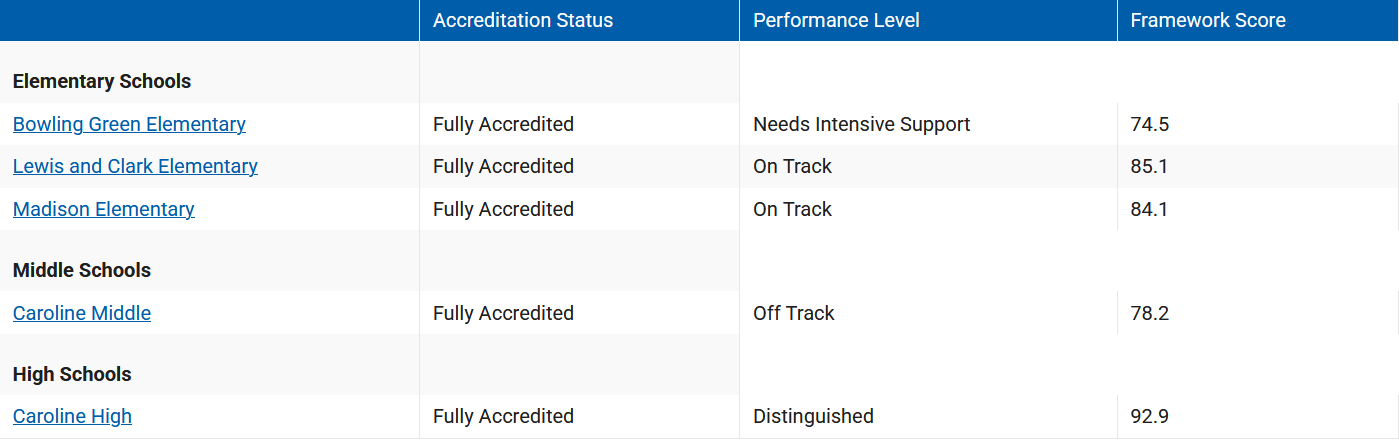
In Caroline, Lewis and Clark Elementary and Madison Elementary were rated On Track, and Caroline High School was rated Distinguished.
Caroline Middle School was rated Off Track, though its summative rating of 78.2 points (out of 100) places it within two points of being in the On Track category.
Bowling Green Elementary’s summative score of 74.5 places it in the Off Track category, but it was dropped to the Needs Intensive Support category due to one student subgroup performing below thresholds set by the VDOE as part of the new accountability system.
The new system identifies schools where one or more student subgroups perform below this threshold for Targeted Support and Investment, and drops schools with this identification to a lower category in the framework.
At Bowling Green, the student subgroup that performed below the threshold was students with disabilities. This is a population that has been increasing across the region and the state in recent years. It’s also an area where it is challenging to recruit and retain qualified instructors.
Caroline Middle School received the least percent of possible points (12.7 out of 20) in the Growth category, which accounts for 20% of the total score for middle schools under the new framework. According to the new framework, a little over half of students showed little to no growth in reading achievement and 62% showed little to no growth in math achievement.
However, the system used by the Virginia Department of Education to measure growth has been criticized for using a proprietary calculation that is not made available to educators.
The other categories are Mastery, accounting for 60%, which considers student performance on math, reading, and science assessments and English learner progress; and Readiness, which considers chronic absenteeism and the number of students taking advanced coursework and accounts for 20% of the total score.
The middle school received 46.7 out of 60 possible points for Mastery and 18.7 out of 20 for Readiness.
Caroline High School’s Distinguished rating came in part from how it scored in the Readiness category, where it received 36.3 out of 35 points. “Readiness” at the high school level considers chronic absenteeism, participation in the “3E” (enrollment, employment, enlistment) framework, and the 6-year graduation rate, and accounts for 35% of the school’s total score.
3E points are awarded for students who receive college credit for taking Advanced Placement or dual enrollment courses, participate in work-based learning, earn workforce credentials, or score well on the military ASVAB test.
The high school received 43.1 out of 60 points in the Mastery category, and 13.4 out of 15 points in the Graduation category (which considers the federal four-year graduation rate).
In a press release issued this week, superintendent Sarah Calveric said the division is grateful for all its students and staff and is “especially proud” of Caroline High School’s Distinguished score.
She said the division continues to be focused on growth.
“Although we still have progress to make to ensure every CCPS student and school reaches Virginia’s newly outlined expectations, we remain confident in our team’s expertise, innovation, and unwavering commitment to all Caroline learners,” Calveric said.
Bottom Line
For individual school profiles, visit the Virginia Department of Education page for Caroline County. Top-line scores are presented below.





Local Obituaries
To view local obituaries or to send a note to family and loved ones, please visit the link that follows.

Support Award-winning, Locally Focused Journalism

The FXBG Advance cuts through the talking points to deliver both incisive and informative news about the issues, people, and organizations that daily affect your life. And we do it in a multi-partisan format that has no equal in this region. Over the past year, our reporting was:
First to break the story of Stafford Board of Supervisors dismissing a citizen library board member for “misconduct,” without informing the citizen or explaining what the person allegedly did wrong.
First to explain falling water levels in the Rappahannock Canal.
First to detail controversial traffic numbers submitted by Stafford staff on the Buc-ee’s project
Our media group also offers the most-extensive election coverage in the region and regular columnists like:
And our newsroom is led by the most-experienced and most-awarded journalists in the region — Adele Uphaus (Managing Editor and multiple VPA award-winner) and Martin Davis (Editor-in-Chief, 2022 Opinion Writer of the Year in Virginia and more than 25 years reporting from around the country and the world).
For just $8 a month, you can help support top-flight journalism that puts people over policies.
Your contributions 100% support our journalists.
Help us as we continue to grow!


This article is published under Creative Commons license CC BY-NC-ND. It can be distributed for noncommercial purposes and must include the following: “Published with permission by FXBG Advance.”
Thanks to 'FXBG Advance' for analyzing each school system's rating on the School Performance and Support Network. Subgroup scores do impact a district's performance, as noted in this article: 'At Bowling Green, the student subgroup that performed below the threshold was students with disabilities. This is a population that has been increasing across the region and the state in recent years. It’s also an area where it is challenging to recruit and retain qualified instructors'.
It has always been difficult to recruit and retain teachers in special education. There is high burnout from heavy workloads, excessive paperwork, low pay compared to other professions, lack of support from leadership, poor working conditions: What other educator is told that their 'room' for this school year is under a stairwell, in the custodian's storage room, or the no longer used boys' shower room in the middle school?
There is isolation and inadequate preparation/mentorship, leading many to leave for better-paying or less stressful jobs. A federal research grant to Peabody College of Vanderbilt University in 1978 provided fully funded fellowships for master's in special education to look at the attrition rate.
The study asked the question: If we train these educators in the science of 'competency-based instruction', by identifying the skills that a special educator needs to practice in the field, and assign a practicum concurrent to the course to apply the skills with supervision, will they stay in the profession?
Results showed that yes, these CBI-trained sped teachers do stay longer than those who took traditional teacher training.
However, there was still employee attrition. If you could keep the employee for 3 years, it would increase the chance that they would stay in the profession. and surprisingly, at that time, those trained under this CBI model who left within the 3 years, became 'flight attendants'. One discussion was: These are people who want to help, serve, interact with and take care of others.
That's all likely changed now. Today's special ed teachers did not sign up for the excessive special ed paperwork. They want to engage and teach their students. However, this comes with Accountability, as some college professors used to warn their students: 'If the learner hasn't learned, then the teacher hasn't taught'.
If these papers are not completed correctly, and implemented as stated, you could have your bottom in a quasi 'witness stand' in a due process hearing, and the parents' attorney asking you, rightly so: to 'show the data that you are actually teaching this child to meet their goals in this IEP/Individualized Education Program'.
That's one reason that years ago, Maryland school systems created a new job in special education to free up the teacher delivering the sped services from the mandated paperwork: 'The IEP Facilitator' to schedule meetings, review the paperwork and coordinate with the special ed and gen ed teams/stakeholders and parents to document the student's present level and check for progress on the IEP goals.
The Special Education teacher and therapists, if properly trained and supported, positively change a student's life: 'Making a Difference One Hour, One Day at a Time'.