

And There Was Light: Abraham Lincoln and the American Struggle
BY JON MEACHAM
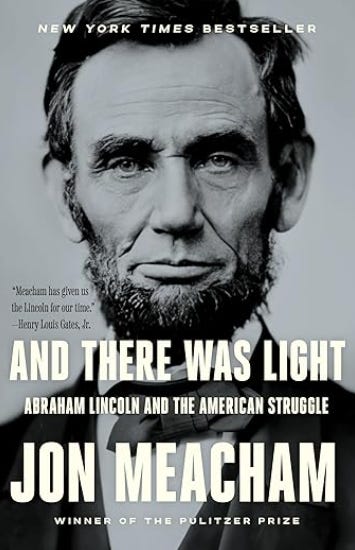
Random House (2022)
Hardcover
Kindl
Reviewed by Martin Davis
On Day One of his administration, Gov. Glenn Youngkin issued Executive Order One banning the teaching of “inherently divisive concepts.” Such concepts, the EO said, “like Critical Race Theory and its progeny”:
instruct students to only view life through the lens of race and presumes that some students are consciously or unconsciously racist, sexist, or oppressive, and that other students are victims.
In Youngkin’s worldview, this approach is equal to “indoctrination,” and denies students the opportunity to “gain important facts, core knowledge, formulate their own opinions, and to think for themselves.”
Jon Meacham’s biography And There Was Light: Abraham Lincoln and the American Struggle. is the antidote to a Youngkin’s deeply flawed understanding of history — and our current reality.
For Lincoln, the onus of America’s original failure — slavery — was a daily reality from his earliest days on the frontier, and the memories of what he saw haunted him throughout his life and shaped his thinking.
Race, in other words, was the lens through which everything was filtered.
Lincoln did not “evolve” on the issue of slavery — turning a blind it to it early in life, becoming morally resolute in his opposition to it by the time of his Second Inaugural Address — rather he was throughout his life morally opposed to the Peculiar Institution.
Lincoln’s letter to his friend Joshua Speed — a slaveholder — in 1855, for example, is just one of the many examples Meacham calls upon to make his case. In that letter, Lincoln recalled a trip the two took along the river from Louisville to the mouth of the Ohio River in 1841 and the slaves aboard the boat they shared. “… there were on board, ten or a dozen slaves, shackled together with irons,” Lincoln wrote:
…. That sight was a continual torment to me; and I see something like it every time I touch the Ohio, or any other slave-boarder. It is hardly fair for you to assume that I have no interest in a thing which has, and continually exercises, the power of making me miserable.
Why, then, the idea that Lincoln was at least tolerant of slavery earlier in his life before moving to an abolitionist position by the end of his presidency?
The answer is found in the ways Lincoln wrestled to bring along politically the half of the country that believed slavery was not just right, but divinely appointed, to an abolitionist position. Consider how Meacham described Lincoln’s thinking for creating a political case for emancipation.
the Lincoln of the mid-1850s held an antislavery ground that foresaw a ban on slavery in new states and, in the current Union, gradual emancipation, with compensation for slave owners, that could be followed by the voluntary removal of Black people from the United States.
That is far from the more-radical abolitionist political position of Frederick Douglass and Theodore Parker, but Lincoln acted throughout his political life on both the “moral” and “political” levels.
And that, Meacham argues, is the hallmark of any great president.
our finest presidents are those committed to bringing a flawed nation closer to the light, a mission that requires an understanding that politics divorced from conscience is fatal to the American experiment in liberty under law.
Since the culmination of the Civil Rights movement, there has been a concerted push to pretend that on the issue of slavery, America has reached a moral plateau. That the issue is behind us.
Unfortunately, we are far from having issues of race resolved. What matters is that we continue to strive to the ideal, and not — as Youngkin has done — pretend that we have arrived. As Meacham writes:
For so long as we are buffeted by the demands of democracy, for so long as we struggle to become what we say we already are — the world’s last, best hope, in Lincoln’s phrase — we will fall short of the ideal more often than we meet the mark. It is a mark of American history we are not always good, but that goodness is possible. Not universal, not ubiquitous, not inevitable — but possible.






Local Obituaries
To view local obituaries or to send a note to family and loved ones, please visit the link that follows.

Support Award-winning, Locally Focused Journalism
The FXBG Advance cuts through the talking points to deliver both incisive and informative news about the issues, people, and organizations that daily affect your life. And we do it in a multi-partisan format that has no equal in this region. Over the past year, our reporting was:
First to break the story of Stafford Board of Supervisors dismissing a citizen library board member for “misconduct,” without informing the citizen or explaining what the person allegedly did wrong.
First to explain falling water levels in the Rappahannock Canal.
First to detail controversial traffic numbers submitted by Stafford staff on the Buc-ee’s project
Our media group also offers the most-extensive election coverage in the region and regular columnists like:
And our newsroom is led by the most-experienced and most-awarded journalists in the region — Adele Uphaus (Managing Editor and multiple VPA award-winner) and Martin Davis (Editor-in-Chief, 2022 Opinion Writer of the Year in Virginia and more than 25 years reporting from around the country and the world).
For just $8 a month, you can help support top-flight journalism that puts people over policies.
Your contributions 100% support our journalists.
Help us as we continue to grow!


This article is published under Creative Commons license CC BY-NC-ND. It can be distributed for noncommercial purposes and must include the following: “Published with permission by FXBG Advance.”