

FLASHES OF BRILLIANCE
by Anika Burgess
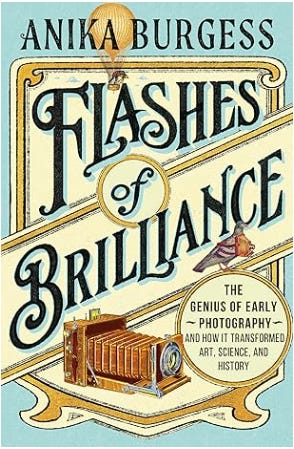
Published by W. W. Norton & Company (July 8, 2025)
Hardcover $26.43
Audiobook $14.99
Reviewed by Penny A Parrish
I bought this book because I am a fine arts photographer based in Fredericksburg. The expanded title reads “The Genius of Early Photography and How it Transformed Art, Science and History.” If that sounds dry, this is anything but. It’s an absolute delight!

The beginnings of photography often involved scientists (some fitting the “mad” description), doctors, tinkerers, and inventors. I’ll highlight some of my favorite revelations:
In the late 19th century in Paris and Chicago, people had photographs printed on their skin and on fingernails.
Picric acid, used in flash powder, is highly explosive. It fell out of use decades ago, but a batch was found at a school laboratory in Olney, Maryland, in 2022. Many people lost their lives trying to figure out how to bring light to photography.
In the late 1880s, Jacob Riis used a camera and flash powder to expose the dangerous and filthy conditions in NYC tenements. He’d walk up a dark staircase and set off the flash, resulting in astonished looks from his subjects.
In 1869, residents were warned not to hang a photo on a green wall as it was likely to fade due to arsenic in the green paint.
William H. Mumler produced “spirit photographs” in New York. He manipulated photos which showed the buyer sitting with a ghostly specter. One of his customers was Mary Todd Lincoln.
In the late 19th century, “photo fiends” took candid photos of celebrities and women’s ankles as they bathed at a beach. They made a lot of money doing this (some things haven’t changed, unfortunately).
Tiny cameras, hidden in buttonholes or top hats, took pictures inside courtrooms.
Burgess provides fascinating details on photography from balloons (and kites carrying people), underwater cameras (the diver/photographer wore equipment weighing at least 170 pounds), and how Eastman revolutionized photography for the common man (or woman) with his Kodak #1 in 1888.
If you’ve ever been to a meeting or a convention where you traded business cards, you’ll appreciate the section on carte-de-visites. They were small cards with photos – of you, your family, your dog – whatever you wanted to share with someone. People collected these and put them into albums (Queen Victoria had 36 albums). After the death of Prince Albert, more than 70,000 orders came in for his carte-de-visite.
One of the most fascinating chapters covers x-rays – how they came about and the terrible deaths of many people who were over-exposed to the harmful rays. It must have been unbelievable to see inside your body. X-ray machines were available for home entertainment. For a penny on a London Street in 1896, you could have your bones x-rayed. By Christmas of that year, x-rays were featured on family holiday cards.
This is just a taste of the research done by Burgess. The writing is engaging, often humorous, and the book is filled with accompanying archival photographs. I wish I could share it with my dad, who studied photography at the Art Institute of Chicago in the 1930s. Anyone who carries around a camera (most of us have one attached to our hand as a cell phone) will delight in how we ever got this far in capturing a moment in time.
Penny A Parrish is a local writer and photographer. You can see her pictures at her website.





Local Obituaries
To view local obituaries or to send a note to family and loved ones, please visit the link that follows.

Support Award-winning, Locally Focused Journalism

The FXBG Advance cuts through the talking points to deliver both incisive and informative news about the issues, people, and organizations that daily affect your life. And we do it in a multi-partisan format that has no equal in this region. Over the past year, our reporting was:
First to break the story of Stafford Board of Supervisors dismissing a citizen library board member for “misconduct,” without informing the citizen or explaining what the person allegedly did wrong.
First to explain falling water levels in the Rappahannock Canal.
First to detail controversial traffic numbers submitted by Stafford staff on the Buc-ee’s project
Our media group also offers the most-extensive election coverage in the region and regular columnists like:
And our newsroom is led by the most-experienced and most-awarded journalists in the region — Adele Uphaus (Managing Editor and multiple VPA award-winner) and Martin Davis (Editor-in-Chief, 2022 Opinion Writer of the Year in Virginia and more than 25 years reporting from around the country and the world).
For just $8 a month, you can help support top-flight journalism that puts people over policies.
Your contributions 100% support our journalists.
Help us as we continue to grow!


This article is published under Creative Commons license CC BY-NC-ND. It can be distributed for noncommercial purposes and must include the following: “Published with permission by FXBG Advance.”