By Steve Rabson, GUEST COLUMNIST
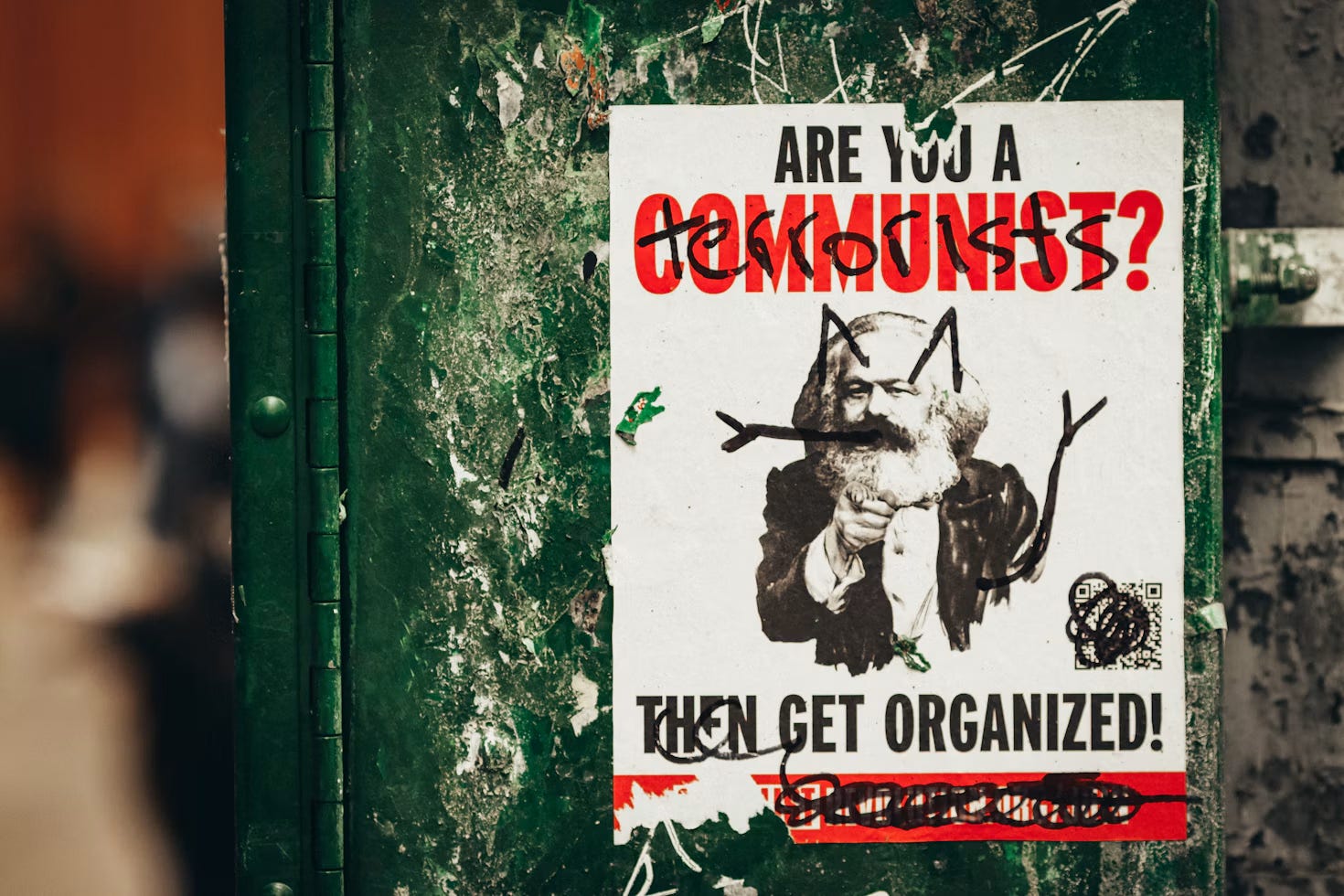
In his column last month, “Trump’s Communist Manifestation,” Phil Huber describes President Trump’s recent infatuation with the word “communist.” As of August of this year, he has said it 81 times, pinning this label on Democrats in Congress, judges, journalists, the mayor of New York, and a vice president. Probably the only public figure to top this was Senator Joseph McCarthy with his scattergun accusations that included General George Marshall, Secretary of State Dean Acheson, and 205 employees of the State Department. Watching Donald Trump today, l remember seeing McCarthy’s sneering face and hearing his scornful voice on television in the 1950s when I was in middle school.
Partly out of curiosity and partly as an expression of adolescent rebellion, I chose the Communist Manifesto when the class was assigned to write a book report during my senior year in high school. I also liked its brevity––only about fifty pages––to minimize the time I would need for the homework. When I told Mr. Cobaugh, our social studies teacher, he got a pained expression on his face, but after a long pause said he would consult the school’s principal and get back to me. A few days later, he told me the principal had given permission, but first I would have to meet with Mr. Cobaugh who would explain to me what was wrong with this 1848 essay. The next day he came came to our study hall period and beckoned me outside the classroom. I followed him down the stairs to the school auditorium where we sat in two of the seats. I cannot remember what he told me, but it was very brief and I soon returned to study hall.
These were the most frigid years of the Cold War, and I had already heard many bad things about communism and communists. They were widely reviled as the ultimate enemy, the suspects in Congressional investigations for the Army-McCarthy hearings, the McCarran Internal Security Act, and the House Un-American Activities Committee. They were having a powerful impact on popular culture as villains in mystery stories and spy novels. Vince Lombardi, legendary coach of the Green Bay Packers, was reportedly telling his players to think of the team across the scrimmage line as “the commies,” and the Cincinnati Reds changed their name to Redlegs (See my column “Red Scared” in the October 2024 Pie & Chai).
So when I got around to reading this essay, I was surprised to find parts of it inspiring. Most of the early chapters criticize existing socialist organizations and political parties for their ineffectiveness and for collaborating with those who exploit workers by controlling the wealth they produce. The authors then describe a process in which workers unite to take political and economic power liberating themselves from this oppression. One reason this essay generated such hostility and fear seemed to be the method it advocated for achieving these aims through violent revolution and the abolishment of private property.
Doing a book report on what adults considered a taboo subject stimulated my interest enough to begin reading about how the theory of communism had been applied. I learned that in Eastern Europe––where governments called themselves communist––central planning for industrialization had sharply reduced unemployment, improved access to health care, and provided universal education. But the ideals of liberation and equality promised in the Manifesto became empty slogans, while a privileged elite exercised tight control over politics and the economy, brutally suppressing dissent. On the other hand, as some of my readings explained, land and resources claimed as private property kept most people impoverished in colonized countries ruled by dictators propped up by corporations and landlords who owned the mines, plantations, and oil fields.
While I was in high school, the 1954 Communist Control Act outlawed the Communist Party in the United States. Never a significant presence in American politics, it suffered from severe government repression, a massive drop in membership, and widespread disillusionment with the Soviet Union. Individual members remained politically active, supporting striking workers and participating in the civil rights movement. Since the 1960s and 70s when the courts overturned the enforcement provisions of the Communist Control Act, the party has reorganized, running candidates in local elections. In 2025 its members won city council seats in Ithaca, New York and Bangor, Maine.
Looking back, the condition my high school placed on a book report about the Communist Manifesto seems mild when compared with the banning of books and control of the curriculum demanded by some local school boards today. Students should be encouraged to learn about subjects adults find uncomfortable, such as race and sexuality. With the knowledge gained, they will be better informed to draw their own conclusions.
***
Steve Rabson is a jazz pianist, retired professor from Brown University, and current adjunct Instructor at the University of Mary Washington.