

Reviewed by Dennis Wemm
THEATRE CRITIC
Tickets: $60.00-72.00
Presented by Riverside Center for the Performing Arts; March 18 - April 26, 2026
Book by Allan Knee (Based on the novel by Louisa May Alcott)
Music by Jason Howland
Lyrics by Mindi Dickstein
Directed by Carson Eubank
Music Director: Ellie Kahn
Choreographer and Assistant Director: Stephanie Wood
Production Stage Manager: Donna Warfield
Scenic Designer: Frank Foster
Costume Designer: Bee Gable
Lighting Designer: Weston Corey
Performers
Jo March Ashlee Beary
Meg March Sarah Mae Andersen
Beth March Ella Schnoor
Amy March Madison Cox
Marmee Grey Garrett
Laurie Matt Beary
Professor Bhaer Ariel Messeca
John Brooke Jarrett Bloom
Aunt March/Mrs. Kirk Andrea Kahane
Mr. Laurence Ian Lane
Little Women suffuses the Riverside stage with light and warmth, keeping from the novel the main story and characters while focusing on the emotional reality of the situation. It delivers emotional punch after emotional punch, capturing the little family’s reactions to poverty, disappointment, and the thousand little tragedies of life. It’s a tall order to fit this all into an evening’s theatre while working within the framework of a musical. Knee, Howland, and Dickinson do it by concentrating their focus on the relations between the March sisters, their mother, and the men at the peripheries of their lives.
Promotional and dramaturgical materials in the lobby display draw audience attention to the parallels between Jo’s and Alcott’s lives. Jo’s narration leads us through. So, the onstage adaptation at Riverside is a story told by Jo.
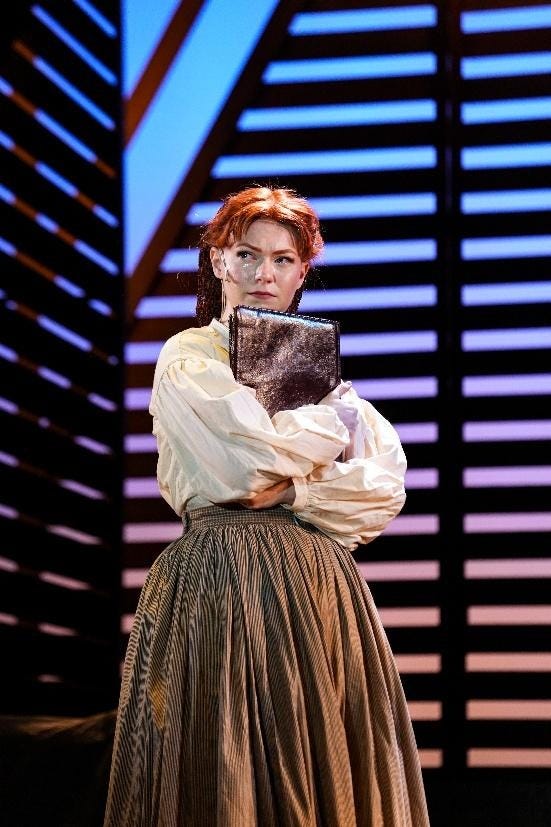
Ashlee Beary’s bravura performance as Jo has the flexibility to show both the inexperienced teen and the experienced narrator. Young Jo lives the action while the grown-up narrator Jo steps out to tell the story. The opening sequence finds young woman Jo, living in a boarding house on her own and attempting to eke out a living by writing for the market-and the market wants ROMANCE. Or so she thinks. Jo casts herself and her family as the heroes of “an operatic tragedy” which uses every plot trick and device that ever a Victorian writer used to maintain audience interest. And it’s not working out too well for her, because no publisher will buy her story for publication.
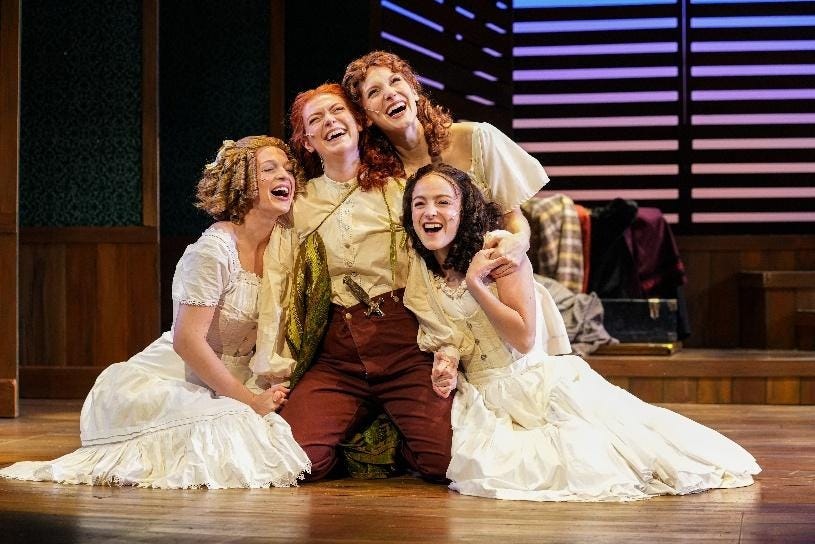
What makes for a fun rainy day activity in the attic doesn’t sell in the jaded New York publishing biz.
While we keep going back to Mrs. Kirk’s boarding house at the conclusion of the Civil War, however, most of the first act deals with the past when the Civil War is at its climax in 1863. Far away the March family’s father has gone off to fight for the good. He will never appear in the show, but his absence is felt by the family. He falls ill far from home leading Marmee (Grey Garrett) to travel to care for him. Her trip will be a trial of the other March’s resilience and independence. The March girls, Amy (Madison Cox); Meg (Sarah Mae Andersen); and Beth (Ella Schoot) must grow up fast and they do so with singular individuality.
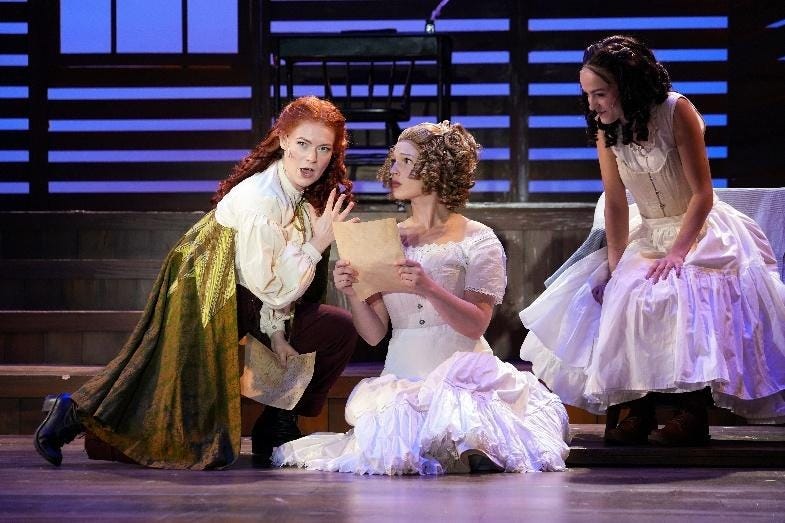
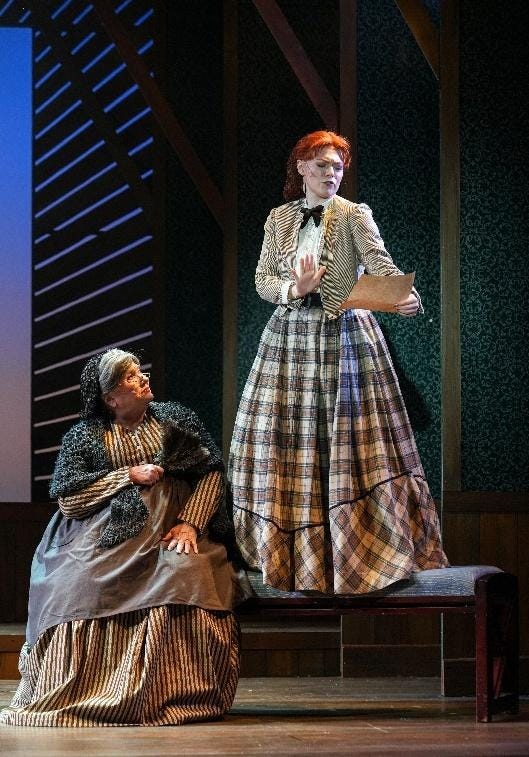
The family does not exist in a social vacuum. Support comes in the form of Mr. Laurence (Ian Lane). He’s a gruff and disapproving friend of Mr. March who provides for the extreme needs of the family. Also contributing is Aunt March (Andrea Kahane) who visits frequently, also to mostly disapprove. Her dearest desire is that Jo will become a bit less of a free spirit and more socially acceptable, and she’s willing to pay for it. Knowing Jo as we do by this point in the show we can guess the answer will be no. Kahane is wonderfully regal in performance, gliding inexorably across the stage-and she’s just as effective as Mrs. Kirk, Jo’s landlady.
Younger men also figure into this story: Laurie (Matt Beary) is Laurence’s grandson. He’s a bit gawky but valuable to Jo because he’s one of two persons in her life that isn’t trying to improve Jo or reshape her into another image. Not so much this is John Brooke who is Laurie’s tutor. Fortunately, Jo has two other marriageable sisters who are a bit more—malleable than Jo.
Finally, Professor Bhaer (Ariel Messeca) is Mrs. Kirk’s other boarder, who surprises Jo by admiring what she can do, and not just for what she’s supposed to do. The show takes its time building their relationship, but the payoff is completely unsurprising for the characters and the audience when it does come.
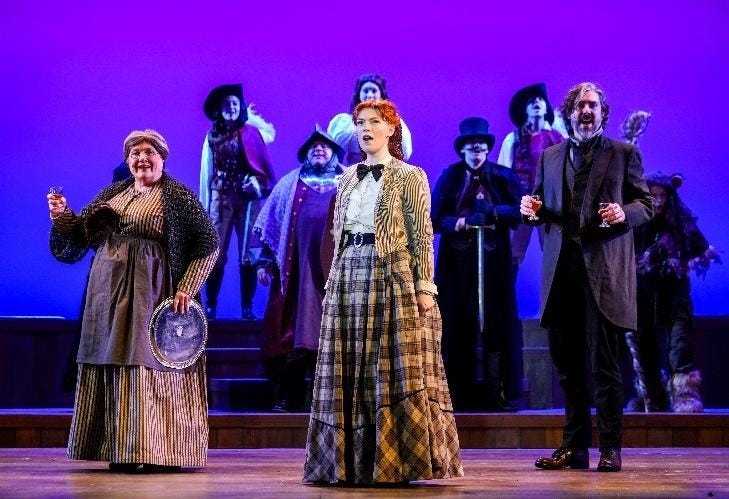
I thoroughly enjoyed the individual moments, scenes, and songs. Moments are allowed to bloom as the characters delve into their scene partners’ motivations and reasons for the things they do. It’s a process of discovery for both the characters and the audience. While the revelations may seem easy assumptions in a lot of cases, the natural reactions of the performers make them as much a surprise for the audience as they are to the characters. In some productions this can be a bit tedious, but this show’s rhythms move fast.
(Maybe a bit too fast, some lyrical moments in the opening numbers pattered along at a pace that left me wondering when I’d be allowed to breathe. It wasn’t just me who had issues, others in the audience had trouble following lyrics in those opening numbers. It had nothing to do with Beary’s diction, more the song’s tempo.)
The staging is spare, symmetrical and freely moving. This is deeply important to the appreciation of this production. Since the action we see is a reflection of adult Jo’s personal opera being staged, using a bare Shakespearean stage sculpted by shifting light and moving furniture units makes perfect sense. The period look of the furniture and the way it narrated the levels of wealth in this period’s society-including the difference between the March family’s tinny piano to the massive piano lent by Mr. Laurence-told the story of the March’s genteel poverty.
Costumes were not just fitted, but seemed almost tailored to the characters, so much so that when they were “wrong” for comic effect you knew it immediately. They reflected the characters and the performers wearing them.
Likewise, the performances were uniformly integral to the theme of the story. The actors’ abilities helped us forget that these grownup women exceeded the age of their characters and accept them as the kids they are portraying. Many Riverside regulars appeared on stage and somehow in this show they were effortlessly appropriate for the characters.
And of course the efforts of the entire orchestra, music, and audio crew assisted with my ability to follow the story’s twists and turns.
I have a confession to make: I skipped reading the book in high school (sorry, Dr. Sever) and have never watched an adaptation of it in the years since. I think I was unconsciously waiting for this performance to be my first experience. I’m kind of happy I waited.
You should take advantage of the remaining days of the run to see this one.
Dennis Wemm is a retired professor of theatre and communication, having taught and led both departments at Glenville State College for 34 years. In his off time, he was president and sometimes Executive Director of the West Virginia Theatre Conference, secretary and president of the Southeastern Theatre Conference, and generally enjoyed a life in theatre.


Local Obituaries
To view local obituaries or to send a note to family and loved ones, please visit the link that follows.
