

By Martin Davis
EDITOR-IN-CHIEF
Email Martin

One of the early pleasant surprises in 2026 has been the popularity of a new weekly feature — Talking Richmond.
The series was created so our readers can hear directly from the area’s representatives about the work they are engaged in. So far in 2026, we’ve had pieces from Del. Phil Scott, Del. Nicole Cole, Del. Joshua Cole, and Sen. Tara Durant. Look for Sen. Bryce Reeves’ first contribution later this week.

By design, the pieces are focused on legislation candidates are carrying and not the politics that drove the candidates when they were campaigning for office.
Ideally, voters understand the difference. Campaigning is about setting out broad political ideals — basic principles, the issues one wants to focus on. To accomplish this, issues are boiled down to easy-to-swallow, bumper-sticker-type statements that oversimplify reality. Legislating, by contrast, is about wrestling with the nuance of enormously complicated issues.
Unfortunately, the rise of the 24-hour national political news cycle has weakened our appreciation for legislation and led to a national collective obsession with politics that has weakened our understanding of and appreciation for the complexity of issues.
This move toward embracing the political and ignoring the legislative has too long affected national politics; increasingly, it’s affecting local politics, too.
When political thinking gives way to legislative thinking, however, the debate changes significantly — we quit thinking of legislators in terms of party and ideology, and we start thinking about them in terms of ideas and the practical impacts their legislation will have.
We have seen that in reactions from readers, who have appreciated gaining insights into the legislation their representatives are putting forward, even when those legislators are from the opposing party.
The Virtues of Moderation
If this distinction between the political and the legislative sounds academic, think about the extent to which political thinking fuels not only polarization, but our ability to understand and combat troubling political threats when they arise.
Over the past year, the Trump Administration has shown itself to be the antithesis of democratic government. Jamelle Bouie of the New York Times put it best:
The only thing Trump and his allies know how to do is use the coercive force of the state…. The more it tries to repress and dominate its opponents, the more it loses ground with the public, and the more it loses ground, the more it leans on force and threats of force to save face.
That the administration’s heavy-handed tactics — ICE’s disgraceful actions in Minneapolis, the recent arrest of journalists, the steady stream of threatening language — are backfiring is made plain in multiple polls, but nowhere more starkly, perhaps, than in the pages of the Economist.
Its polling data shows that on every major issue — inflation, jobs, foreign policy, immigration, and crime — over the 378 days Trump has been in office, he has seen his approval ratings shift from positive to negative.
The Economist tracker also shows that in every state that Biden won in 2020 and Trump flipped in 2024 — Michigan, Wisconsin, Pennsylvania, Georgia, Arizona — Trump’s disapproval rating is now in double-digits.
The story gets worse for Trump when one looks at demographic groups. Trump is underwater across the board — sex, age, race, and education. Surprisingly, not a single subgroup within these demographic groups supports Trump.
By every measure, this administration is failing. It’s not particularly surprising given that Trump excels at politics — driving polarization between Democrats and Republicans is what got him elected in 2016 and again in 2024 — and flounders at legislation. His signature Big, Beautiful Bill is unpopular across the political spectrum.
Trump’s best hope for not becoming irrelevant? Balkanization.
By driving wedges between the groups that are turning on him, Trump mutes the collective power of the growing dissatisfaction with how he is handling the country.
Where we see this most obviously is when Democrats unilaterally dismiss all Republicans as MAGA acolytes. Something polling data makes demonstrably clear isn’t the case.
That was the upshot of last week’s column on the latest Wason Center poll, which showed Democrats and Republicans sharing high levels of agreement on issues ranging from the most-pressing issues facing the commonwealth and data centers, to the restoration of voting rights and right-to-work law.
The agreement isn’t limited to kitchen-table type issues. It’s true even on some hot-button issues, like abortion.
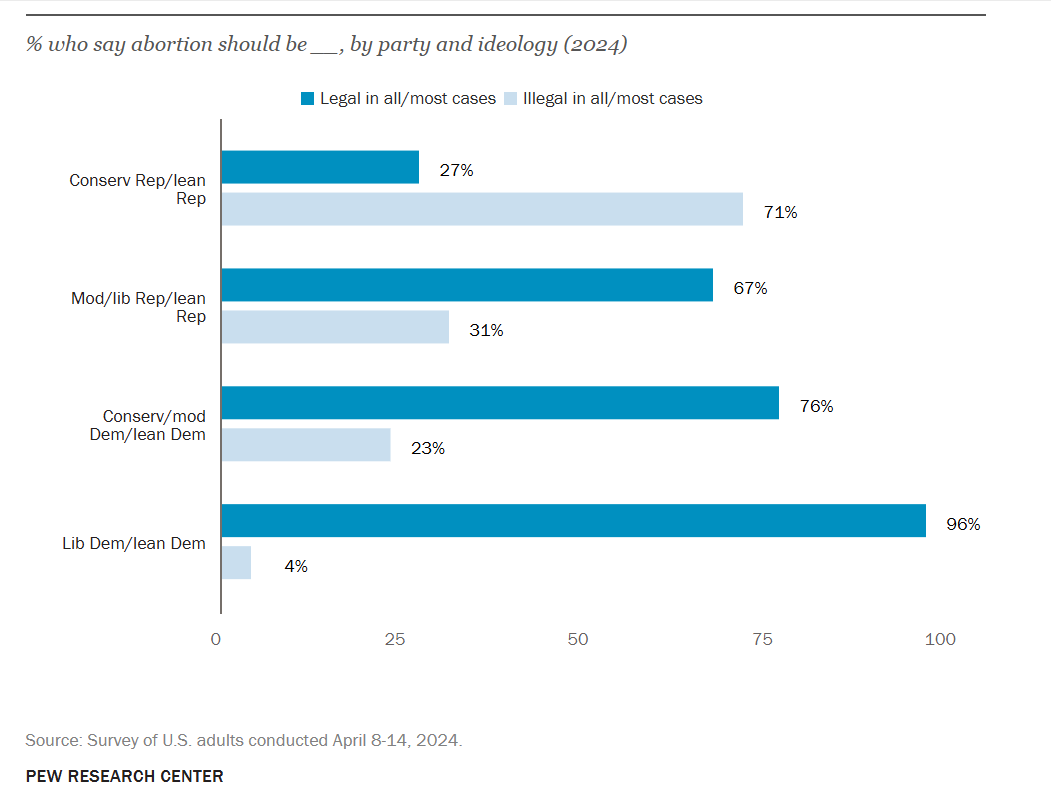
A recent Pew Center poll reveals polarization about abortion is limited to the extreme ends of the two parties. When looking at more moderate members of the two parties, however, there’s an unusually high level of agreement.
The Quiet Center
The key to diminishing the anger that the political generates is embracing the nuance that legislation demands. And that requires that more moderate, legislatively-minded voters speak out.
Moderates certainly have the numbers.
Gallup has tracked political polarization since 1992, and over that 30+ year span, there’s been relatively little change among the percentage of people in the two parties who would call themselves “very” conservative or “very” liberal, and those who consider themselves moderate.
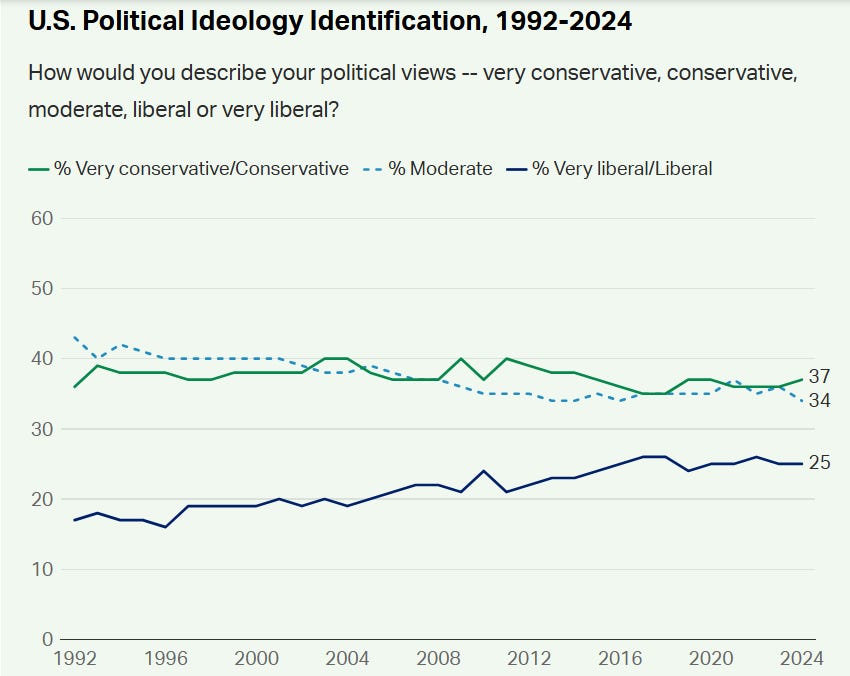
While the numbers say we are not appreciably more polarized now than we were 30 years ago, American citizens say they feel we are more polarized.
The reason for that? One possibility is that we listen more to the political, and less to the legislative.
Learning to listen to the legislative requires a different skill set. It requires attention to detail, a willingness to assess arguments based on their strengths and not on whether they check a political box.
Most important, it requires thinking more deeply about the most important value that defines American political life — pluralism.
America at its best creates space for a great number of cultures, traditions, religions, and values.
Paying attention to the legislative over the political helps us move toward pluralism.
It’s how America has navigated divisions in the past; it’s the key to confronting the divisions we face today, and to strengthening the country for its next quarter century.





Local Obituaries
To view local obituaries or to send a note to family and loved ones, please visit the link that follows.

Support Award-winning, Locally Focused Journalism

The FXBG Advance cuts through the talking points to deliver both incisive and informative news about the issues, people, and organizations that daily affect your life. And we do it in a multi-partisan format that has no equal in this region. Over the past year, our reporting was:
First to break the story of Stafford Board of Supervisors dismissing a citizen library board member for “misconduct,” without informing the citizen or explaining what the person allegedly did wrong.
First to explain falling water levels in the Rappahannock Canal.
First to detail controversial traffic numbers submitted by Stafford staff on the Buc-ee’s project
Our media group also offers the most-extensive election coverage in the region and regular columnists like:
And our newsroom is led by the most-experienced and most-awarded journalists in the region — Adele Uphaus (Managing Editor and multiple VPA award-winner) and Martin Davis (Editor-in-Chief, 2022 Opinion Writer of the Year in Virginia and more than 25 years reporting from around the country and the world).
For just $8 a month, you can help support top-flight journalism that puts people over policies.
Your contributions 100% support our journalists.
Help us as we continue to grow!


This article is published under Creative Commons license CC BY-NC-ND. It can be distributed for noncommercial purposes and must include the following: “Published with permission by FXBG Advance.”
Really appreciate this initiative, Martin. By giving each of our representatives space to talk about the specific bills they’re carrying, you’re helping the community see them as lawmakers with concrete ideas, not just as party labels or campaign brands. That shift—from the purely political to the legislative—is exactly what we need if we want less heat and more light in our local and state debates.
I’d like to offer readers a simple “recipe” they can use when they read future Talking Richmond pieces, so that this series becomes not just informative, but a tool for real engagement.
Step 1: Start with the actual proposal
When you read a legislator’s column, first ask: What specific change in law or policy is this person talking about? Try to put it in one sentence, in your own words. That alone moves us out of “I like/dislike this legislator” and into “Here is what they actually want to do.”
Step 2: Name who is affected
Next, name at least three groups who would be materially affected if this proposal became law—workers, renters, small businesses, school divisions, local governments, immigrants, seniors, etc. For each group, jot a quick note: how might this help, hurt, or change their daily lives? Thinking this way mirrors the kind of balancing real legislators should do.
Step 3: Decide what a ‘good enough’ version would look like
Very few bills are perfect. Ask yourself: If this idea moved forward, what would I need to see in it to be able to live with or support it? That might mean adding safeguards, tightening eligibility, redirecting benefits toward those most in need, building in transparency and reporting, or adding a sunset/review clause. You’re not writing the bill, just defining your “floor.”
Step 4: Turn your analysis into one or two concrete asks
Once you’ve done those three steps, you’re in a position to respond in a way that’s actually useful to your representatives. Instead of “I support/oppose this,” you can say things like:
• “I support your goal of X, and I’d like to see the bill include A and B to protect Y group.”
• “If you move this bill, please add a requirement for public reporting on [specific impact] so the community can track results.”
• “This proposal worries me because of its impact on [group]. I’d like you to reconsider or narrow it in [specific way].”
You can share that feedback right here in the comments bar below, in an email to the legislator, during office hours, or in testimony and letters to the editor. The key is that your engagement is now anchored to the legislation itself, not just to a party or personality.
If more of us read Talking Richmond this way—focusing on bills, tradeoffs, and concrete asks—we’ll be building exactly the “quiet center” Martin describes: a community that takes pluralism and lawmaking seriously, even when we still disagree on the big questions.
Well put Marty!