

By Martin Davis
EDITOR-IN-CHIEF
Email Martin

Better than before, but a lot of work to do.
That’s the bottom line from the Joint Legislative Audit & Review Commission on the state’s new accountability system — School Performance & Support Framework.
The first round of results for the new system was released two weeks ago and the JLARC report found several advantages to the new system that replaces the one that had been in place since 2017.
Three areas in particular were noted as steps in the right direction.
The SPSF combines the state and federal accountability systems, which “reduces complexity and aligns policy goals.”
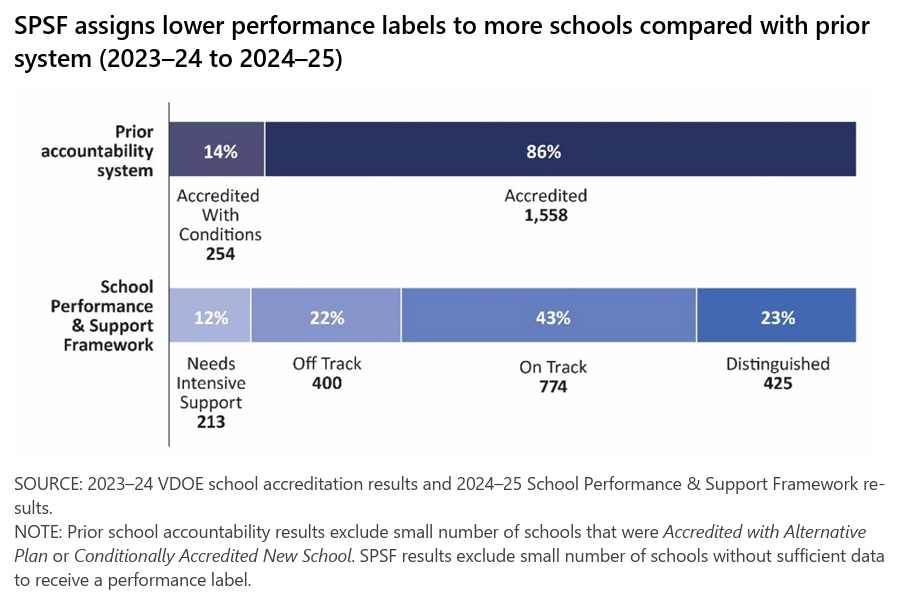
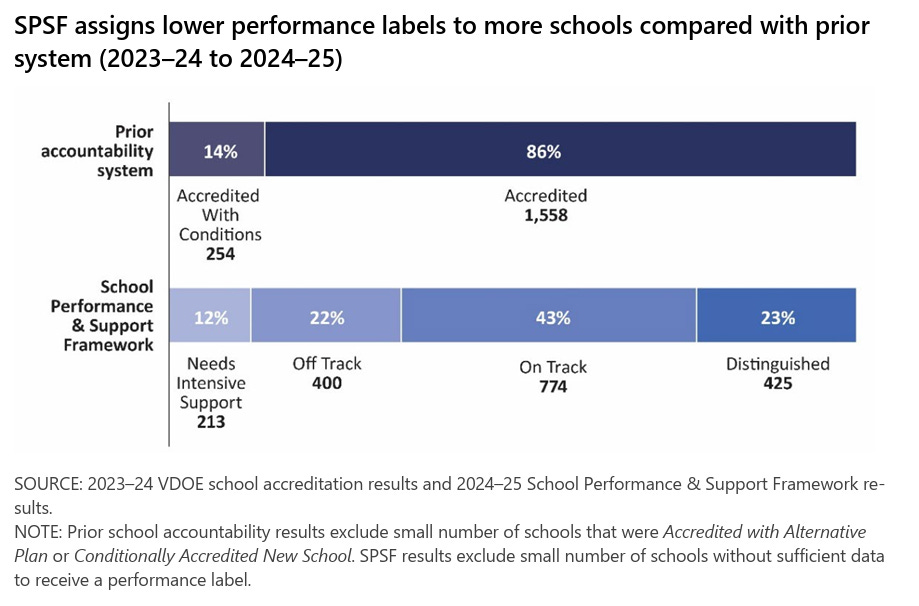
The SPSF does a better job, according to JLARC, of differentiating performance across schools. It points out that under the last system, most schools received the highest rating, but under the new system, school performance was more reasonably spread across the grading curve. Under the new system, “425 schools (23 percent) were labeled Distinguished, 774 (43 percent) On Track, 400 (22 percent) Off Track, and 213 (12 percent) Needs Intensive Support.” It further notes that the new system incentivizes schools to do a better job with a greater proportion of their students, especially those in specific subgroups.
The SPSF will make it easier to maintain “continuity and consistency,” improving our ability to evaluate results over time. Moreover, it theoretically should reduce administrative burden on school divisions.

Finally, the system is not a one-size-fits-all accountability system. Weightings and factors that affect scoring differ by education level, recognizing that what elementary school children require and should be learning is vastly different from what older students in middle and high school should be learning.
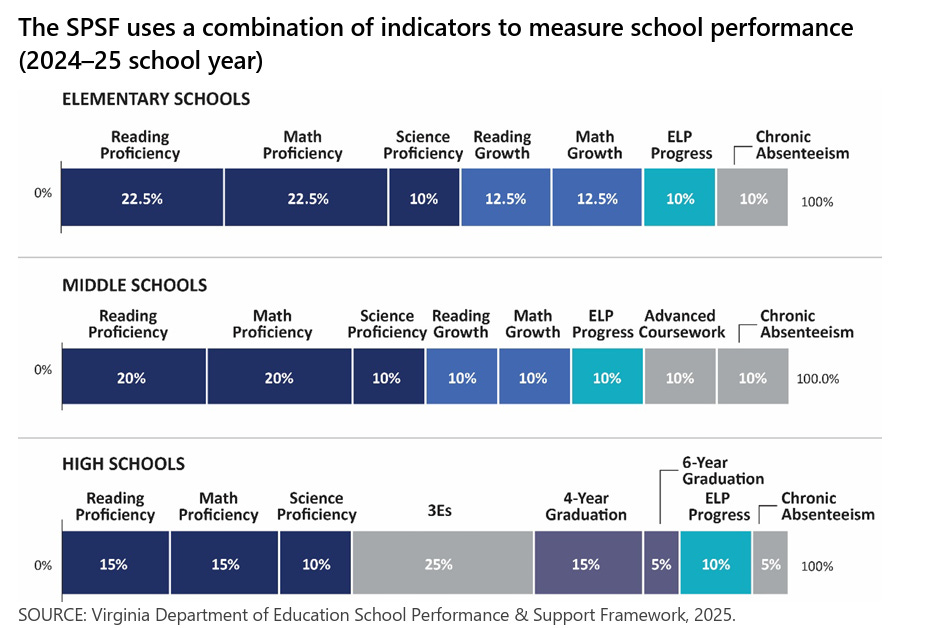
The most noticeable difference is the role that the 3Es (Employment, Enrollment, Enlistment) play in high school evaluations. Further, the weighting of proficiency in reading, science, and math declines as students move up the academic ladder.
A Long Way to Go
Despite the improvements, JLARC finds substantial work is required to make the new system accessible and understandable.
To begin, the labels are misleading — a fact the Advance pointed out in its critique of the system. The four categories are descriptive in nature — Distinguished, On-track, Off-track, and Needs Intensive Support.
However, the report notes that “stakeholders bring different perspectives [to descriptive labels] and many have strong opinions about accountability ratings, making it difficult to design ratings that satisfy everyone.”
As an example, JLARC points to the labels On-track and Off-track, which “imply a school performance trajectory (improving or declining, respectively), which is not the intent of the performance labels and does not accurately characterize at least some schools with those labels.”
A number of schools in the Fredericksburg region were labeled “Off-track,” for example, despite their scores qualifying them for “On-track” labeling. However, because a number of schools were federally identified as needing support, they dropped a full ranking. This implies the schools are trending negatively across the board, when in fact it is one subgroup that is causing the issue.
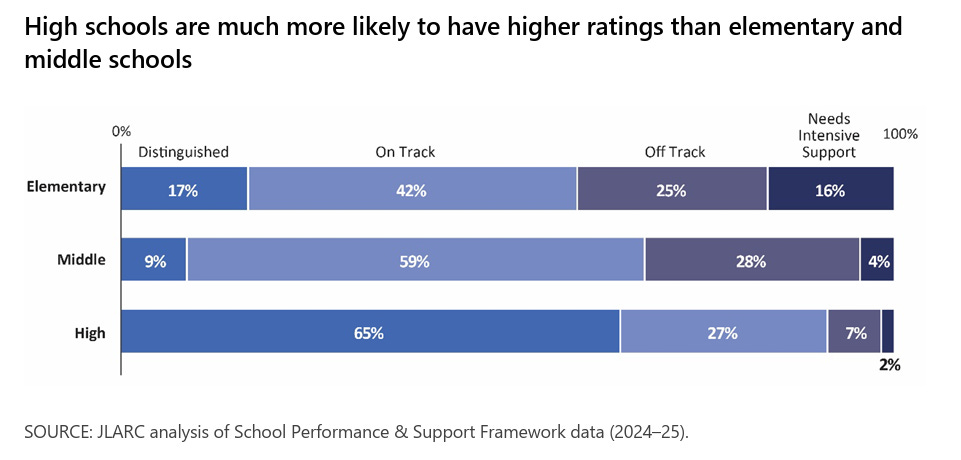
Another issue is tied to the differences in how performance is evaluated. High schools have an easier time earning better scores because their performance is tied to factors that do not apply to elementary or middle schools. According to JLARC: “This reduces the comparability and fairness of results across school levels. For example, it is far easier for high schools to achieve higher overall ratings than elementary or middle schools because it is easier for them to achieve higher scores on certain indicators used only for the high school level.”
Another challenge is that the new Virginia system “weights proficiency much more heavily than growth.” JLARC declares this is ultimately a policy decision and does not recommend a change.
However, this requires serious review.
While proficiency is the goal, students for any number of reasons do not learn at the same pace. And measuring learning that’s heavily weighted toward proficiency can often miss significant learning that is occurring in the classroom.
A student who enters 4th grade reading on a 1st grade level at the beginning of the year and ends the year at a 3rd grade level would not be considered “proficient.” Yet, that student has accomplished more than the student who entered 4th grade at the proficient level and remains at that level when the year ends.
Another adjustment was the way in which English Language Learners are measured.
Prior to this year, ELL student scores weren’t counted for the first six years they were enrolled. This, as JLARC notes, is an outlier nationwide. The state has overcorrected, however, in ways that undercut the efficacy of scoring within schools.
“Many schools do not have enough English learners for the ELP progress indicator to count toward their summative score,” the JLARC study notes. “So the indicator’s weight is redistributed to other indicators to calculate schools’ scores. This meaningfully alters how a substantial portion of elementary and middle schools are evaluated, reducing the comparability and fairness of results.”
In total, the JLARC report offers 15 significant recommendations to policymakers for improving the SPSF system.
A Different Conversation
Policymakers would be wise to recognize the irony in the system the current governor forced on schools this year, and the governor’s embrace of charter schools and vouchers.
From Day One, Gov. Glenn Youngkin, like many conservative education reform promoters, has pressed the state to adopt charter schools, grow a voucher program, and make direct payments to parents of the state’s portion of a child’s education so the parent can use it for education as they desire — be it private school tuition or homeschooling.
These alternatives would be more palatable to public school educators if they played on the same playing field. However, homeschooled students, and students at private and charter schools, aren’t required to take the state exams public school students must take, or use the state-mandated curriculum that traditional public school students have foisted upon them.
Instead, these alternatives to the public school system are allowed to “innovate” and “experiment” and find the best pathways for their students. Does it make a difference?
In the cases of private schools and homeschooling, there is no way to know if it’s better or not, as there is no required SOL testing for private and charter school students in Virginia that would allow for an apples-to-apples comparison.
There is NAEP data, however, that compares charter schools and traditional public schools nationally. And it shows that charter schools on the whole perform no better or worse than traditional public schools.
Why, then, the push for alternatives to public schools?
Youngkin and like-minded reformers have a blind faith that “parents know what’s best for their child,” and therefore whatever decision they make is acceptable.
Set aside the blind belief that parents always know what’s best for their child — clearly, there are times this is not the case — and remember that vouchers and charter schools would depend on taxpayer dollars to heavily underwrite their ventures.
For that reason alone, if public schools are forced into mandated curricula and testing, then so should be the schools that accept vouchers, homeschooled students, and charter school students.
If that isn’t acceptable to the reformers, then there is an alternative.
De-couple traditional public schools from state mandated curricula and testing and allow them to do what they are charged with doing—without the heavy hand of the governor or the state data crunchers setting the rules.





Local Obituaries
To view local obituaries or to send a note to family and loved ones, please visit the link that follows.

Support Award-winning, Locally Focused Journalism
The FXBG Advance cuts through the talking points to deliver both incisive and informative news about the issues, people, and organizations that daily affect your life. And we do it in a multi-partisan format that has no equal in this region. Over the past year, our reporting was:
First to break the story of Stafford Board of Supervisors dismissing a citizen library board member for “misconduct,” without informing the citizen or explaining what the person allegedly did wrong.
First to explain falling water levels in the Rappahannock Canal.
First to detail controversial traffic numbers submitted by Stafford staff on the Buc-ee’s project
Our media group also offers the most-extensive election coverage in the region and regular columnists like:
And our newsroom is led by the most-experienced and most-awarded journalists in the region — Adele Uphaus (Managing Editor and multiple VPA award-winner) and Martin Davis (Editor-in-Chief, 2022 Opinion Writer of the Year in Virginia and more than 25 years reporting from around the country and the world).
For just $8 a month, you can help support top-flight journalism that puts people over policies.
Your contributions 100% support our journalists.
Help us as we continue to grow!


This article is published under Creative Commons license CC BY-NC-ND. It can be distributed for noncommercial purposes and must include the following: “Published with permission by FXBG Advance.”
"To begin, the labels are misleading — a fact the Advance pointed out in its critique of the system."
Interesting to see how many of the local news publishers are now referring to themselves in the 3rd person. I noticed the guy from Potomac Local do it the other day too.
It's a slippery slope.
Just because a certain malfunctioning President does it, doesn't mean you need to.
Next thing you know, you'll be using the royal "we". Kicking people off of the comment board for not showing the proper respect your office is entitled to because they didn't wear a tie while typing. Naming random things after yourself.
Like I said, it's a slippery slope. Please be careful. I'm sure that's how it starts....
Regarding the content, I rarely trust blanket statements. Like when a recent school teacher states:
we should beware "the heavy hand of the governor or the state data crunchers setting the rules."....
The checks and balances that folks like you complain about on public schools may indeed be cumbersome, and open to improvement. Most systems are. It's part of the process. Or should be.
But I suspect, like so many of our laws and regulations - they got put there for a reason.
Some school teacher did molest a child. Another was illiterate in the material they were expected to teach. Brought their own prejudices to work. Applied justice unjustly or dishonestly. Appropriated funds. Or did not have the materials or environment in which to conduct their classes.
I know when I was a deputy sheriff, I didn't like it when there was a review of my use of force. When I was a paramedic, peer review after a serious incident was often more nerve racking than the actual emergency.
No one likes it. Which is why so many policemen are not protesting the recent push toward anonymity for those enforcing the law.
But I also realized that while that oversight was nerve racking, it was an important feature of the system. For the community to have trust in a system - there has to be accountability and oversight.
I don't want a system where that oversight either doesn't exist, or those entrusted with it refuse to use it, like today's Republican Congress.
Recently saw an insightful article in the WaPo regarding veteran's benefits. Where so much of it is determined based upon a trust system rather than expectations of accountability. Unsurprisingly, there are some serious abuses being found in such a system.
It's sorta like Churchill said about democracy. It's the worst system out there. With the exception of all of the others....
So, if you see something that needs improvement, by all means say something. But stick with specifics when doing so. Where you did, it was much more informative.
I'm interested in the high school level's heavy weighting of the "3E's" while growth in reading and math have no relevancy? That seems odd.
Trigonometry and Algebra need not apply? Reduce their weight, yes - not everyone will be doing high calculus upon graduation - but it drops from 20% of the evaluation to 0% in one year?
While making sure we have enough drones becomes 40% of the evaluation (3E's plus overall graduation rate)?
What message does that send the children subjected to that system? Or the teachers, for that matter?
Dare not to dream, we got to get a certain percentage of you out in the warehouse or changing bedpans so the teachers get a raise next year?
Agreed however, regarding the need for charter schools, home schools, or whatever being held to the same basic requirements though. If someone wants to teach their children that they are God's Chosen - that's their business.
But it's not too much to expect for them to teach them that the country that they live in has a Bill of Rights and a Constitution that legally applies to all. Because its not just them paying for it, its all of us.
Likewise - basic mathematical principles. A x A = the area of the square wherever you go. If they want to believe that the basic principles of flight don't apply to angels, fine.
But they should still be expected to teach those principles and why they are accepted by modern science.
There was a story a few years back regarding an Orthodox school in NY that was operating under a voucher system, and the graduates were successfully graduating while performing at a 2-3rd grade level mathematically, but were very learned on their sect's beliefs regarding the Torah.
Hard for me to justify my tax dollars going to pay for that. We should be paying for education, not indoctrination. I'm against that. Which is why I am equally against Republicans when they insist we return to a white-centric version of history, or Democrats start destroying art they object to. In both cases, context, not censorship is the answer.
History includes the people who ran slave labor camps, major religions, and governments and who committed horrible atrocities, and gave us stories of greed, ignorance, and destruction. And at the same time, accomplished great feats, furthered enlightenment, the sciences, and the human condition.
They can teach their children to make of those facts what they will, but pretending that they didn't and don't happen is certainly not the solution.
And if they want the community's money to pay for their children's education - that should include the facts of that history - including the context of all participants. Not a monolithic message of one political party that thinks they speak for God. That too is a form of indoctrination.
I expect uniform basic learning. With accountability and clear return on investment for my tax dollars, regardless of which system they go into.
Because that's the problem with folks like Youngkin say that it's only the parent's choice that matters. That's unjust and out of balance. It's not just the parents paying for it, is it? It will be all of the citizens.
Saw an interesting article in Cardinal the other day on how much NOVA money goes into deep red counties such as in SW and Southside VA.
Is it right for the hard working members of communities that are more acceptant of diversity to pay those tax dollars to teach those children in SW VA that diversity should be rejected? It's a fair question.
What if the parent takes that money and doesn't send their kid to school at all, rather - uses them as child labor on the farm?
Again, accountability, realistic expectations, return on investment.
From any and all.